MCQ
Solve system of linear equations, using matrix method. $2 x-y=-2$ ; $3 x+4 y=3$
  • A
    $x=\frac{5}{11},\,y=\frac{12}{11}$
  • B
    $x=\frac{-5}{11},\,y=\frac{-12}{11}$
  • $x=\frac{-5}{11},\,y=\frac{12}{11}$
  • D
    $x=\frac{5}{11},\,y=\frac{-12}{11}$

Answer

Correct option: C.
$x=\frac{-5}{11},\,y=\frac{12}{11}$
c
The given system of equation can be written in the form of $A X=B$, where

$A=\left[\begin{array}{rr}2 & -1 \\ 3 & 4\end{array}\right], X=\left[\begin{array}{l}x \\ y\end{array}\right]$ and $B=\left[\begin{array}{c}-2 \\ 3\end{array}\right]$

Now,

Now $|A|=8+3=11 \neq 0$

Thus, $A$ is non-singular. Therefore, its inverse exists.

Now,

$A^{-1}=\frac{1}{|A|}(a d J A)=\frac{1}{11}\left[\begin{array}{cc}4 & 1 \\ -3 & 2\end{array}\right]$

$\therefore X=A^{-1} B=\frac{1}{11}\left[\begin{array}{cc}4 & 1 \\ -3 & 2\end{array}\right]\left[\begin{array}{c}-2 \\ 3\end{array}\right]$

$\Rightarrow\left[\begin{array}{l}x \\ y\end{array}\right]=\frac{1}{11}\left[\begin{array}{c}-8+3 \\ 6+6\end{array}\right]=\frac{1}{11}\left[\begin{array}{c}-5 \\ 12\end{array}\right]=\left[\begin{array}{c}-\frac{5}{11} \\ \frac{12}{11}\end{array}\right]$

Hence, $x=\frac{-5}{11}$ and $y=\frac{12}{11}$

Need a full question paper?

Generate a complete, print-ready paper with questions like this in minutes — across 16+ boards, with answer keys.
Start Generating Free

Similar questions

Let $\text{A}=\begin{bmatrix} 2 & 3 \\ 5 & -2 \end{bmatrix}$ be such that $A^{-1} = kA,$ then k equals:
Choose the correct answer from the given four options.

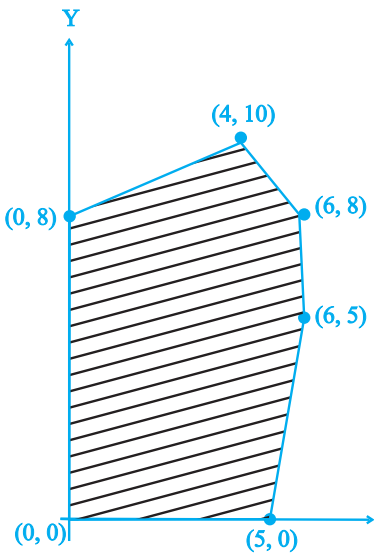
The feasible solution for a LPP shown in Fig. 12.12. Let z = 3x - 4y be objective functio. (Maximum value of Z + Minimum value of Z) is equal to:
Let $\vec{a}$ be a unit vector and $\vec{b}$ is a nonzero vector not parallel to $\vec{a}$ . The angles of the triangle, two of whose sides are represented by $\sqrt 3 (\vec{a} \times \vec{b} )$ and $\vec{b} - (\vec{a} . \vec{b}) \vec{a}$ are
Evaluate $\begin{bmatrix}\text{i}&-1\\-1&\text{i}\end{bmatrix}$
One vertex of a rectangular parallelopiped is at the origin $O$ and the lengths of its edges along $x , y$ and $Z$ axes are $3,4$ and $5$ units respectively. Let $P$ be the vertex $(3,4,5)$. Then the shortest distance between the diagonal $OP$ and an edge parallel to $Z$ axis, not passing through $O$ or $P$ is:
If $f: R \rightarrow R$ is given by $f(x)=3 x-5$, then $f^{-1}(x)$
A man of height $1.8 $ metre is moving away from a lamp post at the rate of $ 1.2 $ $m/\sec .$ If the height of the lamp post be $ 4.5 $ metre, then the rate at which the shadow of the man is lengthening is .......... $m/\sec $.
If the order of matrices $A$ and $B$ are $3 \times 2$ and $2 \times 1$ respectively, then find the order of matrix $($if possible$)\ AB :$
Let $\overrightarrow{ a }=\hat{ i }+2 \hat{ j }-3 \hat{ k }$ and $\overrightarrow{ b }=2 \hat{ i }-3 \hat{ j }+5 \hat{ k }$. If $\overrightarrow{ r } \times \overrightarrow{ a }=\overrightarrow{ b } \times \overrightarrow{ r }, \overrightarrow{ r } \cdot(\alpha \hat{ i }+2 \hat{ j }+\hat{ k })=3$ and $\vec{r} (2 \hat{ i }+5 \hat{ j }-\alpha \hat{ k })=-1, \alpha \in R ,$ then the value of $\alpha+|\overrightarrow{ r }|^{2}$ is equal to :
Let $S$ be the region bounded by the curves $y=x^{3}$ and $y ^{2}= x$. The curve $y =2| x |$ divides $S$ into two regions of areas $R_{1}$ and $R_{2}$.

If $\max \left\{R_{1}, R_{2}\right\}=R_{2}$, then $\frac{R_{2}}{R_{1}}$ is equal to