Question
Solve the following differential equation:
$\frac{\text{dy}}{\text{dx}}+2\text{y}=\sin\text{x}$

Answer

We have,
$\frac{\text{dy}}{\text{dx}}+2\text{y}=\sin\text{x}\ \dots(1)$
Clearly, it is a linear differential equation of the form
$\frac{\text{dy}}{\text{dx}}+\text{Py}=\text{Q}$
where
$\text{P}=1$
and
$\text{Q}=\sin\text{x}$
$\therefore$ I.F. $=\text{e}^{\int\text{Pdx}}$
$=\text{e}^{\int2\text{dx}}$
$=\text{e}^{2\text{x}}$
Multiplying both sides of (1) by I.F. = e2x, we get
$\text{e}^{2\text{x}}\Big(\frac{\text{dy}}{\text{dx}}+2\text{y}\Big)=\text{e}^{2\text{x}}\sin\text{x}$
$\Rightarrow\ \text{e}^{2\text{x}}\frac{\text{dy}}{\text{dx}}+2\text{e}^{2\text{x}}\text{y}=\text{e}^{2\text{x}}\sin\text{x}$
Integrating both sides with respect to x, we get
$\text{ye}^{2\text{x}}=\int\text{e}^{2\text{x}}\sin\text{x dx + C}$
$\Rightarrow\ \text{ye}^{2\text{x}}=\frac{1}5\int[2\text{e}^{2\text{x}}(2\sin\text{x}-\cos\text{x}+\text{e}^{2\text{x}}(2\cos\text{x}+\sin\text{x})]$
Putting $\text{e}^{2\text{x}}(2\sin\text{x}-\cos\text{x})=\text{t}$
$\Rightarrow[2\text{e}^{2\text{x}}(2\sin\text{x}-\cos\text{x})+\text{e}^{2\text{x}}(2\cos\text{x}+\sin\text{x})]\text{dx}=\text{dt}$
$\therefore\ \text{ye}^{2\text{x}}=\frac{1}5\int\text{dt + C}$
$\Rightarrow\text{ye}^{2\text{x}}=\frac{\text{t}}5+\text{C}$
$\text{ye}^{2\text{x}}=\frac{\text{e}^{2\text{x}}}5(2\sin\text{x}-\cos\text{x})+\text{C}$
$\Rightarrow\ \text{y}=\frac{1}5(2\sin\text{x}-\cos\text{x})+\text{Ce}^{-2\text{x}}$
Hence, $\text{y}=\frac{1}5(2\sin\text{x}-\cos\text{x})+\text{Ce}^{-2\text{x}}$ is the required solution.

Need a full question paper?

Generate a complete, print-ready paper with questions like this in minutes — across 16+ boards, with answer keys.
Start Generating Free

Similar questions

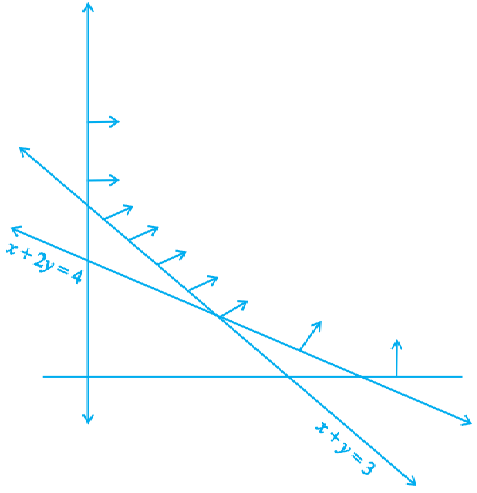
The feasible region for a LPP is shown in Evaluate Z = 4x + y at each of the corner points of this region. Find the minimum value of Z, if it exists.

Determine whether the following pair of lines intersect or not:
$\vec{\text{r}}=\big(\hat{\text{i}}-\hat{\text{j}}\big)+\lambda\big(2\hat{\text{i}}+\hat{\text{k}}\big)$ and $\vec{\text{r}}=\big(2\hat{\text{i}}-\hat{\text{j}}\big)+\mu\big(\hat{\text{i}}+\hat{\text{j}}-\hat{\text{k}}\big)$
Find the vector equation of the line through the origin which is perpendicular to the plane $\vec{\text{r}}\cdot(\hat{\text{i}}+2\hat{\text{j}}+3\hat{\text{k}})=3$
Suppose a girl throw a die. If she gets 1 or 2, she tosses a coin three times and notes the number of tails. If she gets 3, 4, 5 or 6, she tosses a coin once and notes whether a 'head' or 'tail' is obtained exactly one 'tail', what is the probability that she threw 3, 4, 5 or 6 with the die?
Express the vector $\vec{\text{a}}=5\hat{\text{i}}-2\hat{\text{j}}+5\hat{\text{k}}$ as the sum of two vectors such that one is parallel to the vector $\vec{\text{b}}=3\hat{\text{i}}+\hat{\text{k}}$ and other is perpendicular to $\vec{\text{b}}.$
An anti-aircraft gun can take a maximum of 4 shots at an enemy plane moving away from it. The probabilities of hitting the plane at the first, second, third and fourth shot are 0.4, 0.3, 0.2 and 0.1 respectively. What is the probability that the gun hits the plane?
Show that the following set of curves intersect orthogonally.
y = x3 and 6y = 7 - x2
If $\text{x}\sin(\text{a}+\text{y})+\sin\text{a}\cos(\text{a}+\text{y})=0,$ prove that $\frac{\text{dy}}{\text{dx}}=\frac{\sin^2(\text{a}+\text{y})}{\sin\text{a}}$
If  xy = ex –y, show that  $\frac{\text{dy}}{\text{dx}}=\frac{\text{log x}}{\left\{\text{log(x e)}\right\}^{2}}.$
Find the value of x for which the matrix product
$\begin{bmatrix}2&0&7\\0&1&0\\1&-2&1\end{bmatrix}\begin{bmatrix}-\text{x}&14\text{x}&7\text{x}\\0&1&0\\\text{x}&-4\text{x}&-2\text{x}\end{bmatrix}$ equal an identity matrix.