Question
Solve the following differential equation
$(\text{x}^2+1)\frac{\text{dy}}{\text{dx}}=1$

Answer

We have,
$(\text{x}^2+1)\frac{\text{dy}}{\text{dx}}=1$
$\Rightarrow\text{dy}=\frac{1}{\text{x}^2+1}$
Intergrating both sides, we get
$\Rightarrow\int\text{dy}=\int\Big(\frac{1}{\text{x}^2+1}\Big)\text{dx}$
$\Rightarrow\text{y}=\tan^{-1}\text{x}+\text{C}$
so, $\Rightarrow\text{y}=\tan^{-1}\text{x}+\text{C}$ is defined for all $\text{x}\in\text{R}$ except x = 0
Hence, $\Rightarrow\text{y}=\tan^{-1}\text{x}+\text{C}$, where $\text{x}\in\text{R}-\{0\},$ is the solution o the given differential equation.

Need a full question paper?

Generate a complete, print-ready paper with questions like this in minutes — across 16+ boards, with answer keys.
Start Generating Free

Similar questions

Find all points of discontinuity of f, where
$\text{f(x)}=\begin{cases}\frac{\sin\text{x}}{\text{x}},\text{if x}<0\\ \text{x}+ 1, \text{if} \text{x}\geq0\end{cases}$
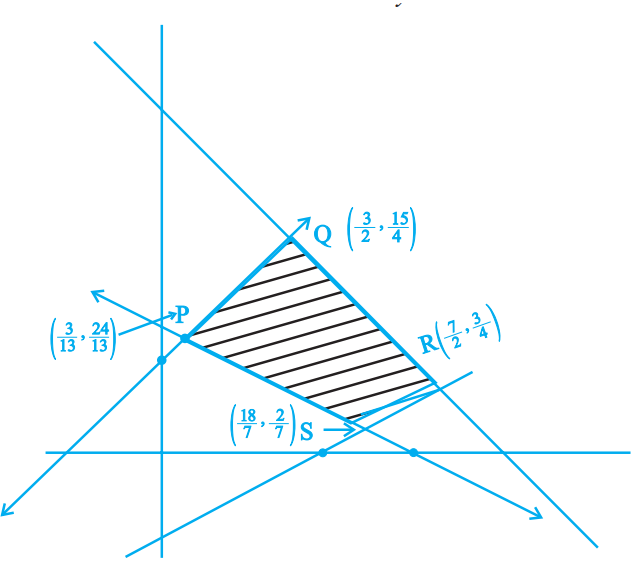
In the feasible region (shaded) for a LPP is shown. Determine the maximum and minimum value of Z = x + 2y.
Show that $\triangle\text{ABC}$ is an isosceles triangle, if the determinant $\triangle=\begin{vmatrix}1&1&1\\1+\cos\text{A}&1+\cos\text{B}&1+\cos\text{C}\\\cos^2\text{A}+\cos\text{A}&\cos^2\text{B}+\cos\text{B}&\cos^2\text{C}+\cos\text{C}\end{vmatrix}=0.$
Maximize $Z = x + y$
Subject to
$-2\text{x}+\text{y}\leq1$
$\text{x}\leq2$
$\text{x}+\text{y}\leq3$
$\text{x},\text{y}\geq0$
A bag contains $4$ white and $5$ black balls and another bag contains $3$ white and $4$ black balls. A ball is taken out from the first bag and without seeing its colour is put in the second bag. A ball is taken out from the latter. Find the probability that the ball drawn is white.
Evaluate $\begin{vmatrix}2&3&-5\\7&1&-2\\-3&4&1\end{vmatrix}$ by two methods.
Evaluate the following definite integrals:
$\int\limits_{1}^{2}\Big(\frac{\text{x}-1}{\text{x}^2}\Big)\text{e}^{\text{x}}\text{ dx}$
Prove that the function f defined by $\text{f(x)}=\begin{cases}\frac{\text{x}}{|\text{x}|+2\text{x}^2},&\text{if x}\neq0\\\text{k},&\text{ if x}=0\end{cases}$ remains discontinuous at x = 0, regardless the choice of k.
Solve the matrix equations:
$\begin{bmatrix}\text{x}&1\end{bmatrix}\begin{bmatrix}1&0\\-2&-3\end{bmatrix}\begin{bmatrix}\text{x}\\5\end{bmatrix}=0$
A manufacturer considers that men and women workers are equally efficient and so he pays them at the same rate. He has 30 and 17 units of workers (male and female) and capital respectively, which he uses to produce two types of goods A and B. To produce one unit of A, 2 workers and 3 units of capital are required while 3 workers and 1 unit of capital is required to produce one unit of B. If A and B are priced at100 and120 per unit respectively, how should he use his resources to maximise the total revenue? Form the above as an LPP and solve graphically. Do you agree with this view of the manufacturer that men and women workers are equally efficient and so should be paid at the same rate?