Question
Solve the following differential equation:
$\text{x}\frac{\text{dy}}{\text{dx}}-\text{y}=2\sqrt{\text{y}^2-\text{x}^2}$

Answer

We have,
$\text{x}\frac{\text{dy}}{\text{dx}}-\text{y}=2\sqrt{\text{y}^2-\text{x}^2}$
$\Rightarrow\ \frac{\text{dy}}{\text{dx}}=\frac{2\sqrt{\text{y}^2-\text{x}^2}+\text{y}}{\text{x}}$
This is a homogeneous differential equation.
Putting x = vy and $\frac{\text{dy}}{\text{dx}}=\text{v + x}\frac{\text{dv}}{\text{dx}}$, we get
$\text{v + x}\frac{\text{dv}}{\text{dx}}=\frac{2\sqrt{\text{v}^2\text{x}^2-\text{x}^2}+\text{vx}}{\text{x}}$
$\Rightarrow\ \text{v + x}\frac{\text{dv}}{\text{dx}}=2\sqrt{\text{v}^2-1}+\text{v}$
$\Rightarrow\ \text{x}\frac{\text{dv}}{\text{dx}}=2\sqrt{\text{v}^2-1}+\text{v}-\text{v}$
$\Rightarrow\ \text{x}\frac{\text{dv}}{\text{dx}}=2\sqrt{\text{v}^2-1}$
$\Rightarrow\ \frac{1}{2\sqrt{\text{v}^2-1}}\text{dv}=\frac{1}{\text{x}}\text{dx}$
Integrating both sides, we get
$\int\frac{1}{2\sqrt{\text{v}^2-1}}\text{dv}=\int\frac{1}{\text{x}}\text{dx}$
$\Rightarrow\ \int\frac{1}{2\sqrt{\text{v}^2-1}}\text{dv}=2\int\frac{1}{\text{x}}\text{dx}$
$\Rightarrow\ \log\Big|\text{v}+\sqrt{\text{v}^2-1}\Big|=2\log|\text{x}|+\log\text{C}$
$\Rightarrow\ \text{v}+\sqrt{\text{v}^2-1}=\text{Cx}^2$
Putting $\text{v}=\frac{\text{y}}{\text{x}}$, we get
$\therefore\ \frac{\text{y}}{\text{x}}+\sqrt{\frac{\text{y}^2}{\text{x}^2}-1}=\text{Cx}^2$
$\Rightarrow\ \text{y}+\sqrt{\text{y}^2-\text{x}^2}=\text{Cx}^3$
Hence, $\text{y}+\sqrt{\text{y}^2-\text{x}^2}=\text{Cx}^3$ is the required solution.

Need a full question paper?

Generate a complete, print-ready paper with questions like this in minutes — across 16+ boards, with answer keys.
Start Generating Free

Similar questions

A rectangular sheet of tin $45\ cm$ by $24\ cm$ is to be made into a box without top, in cutting off squares from each corners and folding up the flaps. What should be the side of the square to be cut off so that the volume of the box is maximum possible?
Evaluate the following integrals:
$\int\text{e}^{2\text{x}}\Big(\frac{1-\sin2\text{x}}{1-\cos2\text{x}}\Big)\text{dx}$
Evaluate the following integrals:$\int\limits^{\frac{\pi}{2}}_0\frac{\text{dx}}{1+\tan\text{x}}$
Write the minors and cofactors of element of the first column of the following matrices and hence evaluate the determinant in case:
$\text{A}=\begin{vmatrix}1&\text{a}&\text{bc}\\1&\text{b}&\text{ca}\\1&\text{c}&\text{ab} \end{vmatrix}$
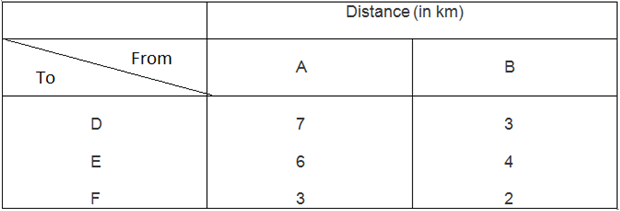
An oil company has two depots, A and B, with capacities of 7000 litres and 4000 litres respectively. The company is to supply oil to three petrol pumps, D, E, F whose requirements are 4500, 3000 and 3500 litres respectively. The distance (in km) between the depots and petrol pumps is given in the following table:

Assuming that the transportation cost per km is Rs. 1.00 per litre, how should the delivery be scheduled in order that the transportation cost is minimum?
Evaluate the following integrals:
$\int\frac{1}{\text{x}^4+\text{x}^2+1}\ \text{dx}$
Find the equation of the plane passing through (a, b, c) and parallel to the plane $\vec{\text{r}}\cdot(\hat{\text{i}}+\hat{\text{j}}+\hat{\text{k}})=2.$
Using integration find the area of the region bounded by the curve $\text{y}=\sqrt{4-\text{x}^2},\text{ x}^2+\text{y}^2-4\text{x}=0$ and the x-axis.
At what points on the curve $y = 2x^2 - x + 1$ is the tangent parallel to the line $y = 3x + 4?$
Three urns $A, B$ and $C$ contain $6$ red and $4$ white; $2$ red and $6$ white; and $1$ red and $5$ white balls respectively. An urn is chosen at random and a ball is drawn. If the ball drawn is found to be red, find the probability that the ball was drawn from urn A.