Question
Solve the following differential equation:
$(\text{x}^2-2\text{xy})\text{dy}+(\text{x}^2-3\text{xy}+2\text{y}^2)\text{dx}=0$

Answer

Here, $(\text{x}^2-2\text{xy})\text{dy}+(\text{x}^2-3\text{xy}+2\text{y}^2)\text{dx}=0$
$\Rightarrow\ \frac{\text{dy}}{\text{dx}}=\frac{\text{x}^2-3\text{xy}+2\text{y}^2}{2\text{xy}-\text{x}^2}$
It is a homogeneous equation.
Put x = vy
and $\frac{\text{dy}}{\text{dx}}=\text{v + x}\frac{\text{dv}}{\text{dx}}$
So,
$\text{v + x}\frac{\text{dv}}{\text{dx}}=\frac{\text{x}^2-3\text{xvx}+2\text{v}^2\text{x}^2}{2\text{xvx}-\text{x}^2}$
$\text{x}\frac{\text{dv}}{\text{dx}}=\frac{1-3\text{v}+2\text{v}^2}{2\text{v}-1}-\text{v}$
$\text{x}\frac{\text{dv}}{\text{dx}}=\frac{1-3\text{v}+2\text{v}^2-2\text{v}^2+\text{v}}{2\text{v}-1}$
$\text{x}\frac{\text{dv}}{\text{dx}}=\frac{1-2\text{v}}{2\text{v}-1}$
$\frac{2\text{v}-1}{1-2\text{v}}\text{dv}=\frac{\text{dx}}{\text{x}}$
$\frac{1-2\text{v}}{1-2\text{v}}\text{dv}=-\int\frac{\text{dx}}{\text{x}}$
$\int\text{dv}=-\int\frac{\text{dx}}{\text{x}}$
$\text{v}=-\log|\text{x}|+\text{C}$
$\frac{\text{y}}{\text{x}}+\log\text{x}=\text{C}$

Need a full question paper?

Generate a complete, print-ready paper with questions like this in minutes — across 16+ boards, with answer keys.

Start Generating Free

Similar questions

Find the area of the region bounded by the parabola y2 = 2x and the straight line x - y = 4
For the following pairs of matrices verify that (AB)-1 = B-1 A-1:

$\text{A}=\begin{bmatrix}3 & 2 \\7 & 5 \end{bmatrix}\text{ and B}=\begin{bmatrix}4 & 6 \\3 & 2 \end{bmatrix}$
If $\begin{vmatrix}\text{a}&\text{b}-\text{y}&\text{c}-\text{z}\\\text{a}-\text{x}&\text{b}&\text{c}-\text{z}\\\text{a}-\text{x}&\text{b}-\text{y}&\text{c}\end{vmatrix}=0,$ then using properties of determinants, find the value of $\frac{\text{a}}{\text{x}}+\frac{\text{b}}{\text{y}}+\frac{\text{c}}{\text{z}},$ where $\text{x},\text{y},\text{z}\neq0.$ 
Using integration, find the area of the region bounded by the triangle whose vertices are (2, –2), (4, 5) and (6, 2).
Maximum Z = 3x + 5y
Subject to
$\text{x}+2\text{y}\leq20$
$\text{x}+\text{y}\leq15$
$\text{y}\leq5$
$\text{x},\text{y}\geq0$
A manufacturing company makes two models A and B of a product. Each piece of model A requires 9 labour hours for fabricating and 1 labour hour for finishing.  Each piece of model B requires 12 labour hours for fabricating and 3 labour hours for finishing. For fabricating and finishing, the maximum labour hours available are 180 and 30 respectively. The company makes a profit of Rs. 8000 on each piece of model A and Rs. 12000 on each piece of model B. How many pieces of model A and model B should be manufactured per week to realise a maximum profit? What is the maximum profit per week?
Evaluate the following integrals:
$\int\limits^0_{-5}\text{f(x)}\text{dx,}$ Where $\text{f(x)}=|\text{x}|+|\text{x}+2|+|\text{x}+5|$
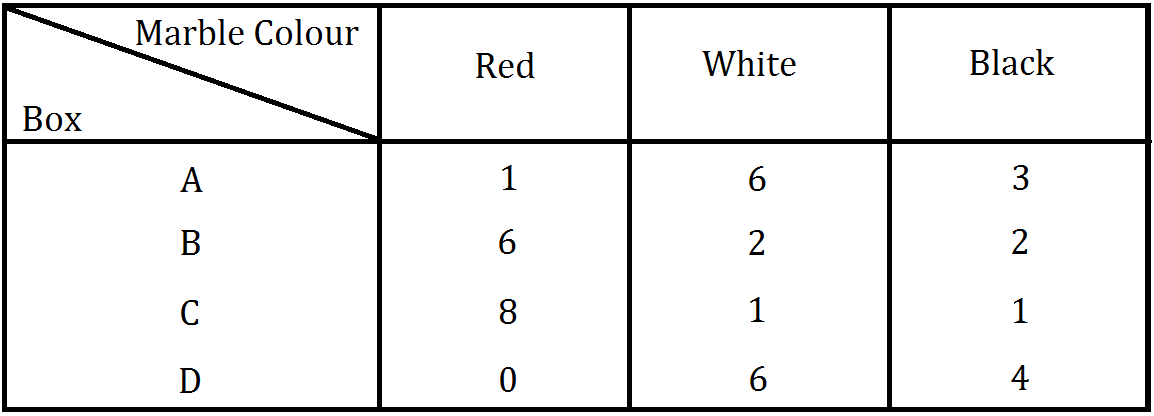
Suppose we have four boxes A, B, C, D containing coloured marbles as given below:

One of the boxes has been selected at random and a single marble is drawn from it. If the marble is red, what is the probability that it was drawn from,

  1. Box A?
  2. Box B?
  3. Box C?
$\text{Let A} = \begin{pmatrix} 2 & -1 \\ 3 & 4 \\ \end{pmatrix}, = \text{B} = \begin{pmatrix} 5 & 2 \\ 7 & 4 \\ \end{pmatrix}, \text{C} = \begin{pmatrix} 2 & 5 \\ 3 & 8 \\ \end{pmatrix},$find a matrix D such that CD – AB = O.
Evaluvate the following intregals:
$\int\frac{2\sin\text{x}+3\cos\text{x}}{3\sin\text{x}+4\cos\text{x}}\ \text{dx}$