Question
Solve the following differential equations $\frac{\text{dy}}{\text{dx}}=\frac{2\text{x}(\log\text{x}+1)}{\sin\text{y+y}\cos\text{y}},$ given that $\text{y}=0,$ when $\text{x}=1.$

Answer

$\frac{\text{dy}}{\text{dx}}=\frac{2\text{x}(\log\text{x}+1)}{\sin\text{y+y}\cos\text{y}},\text{y}=0$ at $\text{x}=1$
$\int(\sin\text{y+y}\cos\text{y})\text{dy}=\int2\text{x}(\log\text{x}+1)\text{dx}$
$\Rightarrow\int\sin\text{y dy}+\int\text{y}\cos\text{y dy}=\int2\text{x}\log\text{x dx}+2\int\text{x dx}$
$\Rightarrow-\cos\text{y}+\big[\text{y}\times\int\cos\text{y dy}-\int(1\times\int\cos\text{y dy})\text{dy}\big]\\=2\Big[\log\text{x}\int\text{x dx}-\int\Big(\frac{1}{\text{x}}\int\text{x dx}\Big)\text{dx}\Big]+\text{x}^2+\text{C}$
$\Rightarrow-\cos\text{y + y}\sin\text{y}-\int\sin\text{y dy}=2\frac{\text{x}^2}{2}\log\text{x}-2\int\frac{\text{x}}{2}\text{dx}+\text{x}^2+\text{C}$
$\Rightarrow-\cos\text{y + y}\sin\text{y}+\cos\text{y}=\text{x}^2\log\text{x}-\frac{\text{x}^2}{2}+\text{x}^2+\text{C}$
$\text{y}\sin\text{y}=\text{x}^2\log\text{x}+\frac{\text{x}^2}{2}+\text{C}$
Put $\text{y}=0,\text{x}=1$
$0=0+\frac{1}{2}+\text{C}$
$\text{C}=-\frac{1}{2}$
Put $\text{C}=-\frac{1}{2}$ in equation (1),
$\text{y}\sin\text{y = x}^2\log\text{x}+\frac{\text{x}^2}{2}-\frac{1}{2}$
$2\text{y}\sin\text{y}=2\text{x}^2\log\text{x + x}^2-1$

Need a full question paper?

Generate a complete, print-ready paper with questions like this in minutes — across 16+ boards, with answer keys.
Start Generating Free

Similar questions

Show that the differential equation $(x-y) \frac{d y}{d x}=x+2 y$ is homogeneous and solve it.
Find the intervals in which $\text{f(x)} = \sin 3x - \cos 3x, 0 < x < \pi.$ is strictly increasing or strictly decreasing.
Write the number of points where f(x) = |x| + |x − 1| is continuous but not differentiable.
Show that the lines $\frac{\text{x}+1}{-3}=\frac{\text{y}-3}{2}=\frac{\text{z}+2}{1}$ and $\frac{\text{x}}{1}=\frac{\text{y}-7}{-3}=\frac{\text{z}+7}{2}$ are coplanar. Also, find the equation of the plane containing them.
Find the equation of the plane passing through the intersection of the planes $\vec{\text{r}}\cdot(2\hat{\text{i}}+\hat{\text{j}}+3\hat{\text{k}})=7,\vec{\text{r}}\cdot(2\hat{\text{i}}+5\hat{\text{j}}+3\hat{\text{k}})=9$ and the point (2, 1, 3).
Evaluate the following integrals:
$\int\frac{1}{\sin^4\text{x}+\sin^2\text{x}\cos^2\text{x}+\cos^4\text{x}}\ \text{dx}$
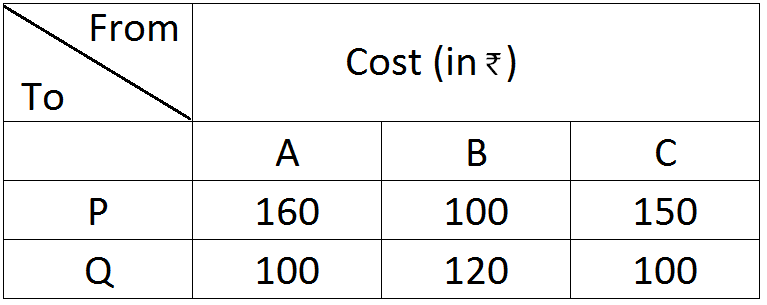
There are two factories located one at place P and the other at place Q. From these locations, a certain commodity is to be delivered to each of the three depots situated at A, B and C. The weekly requirements of the depots are respectively 5, 5 and 4 units of the commodity while the production capacity of the factories at P and Q are respectively 8 and 6 units. The cost of transportation per unit is given below:
How many units should be transported from each factory to each depot in order that the transportation cost is minimum. What will be the minimum transportation cost?
Find the distance of a point $(2,4,-1)$ from the line $\frac{x+5}{1}=\frac{y+3}{4}=\frac{z-6}{-9}$.
Two men A and B start with velocities v at the same time from the junction of two roads inclined at 45° to each other. If they travel by different roads, find the rate at which they are being seperated.
A total amount of ₹ $7000$ is deposited in three different saving bank accounts with annual interest rates $5\%, 8\%$ and 8$\frac{1}{2}$% respectively. The total annual interest from these three accounts is ₹ $550$. Equal amounts have been deposited in the $5\%$ and $8\%$ saving accounts. Find the amount deposited in each of the three accounts, with the help of matrices.