Question
Solve the following differential equations:$(1+\text{x})(1+\text{y}^2)\text{dx}+(1+\text{y})(1+\text{x}^2)\text{dy}=0$

Answer

We have,
$(1+\text{x})(1+\text{y}^2)\text{dx}+(1+\text{y})(1+\text{x}^2)\text{dy}=0$
$\Rightarrow(1+\text{x})(1+\text{y}^2)\text{dx}=-(1+\text{y})(1+\text{x}^2)\text{dy}$
$\Rightarrow\frac{1+\text{x}}{1+\text{x}^2}\text{dx}=-\frac{1+\text{y}}{1+\text{y}^2}\text{dy}$
Integrating both sides, we get
$\Rightarrow\frac{1+\text{x}}{1+\text{x}^2}\text{dx}=-\frac{1+\text{y}}{1+\text{y}^2}\text{dy}$
$\Rightarrow\int\frac{1}{1+\text{x}^2}\text{dx}+\int\frac{\text{x}}{1+\text{x}^2}\text{dx}=-\int\frac{1}{1+\text{y}^2}\text{dy}-\int\frac{\text{y}}{1+\text{y}^2}\text{dy}$
Substituting $1+\text{x}^2=\text{t}$ in the second integral of LHS and $1+\text{y}^2=\text{u}$ in the second integral of RHS, we get
$2\text{x dx = dt}$ and $2\text{y dy = du}$
$\therefore\int \frac{1}{1+\text{x}^2}\text{dx}+\frac{1}{2}\int\text{dt}=-\int\frac{1}{1+\text{y}^2}\text{dy}-\frac{1}{2}\int\frac{1}{\text{u}}\text{du}$
$\Rightarrow\tan^{-1}\text{x}+\frac{1}{2}\log|\text{t}|=-\tan^{-1}\text{y}-\frac{1}{2}\log|\text{u}|+\text{C}$
$\Rightarrow\tan^{-1}\text{x}+\frac{1}{2}\log|1+\text{x}^2|=-\tan^{-1}\text{y}-\frac{1}{2}\log|1+\text{y}^2|+\text{C}$
$\Rightarrow\tan^{-1}\text{x}+\tan^{-1}\text{y}+\frac{1}{2}\log|1+\text{x}^2|+\frac{1}{2}\log|1+\text{y}^2|=\text{C}$
$\Rightarrow\tan^{-1}\text{x}+\tan^{-1}\text{y}+\frac{1}{2}\log\big|(1+\text{x}^2)(1+\text{y}^2)\big|=\text{C}$
Hence, $\tan^{-1}\text{x}+\tan^{-1}\text{y}+\frac{1}{2}\log\big|(1+\text{x}^2)(1+\text{y}^2)\big|=\text{C}$ is the required solution.

Need a full question paper?

Generate a complete, print-ready paper with questions like this in minutes — across 16+ boards, with answer keys.

Start Generating Free

Similar questions

Find the values of a and b such that the function f defined by $\text{f(x)}=\begin{cases}\frac{\text{x}-4}{|\text{x}-4|}+\text{a},&\text{if x}<4\\\text{a+}\text{b},&\text{if x}=4\\\frac{\text{x}-4}{|\text{x}-4|}+\text{b},&\text{if x}>4\end{cases}$ is a continuous function at x = 4.
A given quantity of metal is to be cast into a half cylinder with a rectangular base and semicircular ends. Show that in order that the total surface area may be minimum the ratio of the length of the cylinder to the diameter of its semi-circular ends is $\pi:(\pi+2)$.
In order to supplement daily diet, a person wishes to take $X$ and $Y$ tablets. The contents $($in milligrams per tablet$)$ of iron, calcium and vitamins in $X$ and $Y$ are given as below:
Tablets Iron Calcium Vitamin
$X$ $6$ $3$ $2$
$Y$ $2$ $3$ $4$
The person needs to supplement at least $18$ milligrams of iron, $21$ milligrams of calcium and $16$ milligrams of vitamins. The price of each tablet of $X$ and $Y$ is $₹ 2$ and $₹1$ respectively. How many tablets of each type should the person take in order to satisfy the above requirement at the minimum cost? Make an $LPP$ and solve graphically.
Show that the differential equation $(x-y) \frac{d y}{d x}=x+2 y$ is homogeneous and solve it.
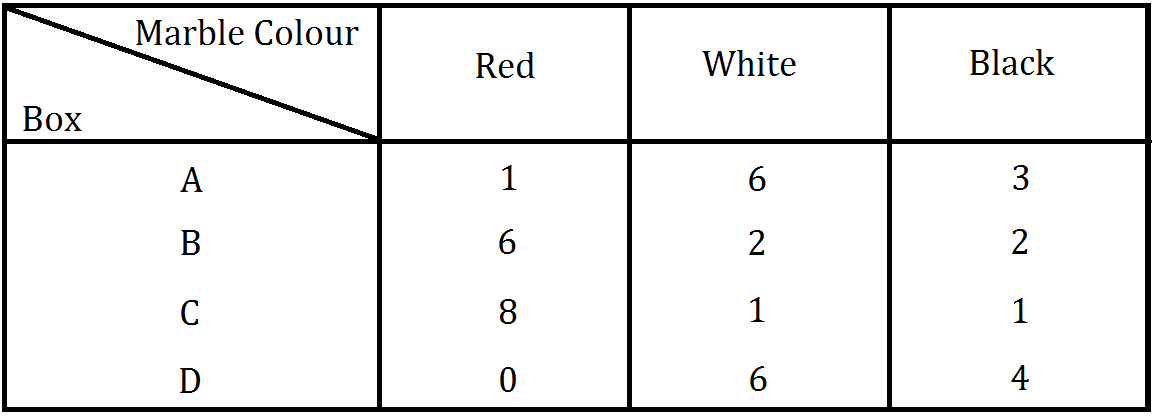
Suppose we have four boxes A, B, C, D containing coloured marbles as given below:
One of the boxes has been selected at random and a single marble is drawn from it. If the marble is red, what is the probability that it was drawn from,
  1. Box A?
  2. Box B?
  3. Box C?
If the derivative of $\tan^{-1} (a + bx)$ takes the value $1$ at $x = 0,$ prove that $1 + a^2 = b.$
Tangent to the circle $\text{x}^{2} + \text{y}^{2} = 4$ at any point on it in the first quadrant makes intercepts OA and OB on x and y axes respectively, O being the centre of the circle. Find the minimum value of (OA + OB).
Two tailors A and B earn Rs 150 and Rs 200 per day respectively. A can stitch 6 shirts and 4 pants per day while B can stitch 10 shirts and 4 pants per day. Form a linear programming problem to minimize the labour cost to produce at least 60 shirts and 32 pants.
Evaluate: $\int\limits_{0}^{\pi}\frac{4\text{x}\sin\text{x}}{1 + \cos^{2}\text{x}}\text{dx}.$
Prove that the volume of the largest cone that can be inscribed in a sphere of radius R is $\frac{8}{{27}}$ of the volume of the sphere.