Question
Solve the following equation and verify your answer:
$\frac{3\text{x}+5}{4\text{x}+2}=\frac{3\text{x}+4}{4\text{x}+7}$

Answer

$\frac{3\text{x}+5}{4\text{x}+2}=\frac{3\text{x}+4}{4\text{x}+7}$
By cross multiplication:
$(3\text{x}+5)(4\text{x}+7)=(3\text{x}+4)(4\text{x}+2)$
$\Rightarrow12\text{x}^2+21\text{x}+20\text{x}+35=12\text{x}^2+6\text{x}+16\text{x}+8$
$\Rightarrow12\text{x}^2+41\text{x}-12\text{x}^2-22\text{x}=8-35$
$\Rightarrow19\text{x}=-27$
$\Rightarrow\text{x}=\frac{-27}{19}$
$\therefore\text{x}=\frac{-27}{19}$
Verification:
$\text{L.H.S.}=\frac{3\text{x}+5}{4\text{x}+2}=\frac{3\Big(\frac{-27}{19}\Big)+5}{4\Big(\frac{-27}{19}\Big)+2}$
$=\frac{\frac{-81}{19}+5}{\frac{-108}{19}+2}=\frac{\frac{-81+95}{19}}{\frac{-108+38}{19}}=\frac{\frac{14}{19}}{\frac{-70}{19}}$
$\text{R.H.S.}=\frac{3\text{x}+4}{4\text{x}+7}$
$=\frac{3\Big(\frac{-27}{19}\Big)+4}{4\Big(\frac{-27}{19}\Big)+7}=\frac{\frac{-81}{19}+4}{\frac{-108}{19}+7}$
$=\frac{\frac{-81+76}{19}}{\frac{-108+133}{19}}=\frac{\frac{-5}{19}}{\frac{25}{19}}=\frac{-5}{19}\times\frac{19}{25}$
$=\frac{-1}{5}$
$\therefore\text{L.H.S.}=\text{R.H.S.}$

Need a full question paper?

Generate a complete, print-ready paper with questions like this in minutes — across 16+ boards, with answer keys.

Start Generating Free

Similar questions

Multiply $\left(3\text y^5-7\text y^3+2\text y^2-\text y+4\right)$ by $\left(\text y^3-2\text y^2+3\text y-1\right).$
Mohan's income is $Rs.\ 15500$ per month. He saves $11\%$ of his income. If his income increases by $10\%$, then he reduces his saving by $1\%$, how much does he save now?
Write the following squares of binomials as trinomials: $\big(\frac{\text{x}}{\text{y}}−\frac{\text{y}}{\text{x}})^2$
Construct a quadrilateral $ABCD$, where $AB = 5.5\ cm, BC = 3.7\ cm,$$\angle\text{A}=60^\circ,$ $\angle\text{B}=105^\circ$ and $\angle\text{D}=90^\circ$
All the angles of a quadrilateral are equal to each other. Find the measure of each. Is the quadrilateral a parallelogram? What special type of parallelogram is it?
Represent the following data by a pie-diagram:
Items of expenditure
Expenditure
Family $A$
Family $B$
Food
$4000$
$6400$
Clothing
$2500$
$480$
Rent
$1500$
$3200$
Education
$400$
$1000$
Miscellaneous
$1600$
$600$
Total
$10000$
$16000$
Draw a trapezium $ABCD$ in which $AB || DC, AB = 7\ cm, BC = 5\ cm, AD = 6.5\ cm$ and $\angle\text{B}=60^\circ.$
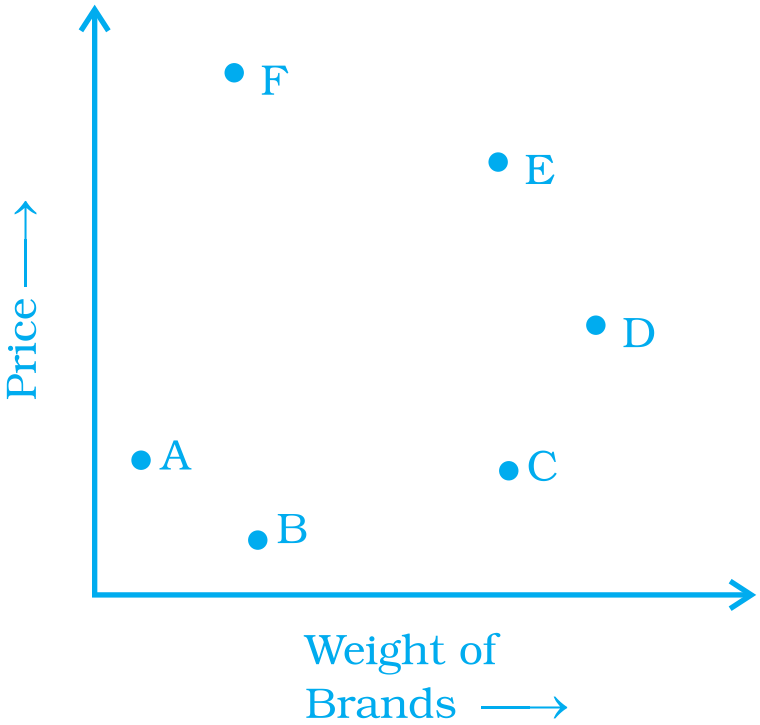
The graph given below compares the price $($ in $Rs.)$ and weight of $6$ bags $($in $kg)$ of sugar of different brands $\text{A, B, C, D, E, F}$.
$a.$ Which brand$(s)$ costs/cost more than Brand $D$?
$b.$ Bag of which brand of sugar is the heaviest?
$c.$ Which brands weigh the same?
$d.$ Which brands are heavier than brand $B$?
$e.$ Which bag is the lightest?
$f.$ Which bags are of the same price?
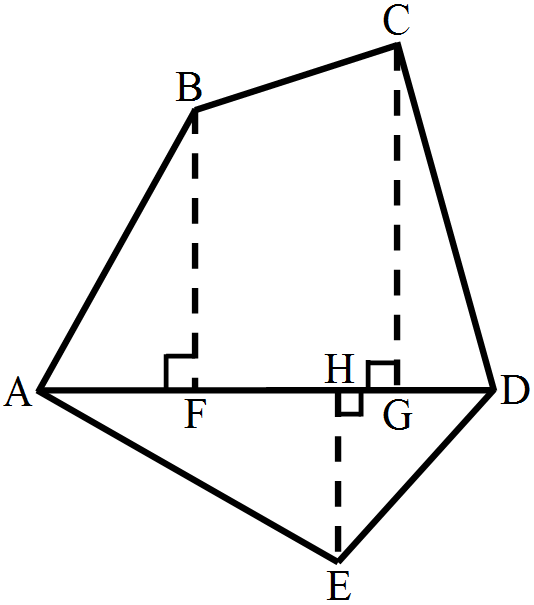
Find the area of the pentagon shown in fig. if $AD = 10\ cm, AG = 8\ cm, AH = 6\ cm, AF = 5\ cm, BF = 5\ cm, CG = 7\ cm$ and $EH = 3\ cm$.
Prove that the diagonals of a rhombus bisect each other at right angles.