Question
Solve the following equations for the unknown: $(a + 2)(2a +5) = 2(a + 1)^2+ 13$

Answer

$(a + 2)(2a +5) = 2(a + 1)^2+ 13$
Collecting like terms,
$\Rightarrow a(2a + 5) + 2 (2a + 5) = 2a^2 + 2 + 4a + 13$
$\Rightarrow 2a^2+ 5a + 4a + 10 - (2a^2+ 4a + 15) = 0$
$\Rightarrow 5a + 10 - 15 = 0$
$\Rightarrow a = 1$ is the unknown.

Need a full question paper?

Generate a complete, print-ready paper with questions like this in minutes — across 16+ boards, with answer keys.
Start Generating Free

Similar questions

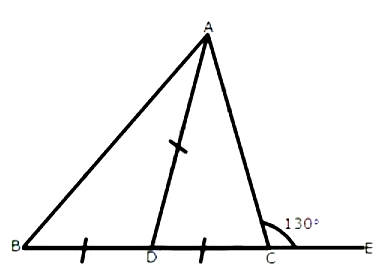
Calculate :$(i)\angle ADC(ii)\angle ABC(iii)\angle BAC$
Each interior angle of a regular polygon is $162^\circ.$ Another regular polygon has number of sides double the first polygon. Find each interior angle of the second polygon.
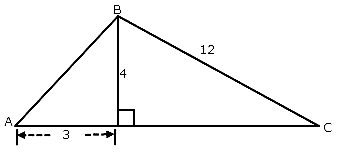
From the following figure, find the values of $(i)\cos A;(ii)\operatorname{cosec}A;(iii)\tan^2A - \sec^2A;(iv)\sin C;(v)\sec C;(vi)\cot^2 C - \frac{1}{\sin ^2 c}$
If $a^2+\frac{1}{a^2}=47$ and $a \neq 0$ find$:(i) a+\frac{1}{a},(ii)a^3+\frac{1}{a^3}$
In $\triangle ABC, D$ and $E$ are the mid$-$point on $AB$ and $AC$ such that $DE \| BC.$If $AD = 4, AE = 8, DB = x - 4$ and $EC = 3x - 19$, find $x.$
Construct a rectangle $\text{ABCD},$ when:Area $= 24 \ cm^2$ and base $= 4.8 \ cm^2$.
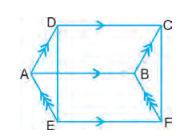
In the adjoining figure, two parallelograms ABCD and AEFB are drawn on opposite sides of AB .
Prove that:
$\operatorname{ar}(\| \operatorname{gm~ABCD})+\operatorname{ar}(\| \operatorname{gm}$ AEFB $)=\operatorname{ar}(\| \operatorname{gm}$ EFCD $)$.
Image
Factorise the following:$x^3y^3 - 8x^2y^2 + 15xy$
The population of a town is 64000. If the annual birth rate is 11.7% and the annual death rate is 4.2%, calculate the population of the town after 3 years.
Image
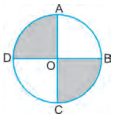
AC and BD are two perpendicular diameters of a circle with centre O. If AC = 16 cm, calculate the area and perimeter of the shaded part. (Take $\pi$ = 3.14)
[Hint: Perimeter of the shaded parts = 2(OA + OD + arc AD)
$\begin{aligned} & =2\left(8+8+\frac{3.14 \times 8 \times 90}{360}\right) cm =57.12 cm \\ \text { Area of the shaded parts } & =2 \times(\text { area of quadrant } O A D) \\ & \left.=\frac{(2 \times \pi \times 8 \times 8 \times 90)}{360} cm^2=100.48 cm^2\right]\end{aligned}$