Question
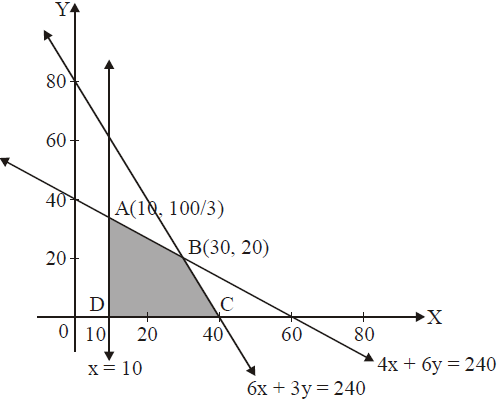
Solve the following linear programming problem graphically:
Maximise Z = 7x + 10y
subject to the constraints
4x + 6y $\leq$ 240
6x + 3y $\leq$ 240
x $\geq$ 10
x $\geq$ 0, y $\geq$ 0
Answer


Maximise z = 7x + 10y, subject to 4x + 6y $\leq$ 240;
6x + 3y $\leq$ 240; x $\geq$ 10, x $\geq$ 0, y $\geq$ 0
Correct graph of three lines
For correct shading
$\text{Z}(\text{A})=\text{Z}\Big(10,\frac{200}{6}\Big)=70+10\times\frac{100}{3}=403\frac{1}{3}$
Z(B) = Z(30, 20) = 210 + 200 = 410
Z(C) = Z(40, 0) = 280 + 0 = 280
Z(D) = Z(10, 0) = 70 + 0 = 70
⇒ Max (= 410) at x = 30, y = 20

Need a full question paper?

Generate a complete, print-ready paper with questions like this in minutes — across 16+ boards, with answer keys.

Start Generating Free

Similar questions

Find the vector and Cartesian equations of the line through the point (1, 2, – 4) and perpendicular to the two lines.
$\overrightarrow{\text{r}} = (8\hat{\text{i}} - 19\hat{\text{j}} + 10\hat{\text{k}})+\lambda(3\hat{\text{i}} - 16\hat{\text{j}} + 7\hat{\text{k})}$ and $\overrightarrow{\text{r}} = (15\hat{\text{i}} - 29\hat{\text{j}} + 5\hat{\text{k}})+\mu(3\hat{\text{i}} - 8\hat{\text{j}} + 5\hat{\text{k})}.$
Evaluate the following integrals:
$\int(2\text{x}+5)\sqrt{10-4\text{x}-3\text{x}^2}\text{dx}$
Find the values of $x$ for which $\text{y}=[\text{x}(\text{x}-2)]^2$ is an increasing function.
Find the equation of the plane passing through the line of intersection of the planes $2x - y = 0$ and $3z - y= 0$ and perpendicular to the plane $4x + 5y - 3z = 8$.
If $\text{x}=\text{a}\sin\text{t}\ \text{and}\ \text{y}=\text{a}(\cos\text{t}+\log\tan\frac{\text{t}}{2}),$ find $\frac{\text{d}^2\text{y}}{\text{dx}^2}$
Using integration find the are of the region bounded by the parabola $y^{2} ={4x}$ and the circle $4x^{2} + 4y^{2} = 9$
Find the angle between the line joining the points (3, -4, -2) and (12, 2, 0) and the plane 3x - y + z = 1.
Solve the following differential equation
$\frac{\text{dy}}{\text{dx}}-\text{x}\sin^2\text{x}=\frac{1}{\text{x}\log\text{x}}$
If $\text{A}=\begin{bmatrix}2&0&1\\2&1&3\\1&-1&0\end{bmatrix},$ find $A^2 - 5A + 4I$ and hence find a matrix $X$ such that $A^2 - 5A + 4I + X = 0$.
Integrate the following integrals:
$\int\sin2\text{x}\sin4\text{x}\sin6\text{x dx}$