Question
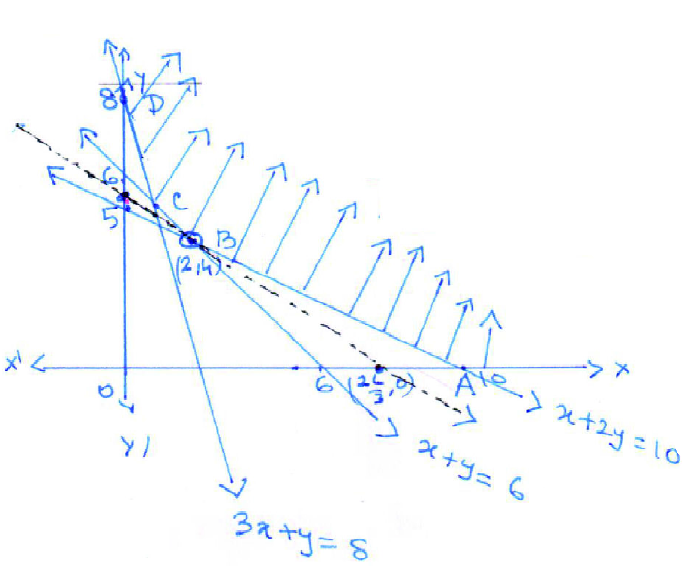
Solve the following linear programming problem graphically.Minimise $\text{z = 3x + 5y}$
subject to the constraints
$\text{x + 2y}\geq 10$
$\text{x + y}\geq 6$
$\text{3x + y}\geq 8$
$\text{x, y}\geq 0.$
Answer


Vertices are A (10, 0), 2, 4 ), C(1, 5) & D (0, 8)$\text{Z = 3 x + 5y}$ is minimum
at B (2, 4) and the minimum Value is 26.
on Ploting $\text{(3x + 5y < 26)}$
since these it no common point with the feasible
region, Hence, $\text{x = 2, y = 4}$ gives minimum Z

Need a full question paper?

Generate a complete, print-ready paper with questions like this in minutes — across 16+ boards, with answer keys.

Start Generating Free

Similar questions

Using differentials, find the approximate values of the following:
$\frac{1}{(2.002)^2}$
Suppose a girl throws a die. If she gets $1$ or $2,$ she tosses a coin three times and notes the number of tails. If she gets $3, 4, 5$ or $6,$ she tosses a coin once and notes whether a 'head' or 'tail' is obtained. If she obtained exactly one 'tail', then what is the probability that she threw $3, 4, 5$ or $6$ with the die?
If $\text{A}=\begin{bmatrix}1&-1&0\\ 2&3&4\\ 0&1&2\end{bmatrix}\text{and }\text{B}=\begin{bmatrix}2&2&-4\\ -4&2&-4\\ 2&-1&5\end{bmatrix}$  are two square matrices, find AB and hence solve the system of linear equations:
x - y = 3, 2x + 3y + 4z = 17, y + 2z = 7
Find $\frac{\text{dy}}{\text{ dx}} $in the following:
$\text{y}=\sin^{-1}\Bigg(\frac{2\text{x}}{1+\text{x}^{2}}\Bigg)$
At every point on a curve the slope is the sum of the abscissa and the product of the ordinate and the abscissa, and the curve passes through (0, 1). Find the equation of the curve.
Prove the following identities:
$\begin{vmatrix}\text{a}+\text{x}&\text{y}&\text{z}\\\text{x}&\text{a}+\text{y}&\text{z}\\\text{x}&\text{y}&\text{a}+\text{z}\end{vmatrix}=\text{a}^2(\text{a}+\text{x}+\text{y}+\text{z})$
Write a value of $\int\text{e}^{\log\sin\text{x}}\cos\text{x}\text{ dx}$
Draw a rough sketch of the graph of the function $\text{y}=2\sqrt{1-\text{x}^{2}}, \text{x}\in [0, 1] $ and evaluate the area enclosed between the curve and the x-axis.
If $\text{x}=2\cos\text{t}-\cos2\text{t},\text{y}=2\sin\text{t}-\sin2\text{t},$ find $\frac{\text{d}^2\text{y}}{\text{dx}^2}\ \text{at}\ \text{t}=\frac{\pi}{2}.$
$\text{If}\ \vec{\text{a},}\ \vec{\text{b}},\ \vec{\text{c}}$ are mutually perpendicular vectors of equal magnitudes, show that the vector $\vec{\text{a}}+ \vec{\text{b}}+ \vec{\text{c}}$ is equally inclined to $\vec{\text{a},}\ \vec{\text{b}},\text{and}\ \vec{\text{c}}.$