Question
Solve the following LPP graphically:
Manimize Z = 6x + 3y
Subject to the constraints:
$4\text{x}+\text{y}\geq80$
$\text{x}+5\text{y}\geq115$
$3\text{x}+2\text{y}\leq150$
$\text{x}\geq0,\text{y}\geq0$
Answer

The given contraints are:
$4\text{x}+\text{y}\geq80$
$\text{x}+5\text{y}\geq115$
$3\text{x}+2\text{y}\leq150$
$\text{x}\geq0,\text{y}\geq0$
Converting the given inequation into equation, we get
4x + y = 80, x + 5y = 115, 3x + 2y = 150, x = 0 and y = 0
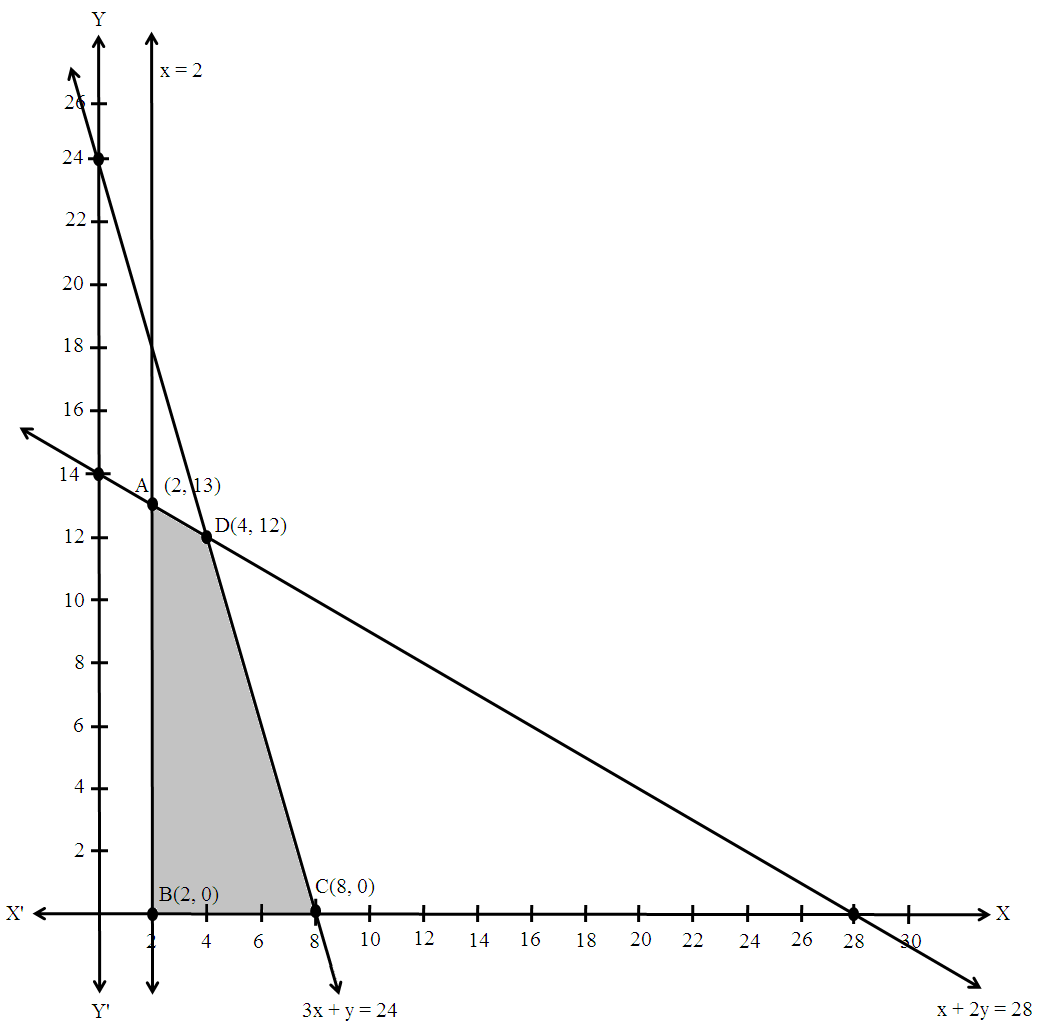
These lines are drawn on the graph and the shaded region ABC represents the feasible region of the given LPP.

It can be observed that the feasible region is bounded.
The coordinates of the corner points of the feasible region are A(2, 72), B(15, 20), and C(40, 15).
The values of the objective function, Z at these corner points are given in the following table:
Corner point Value of the objective Function Z = 6x + 3y
A(2, 72) Z = 6 × 2 + 3 × 72 = 228
B(15, 20) Z = 6 × 15 + 3 × 20 = 150
C(40, 15) Z = 6 × 40 + 3 × 15 = 150
From the table, Z is manimum at x = 15 and y = 20 and the manimum value of Z is 150.
Thus, the manimum value of Z is 150.

Need a full question paper?

Generate a complete, print-ready paper with questions like this in minutes — across 16+ boards, with answer keys.

Start Generating Free

Similar questions

Solve the following differential equation:
$\frac{\text{dy}}{\text{dx}}=\text{y}\tan\text{x}-2\sin\text{x}$
The coordinates of the foot of the perpendicular drawn from the origin to a plane are (12, -4, 3). Find the equation of the plane.
If $y =\log \left(x+\sqrt{x^2+a^2}\right)^m$, show that $\left(x^2+a^2\right) \frac{d^2 y}{d x^2}+x \frac{d y}{d x}=0$
Find the angle of intersecting of the following curves:
$2\text{y}^2=\text{x}^3\text{ and }\text {y}^2=32\text{x}$
Solve the following initial value problems:
$\frac{\text{dy}}{\text{dx}}+\text{y}\cot\text{x}=2\cos\text{x},\text{ y}\Big(\frac{\pi}{2}\Big)=0$
In the following, determine the values of constants involved in the definition so that the given function is continuous:
$\text{f(x)}=\begin{cases}4,&\text{if }\text{ x}\leq-1\\\text{ax}^2+\text{b},&\text{if }-1<\text{ x}<0\\\cos\text{x},&\text{if }\text{ x}\geq0\end{cases}$
If $\tan^{-1}\Big(\frac{\text{x}^2-\text{y}^2}{\text{x}^2+\text{y}^2}\Big)=\text{a}$ prove that $\frac{\text{dx}}{\text{dx}}=\frac{\text{y}}{\text{x}}\frac{(1-\tan\text{a})}{(1+\tan\text{a})}$
Solve the following differential equation:
$(1+\text{y}^2)+(\text{x}-\text{e}^{\tan^{-1}\text{y}})\frac{\text{dy}}{\text{dx}}=0$
Let $d_1, d_2, d_3$ be three mutually exclusive diseases. Let $S$ be the set of observable symptoms of these diseases. $A$ doctor has the following information from a random sample of 5000 patients: 1800 had disease $\mathrm{d}_1, 2100$ has disease $\mathrm{d}_2$, and others had disease $\mathrm{d}_3 .1500$ patients with disease $\mathrm{d}_1, 1200$ patients with disease $\mathrm{d}_2$, and 900 patients with disease $d_3$ showed the symptom. Which of the diseases is the patient most likely to have?
If $\vec{\text{a}},\vec{\text{b}},\vec{\text{c}}$ are non-zero, non-coplanar vectors, prove that the vector is coplanar:
$5\vec{\text{a}}+6\vec{\text{b}}+7\vec{\text{c}},\ 7\vec{\text{a}}-8\vec{\text{b}}+9\vec{\text{c}}$ and $3\vec{\text{a}}+20\vec{\text{b}}+5\vec{\text{c}}$