Question
Solve the following quadratic equation by factorization method $2 x^2-x+\frac{1}{8}=0$

Answer

$\begin{aligned} & 2 x^2-x+\frac{1}{8}=0 \\ & 16 x^2-8 x+1=0 \quad \ldots(\text { multiply by } 8)\end{aligned}$

$
\begin{aligned}
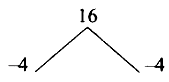
& 16 x^2-4 x-4 x+1 \\
& 4 x(4 x-1)-1(4 x-1)=0 \\
& (4 x-1)(4 x-1)=0 \\
& 4 x=1,4 x=1 \\
& x=\frac{1}{4}, x=\frac{1}{4}
\end{aligned}
$
The roots are $\frac{1}{4}$ and $\frac{1}{4}$

Need a full question paper?

Generate a complete, print-ready paper with questions like this in minutes — across 16+ boards, with answer keys.
Start Generating Free

Similar questions

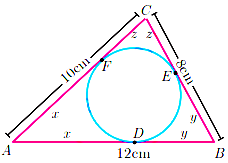
A circle is inscribed in ∆ABC having sides 8 cm, 10 cm and 12 cm as shown in the figure, Find AD, BE and CF.
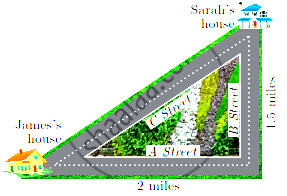
There are two paths that one can choose to go from Sarah’s house to James's house. One way is to take C street, and the other way requires to take B street and then A street. How much shorter is the direct path along C street?
The number of seats in a row is equal to the total number of rows in a hall. The total number of seats in the hall will increase by 375 if the number of rows is doubled and the number of seats in each row is reduced by 5. Find the number of rows in the hall at the beginning.
The roots of the equation $2 x^2-7 x+5=0$ are $\alpha$ and $\beta$. Without solving for the roots, find $\frac{\alpha+2}{\beta+2}+\frac{\beta+2}{\alpha+2}$
Find x, y and z, given that the numbers x, 10, y, 24, z are in A.P.
A girl is twice as old as her sister. Five years hence, the product of their ages (in years) will be 375. Find their present ages.
Identify rational expression should be subtracted from $\frac{x^2+6 x+8}{x^3+8}$ to get $\frac{3}{x^2-2 x+4}$
Simplify $\frac{2 a ^2+5 a +3}{2 a ^2+7 a +6} \div \frac{ a ^2+6 a +5}{-5 a ^2-35 a -50}$
Construct a triangle similar to a given triangle $A B C$ with its sides equal to $\frac{6}{5}$ of the corresponding sides of the triangle $ABC$ (scale factor $\frac{6}{5}>1$ )
Let A = The set of all natural number less than 8, B = The set of all prime numbers less than 8, C = The set of even prime number. Verify that (A ∩ B) × C = (A × C) ∩ (B × C)