Question
Solve the following quadratic equation using formula method only
$\sqrt{3} x^2+10 x-8 \sqrt{3}=0$

Answer

$\sqrt{3} x^2+10 x-8 \sqrt{3}=0$
$a=\sqrt{3} ; b=10 ; c=-\frac{8}{\sqrt{3}}$
$ D=b^2-4 a c$
$ =(10)^2-4(\sqrt{3})(-8 \sqrt{3})$
$=100+96 $
$=196$
$x =\frac{- b \pm \sqrt{ b ^2-4 ac }}{2 a}$
$ x=\frac{-10 \pm \sqrt{196}}{2 \sqrt{3}} $
$ x=\frac{-10+14}{2 \sqrt{3}}, x=\frac{-10-14}{2 \sqrt{3}} $
$x=\frac{4}{2 \sqrt{3}}, x=\frac{24}{2 \sqrt{3}} $
$x=\frac{2}{\sqrt{3}}, x=-\frac{12}{\sqrt{3}}$

Need a full question paper?

Generate a complete, print-ready paper with questions like this in minutes — across 16+ boards, with answer keys.
Start Generating Free

Similar questions

Find the sum of all multiples of $7$ between $300$ and $700.$
A sum of money is lent out at compound interest for two years at 20% p.a., being reckoned yearly. If the same sum of the money was lent Gut at compound interest of the same rate of percent per annum C.I., being reckoned half yearly would have fetched Rs. 482 more by way of interest. Calculate the sum of money lent out.
If two sides of a cyclic quadrilateral are parallel; prove that:
(i) its other two sides are equal.
(ii) its diagonals are equal.
A manufacturer in Noida (UP) sold a carton of hair oil to a dealer in Raipur (Chhattisgarh) for ₹ $22,000$. The dealer in Raipur sold it to a consumer in Bastar (Chhattisgarh) at a profit of ₹ $5,000$ . If the rate of GST is $18 \%$, find :
(i) the net IGST, CSGT, and SGST payable by the dealer in Raipur.
(ii) the cost price of the hair oil for the consumer.
Use a ruler and compass only for this question to construct the cyclic quadrilateral ABCD in which AB = 5 cm, BC = 8 cm, ∠ ABC = $67 \frac{1}{2}^{\circ}$, and D is equidistant from B and C.
Divide $15$ into two parts such that the sum of their reciprocals is
$\frac{3}{10}$
In triangle ABC, AB = AC. A circle passing through B and c intersects the sides AB and AC at D and E respectively. Prove that DE || BC.
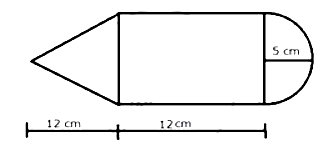
The given figure shows the cross$-$section of a cone, a cylinder and a hemisphere all with the same diameter $10 \ cm$ and the other dimensions are as shown. Calculate :the total surface area .
A takes $6$ days less than the time taken by B to finish a piece of work. If both A and B work together they can finish in $4$ days. Find the time taken by B to finish the work.
A cubical block of side $7 \ cm$ is surmounted by a hemisphere of the largest size. Find the surfacearea of the resulting solid.