Question
Solve the following quadratic equations by factorization:
$3\Big(\frac{7\text{x}+1}{5\text{x}-3}\Big)-4\Big(\frac{5\text{x}-3}{7\text{x}+1}\Big)=11,$ $\text{x}\neq\frac{3}{5},-\frac{1}{7}$
Answer

$\Rightarrow3\Big(\frac{7\text{x}+1}{5\text{x}-3}\Big)-4\Big(\frac{5\text{x}-3}{7\text{x}+1}\Big)=11$
$\Rightarrow\frac{3(7\text{x}+1)^2-4(5\text{x}-3)^2}{(5\text{x}-3)(7\text{x}+1)}=11$
$\Rightarrow\frac{3(49\text{x}^2+1+14\text{x})-4(25\text{x}^2+9-30\text{x})}{35\text{x}^2+5\text{x}-21\text{x}-3}=11$
$\Rightarrow\frac{147\text{x}^2+3+42\text{x}-100\text{x}^2-36+120\text{x}}{35\text{x}^2-16\text{x}-3}=11$
$\Rightarrow47\text{x}^2+162\text{x}-33\\=11(35\text{x}^2-16\text{x}-3)$
$\Rightarrow47\text{x}^2+162\text{x}-33\\=385\text{x}^2-176\text{x}-33$
$\Rightarrow385\text{x}^2-47\text{x}^2-176\text{x}\\-162\text{x}-33+33=0$
$\Rightarrow338\text{x}^2-338\text{x}=0$
$\Rightarrow\text{x}^2-\text{x}=0$
$\Rightarrow\text{x}(\text{x}-1)=0$
$\Rightarrow\text{x}=0$ or $\text{x}-1=0$
$\Rightarrow\text{x}=0$ or $\text{x}=1$
Hence, the factors are 0 and 1.

Need a full question paper?

Generate a complete, print-ready paper with questions like this in minutes — across 16+ boards, with answer keys.

Start Generating Free

Similar questions

If $\alpha$ and $\beta$ are the zeroes of the quadratic polynomial $f(x) = ax^2 + bx + c$, find evaluate:$\frac{\beta}{\text{a}\alpha+\text{b}}+\frac{\alpha}{\text{a}\beta+\text{b}} $
Show that the line segment joining the points $(5,7),(3,9)$ and $(8,6),(0,10)$ bisect each other.
Prove the following identities:
$\frac{1+\cos\theta-\sin^2\theta}{\sin\theta(1+\cos\theta)}=\cot\theta$
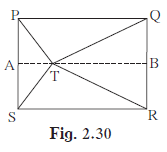
In figure 2.30, point $T$ is in theinterior of rectangle PQRS, Prove that, $T S^2+T Q^2=T P^2+T R^2$ (As shown in the figure, drawseg $A B ~\|$ side $S R$ and $A-T-B)$
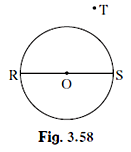
In figure 3.58, seg RS is a diameter of the circle with centre O. Point T lies in the exterior of the circle. Prove that ∠ RTS is an acute angle.
One card is drawn from a well-shuffled deck of 52 cards. Find the probability of getting:
  1. A king of red suit.
  2. A face card.
  3. A red face card.
  4. A queen of black suit.
  5. A jack of hearts.
  6. A spade.
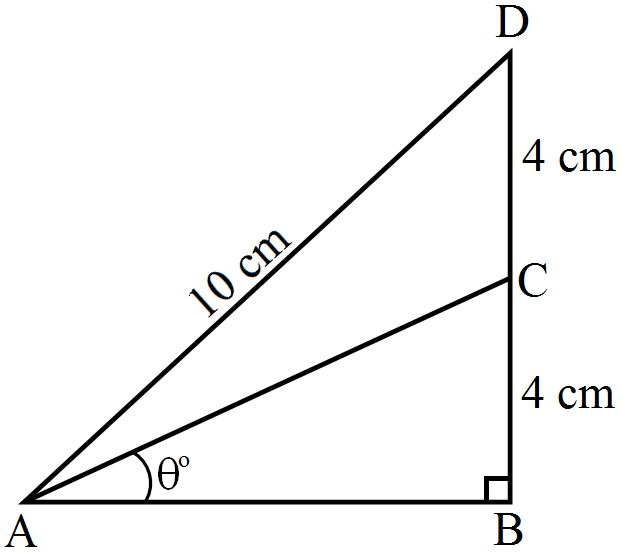
In the adjoining figure, $\angle\text{B}=90^\circ,\angle\text{BAC}=\theta,\text{BC}=\text{CD}=4\text{cm}$ and AD = 10cm. Find
  1. $\sin\theta$
  2. $\cos\theta.$
Hint: $\text{AB}^2=\big(\text{AD}^2-\text{BD}^2\big)=36\text{cm}^2$ $\therefore\text{AB}=6\text{cm}.$ $\text{AC}^2=\big(\text{AB}^2+\text{BC}^2\big)=52\text{cm}^2$ $\therefore\text{AC}=2\sqrt{13}\text{cm}.$ Thus, AB = 6cm and $\text{AC}=2\sqrt{13}\text{cm}.$
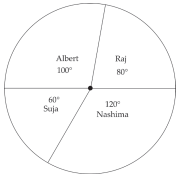
The following pie diagram represents the number of valid votes obtained by four students who contested for school captain. The total of valid votes polled was 720. Answer the following questions.
Image
(i) Who has won the election?
(ii) What is the minimum no. of votes? Who got it?
(iii) By how many votes did the winner defeat the nearest contestant?
A man arranges to pay off a debt of Rs 3600 by 40 annual instalments which form an arithmetic series. When 30 of the instalments are paid, he dies leaving one-third of all debt unpaid, find the value of the first instalment.
Solve the following quadratic equations by factorization:
$a^2x^2 - 3abx + 2b^2 = 0$