Question
Solve the following quadratic equations by factorization:
$\frac{4}{\text{x}}-3=\frac{5}{2\text{x}+3},$ $\text{x}\neq-0,-\frac{3}{2}$

Answer

$\frac{4}{\text{x}}-3=\frac{5}{2\text{x}+3}$
$\Rightarrow\frac{4-3\text{x}}{\text{x}}=\frac{5}{2\text{x}+3}$
$\Rightarrow (4 - 3x)(2x + 3) = 5x$
$\Rightarrow 8x + 12 - 6x^2 - 9x = 5x$
$\Rightarrow -6x^2 - 6x + 12 = 0$
$\Rightarrow x^2 + x - 2 = 0$
$\Rightarrow x^2 + 2x - x - 2 = 0$
$\Rightarrow x(x + 2) - 1(x + 2) = 0$
$\Rightarrow (x - 1)(x + 2) = 0$
$\Rightarrow x - 1 = 0 or x + 2 = 0$
$\Rightarrow x = 1 or x = -2$
Hence, the factors are 1 and -2

Need a full question paper?

Generate a complete, print-ready paper with questions like this in minutes — across 16+ boards, with answer keys.

Start Generating Free

Similar questions

Five year hence, the age of Jacob will be three times that of his son. Five years ago, Jacob's age was seven times that of his son. What are their present ages? Solve by substitution method.
The sum of two numbers is 16 and the sum of their reciprocals is $\frac{1}{3}.$ Find the numbers.
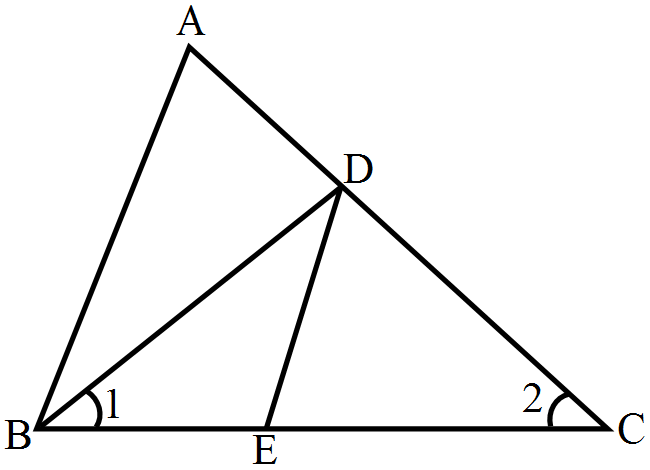
In the given figure, $\angle1=\angle2$ and $\frac{\text{AC}}{\text{BD}}=\frac{\text{CB}}{\text{CE}}$
Prove that $\triangle\text{ACB}\sim\triangle\text{DCE}.$
A natural number when increased by 13 equals 160 times its reciprocal. Find the number.
Show graphically that each of the following given systems of equations is inconsistent, i.e., has no solutions:
2x + 3y = 4, 4x + 6y = 12
Find the value of k for which the root are real and equal in the following equations:
$4x^2- 2(k + 1)x + (k + 4) = 0$
If $12^{th}$​​​​​​​ term of an A.P. is -13 and the sum of the first four terms is 24, what is the sum of first 10 terms?
A solid toy is in the form of a hemisphere surmounted by a right circular cone. The height of cone is $4 \ cm$ and the diameter of the base is $8 \ cm.$ Determine the volume of the toy. If a cube circumscribes the toy, then find the difference of the volumes of cube and the toy. Also, find the total surface area of the toy.
The numerator of a fraction is 3 less than its denominator. If 2 is added to both the numerator and the denominator, then the sum of the new fraction and original fraction is $\frac{29}{20}$. Find the original fraction.
Find the value of k for which the following equations have real and equal roots:
$x^2 - 2(k + 1)x + k^2 = 0$