Question
Solve the following quadratic equations by factorization:
$\text{x}^2-\big(\sqrt{2}+1\big)\text{x}+\sqrt{2}=0$

Answer

$\text{x}^2-\big(\sqrt{2}+1\big)\text{x}+\sqrt{2}=0$
$\Rightarrow(\text{x})^2-2\Big(\frac{\sqrt{2}+1}{2}\Big)\text{x}+\sqrt{2}=0$
$\Rightarrow(\text{x})^2-2\times\Big(\frac{\sqrt{2}+1}{2}\Big)\times\text{x}+\Big(\frac{\sqrt{2}+1}{2}\Big)^2-\frac{3-2\sqrt{2}}{4}=0$
$\begin{cases}\Big(\frac{\sqrt{2}+1}{2}\Big)^2-\frac{3-2\sqrt{2}}{4}\\=\frac{2+1+2\sqrt{2}}{4}-\frac{3-2\sqrt{2}}{4}=\sqrt{2}\end{cases}$
$\Rightarrow\Big(\text{x}-\frac{\sqrt{2}+1}{2}\Big)^2$
$=\frac{3-2\sqrt{2}}{4}$
$=\frac{2+1-2\sqrt{2}}{4}$
$=\Big(\pm\frac{\sqrt{2}-1}{2}\Big)^2$
$\therefore\text{x}-\frac{\sqrt{2}+1}{2}=\pm\frac{\sqrt{2}-1}{2}$
$\Rightarrow\text{x}=\frac{\sqrt{2}+1}{2}\pm\frac{\sqrt{2}-1}{2}$
$\therefore\text{x}=\frac{\sqrt{2}+1}{2}+\frac{\sqrt{2}-1}{2}$
$=\frac{2\sqrt{2}}{2}-\sqrt{2}$
and $\text{x}=\frac{\sqrt{2}+1}{2}-\frac{\sqrt{2}-1}{2}$
$=\frac{2}{2}=1$
Hence roots are $1,\sqrt{2}$

Need a full question paper?

Generate a complete, print-ready paper with questions like this in minutes — across 16+ boards, with answer keys.
Start Generating Free

Similar questions

Find the quotient when $p(x)=3 x^4+5 x^3-7 x^2+2 x+2$ is divided by $\left(x^2+3 x+1\right)$.
Show that $\triangle\text{ABC},$ with vertices $A(-2, 0), B(0, 2)$ and $C(2, 0)$ is similar to $\triangle\text{DEF}$ with vertices $D(-4, 0), F(4, 0)$ and $E(0, 4).$
Show that the equation $2\left(a^2+b^2\right) x^2+2(a+b) x+1=0$ has no real roots, when $\text{a}\neq\text{b}.$
A chord of a circle subtends an angle of $\theta$ at the centre of the circle. The area of the minor segment cut off by the chord is one eighth of the area of the circle. Prove that
$8\sin\frac{\theta}{2}\cos\frac{\theta}{2}+\pi=\frac{\pi\theta}{45}.$
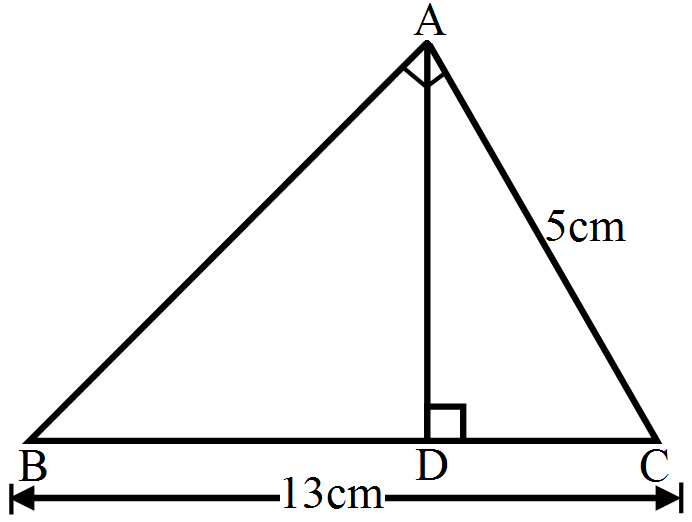
$\triangle\text{ABC}$ is right-angled at $A$ and $\text{AD}\perp\text{BC}.$ If $BC = 13\ cm$ and $AC =5\ cm$, find the ratio of the areas of $\triangle\text{ABC}$ and $​​​​$$\triangle\text{ADC}.$
The lower window of a house is at a height of $2 \ m$ above the ground and its upper window is $4 \ m$ vertically above the lower window. At certain instant the angles of elevation of a balloon from these windows are observed to be $60^{\circ}$ and $30^{\circ}$ respectively. Find the height of the balloon above the ground.
A chord $10\ cm$ long is drawn in a circle whose radius $5\sqrt{2}\text{cm}.$ find the areas of both the segments. $[\text{Take }\pi=3.14]$
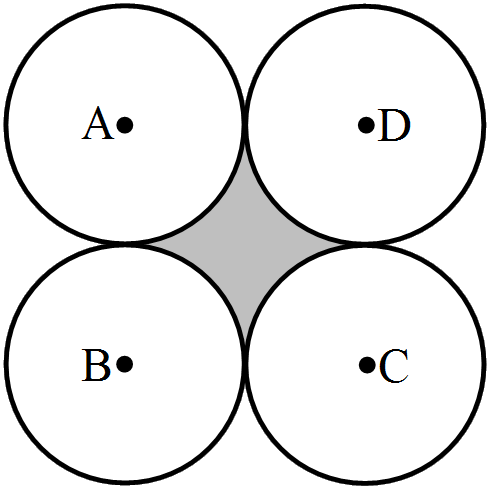
Four equal circles, each of radius $5\ cm$, touch each other, as shown in the figure. Find the area included between them. $[\text{Take }\pi\ =3.14]$
The horizontal distance between two poles is $15\ m$. The angle of depression of the top of the first pole as seen from the top of the second pole is $30^\circ $. If the height of the second pole is $24\ m$, find the height of the first pole. $(\sqrt{3}=1.732)$
Solve for $x$ and $y$
$\frac{5}{\text{x}+\text{1}}-\frac{2}{\text{x}-\text{1}}=\frac{1}{2}$
$\frac{10}{\text{x}+\text{1}}+\frac{2}{\text{y}-\text{1}}=\frac{5}{2}$