Question
Solve the following simultaneou equation graphically :
y = 2x + 3 and y = 3x + 1

Answer

x = 2, y = 7

Need a full question paper?

Generate a complete, print-ready paper with questions like this in minutes — across 16+ boards, with answer keys.
Start Generating Free

Similar questions

Prove that the bisectors of the interior angles of a rectangle form a square.
A point $A$ is at a distance of $\sqrt{10}$ unit from the point $(4, 3)$. Find the co$-$ordinates of point $A$, if its ordinate is twice its abscissa.
The perimeter of a rectangular field is $80\ m$. If the breadth is increased by $2 \ m$ and the length is decreased by $2 \ m$, the area of the field increases by $36\ m^2$.Find the length and breadth of the field.
Draw a graph of the equation $3x - y = 7$. From the graph find the value of$:\ (i) y$, when $x = 1;(ii) x$, when $y = 8$
A man sells an article and makes a profit of $6\%$. Had he bought the article at a price $4\%$ less and sold at a price higher by $Rs. 7.60$, he would have made a profit of $12\%$. Find his cost price.
How much will $Rs. 50,000$ amount to in $3$ years, compounded yearly, if the rates for the successive years are $6\ \%\ , 8\ \%\ $ and $10\ \%\ $ respectively?
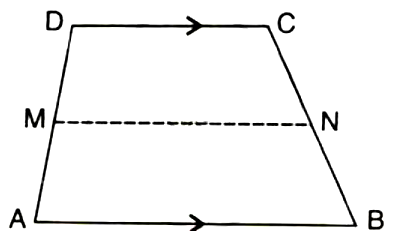
The figure, given below, shows a trapezium $\text{ABCD} . M$ and $N$ are the mid-point of the non$-$parallel sides $A D$ and $B C$ respectively. Find :

$(i) MN$, if $AB =11 \ cm$ and $DC =8 \ cm.(ii) A B$, if $D C=20 \ cm$ and $M N=27 \ cm.(iii) DC$, if $MN =15 \ cm$ and $AB =23 \ cm$.
Draw frequency polygons for each of the following frequency distribution:$(a)$ using histogram$(b)$ without using histogram
$C.I$ $5 -15$ $15 -25$ $25 -35$ $35 - 45$ $45-55$ $55-65$
$ƒ$ $8$ $16$ $18$ $14$ $8$ $2$
For the pair of linear equations given below, draw graphs and then state, whether the lines drawn are parallel or perpendicular to each other.$2x - 3y = 6;\frac{x}{2}+\frac{y}{3}=1$
If the medians of a $\triangle A B B C$ intersect at $G$, show that $\operatorname{ar}(\triangle A G B)=\operatorname{ar}(\triangle A G C)=\operatorname{ar}(\triangle B G C)=\frac{1}{3} \operatorname{ar}(\triangle A B C)$.