Question
Solve the following system of equations by matrix method:
$5x + 7y + 2 = 0$
$4x + 6y + 3 = 0$

Answer

The given system of equations can be written in matrix from as follws: $\begin{bmatrix}5&7\\ 4&6\end{bmatrix}\begin{bmatrix}\text{x}\\ \text{y}\end{bmatrix}=\begin{bmatrix}-2\\ -3\end{bmatrix}$ $\text{AX = B}$Here,
$\text{A}=\begin{bmatrix}5&7\\ 4&6\end{bmatrix},\text{X=}\begin{bmatrix}\text{x}\\ \text{y}\end{bmatrix}$ And$\text{ B}=\begin{bmatrix}-2\\ -3\end{bmatrix}$ Now, $|\text{A}|=\begin{bmatrix}5&7\\ 4&6\end{bmatrix}\\ $ $=30-28$ $=2\neq0$ The given system has a unique solution given by $\text{X}=\text{A}^{-1 }\text{B.}$ Let $C_{ij}$ be the cofactors of the elements $a_{ij}$ in $A = [a_{ij}]$. Then, $\text{C}_{11}=(-1)^{1+1}(6)=6,\text{C}_{12}=(-1)^{1+2}(4)=-4$ $\text{C}_{21}=(-1)^{2+1}(7)=-7,\text{C}_{22}=(-1)^{2+2}(5)$ $\text{adj}\ \text{A}=\begin{bmatrix}6&-4\\ -7&5\end{bmatrix}=\begin{bmatrix}6&-7\\ -4&5\end{bmatrix}$ $\text{A}^{-1}=\frac{1}{\text{|A|}}\text{ adj}\text{ A}$
$\Rightarrow \text{A}^{-1}=\frac{1}{2}\begin{bmatrix}6&-7\\ -4&5\end{bmatrix}$ $\text{X}=\text{A}^{-1}\text{B}$ $=\frac{1}{2}\begin{bmatrix}6&-7\\ -4&5\end{bmatrix}\begin{bmatrix}-2\\-3\end{bmatrix} $ $=\frac{1}{2}\begin{bmatrix}-12+21\\ 8-15\end{bmatrix} $
$\Rightarrow\begin{bmatrix}\text{x}\\ \text{y}\end{bmatrix}=\begin{bmatrix}\frac{9}{2}\\ \frac{-7}{2}\end{bmatrix}$ $\therefore\text{X}=\frac{9}{2}$ And $\text{ y }=\frac{-7}{2}$

Need a full question paper?

Generate a complete, print-ready paper with questions like this in minutes — across 16+ boards, with answer keys.
Start Generating Free

Similar questions

Given three identical boxes I, II and III each containing two coins. In box I, both coins are gold coins, in box II, both are silver coins and in box III, there is one gold and one silver coin. A person chooses a box at random and takes out a coin. If the coin is of gold, what is the probability that the other coin in the box is also of gold?
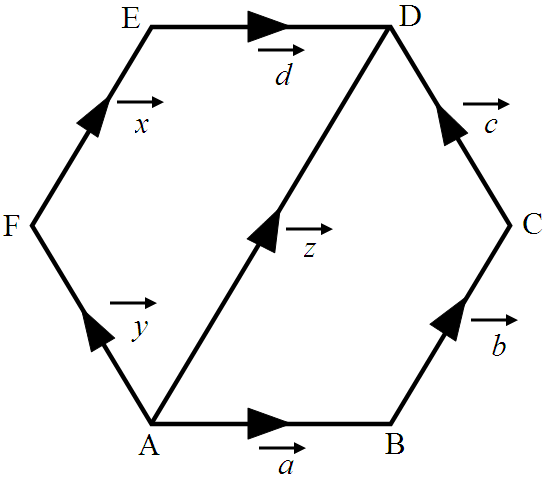
In Figure ABCD is a regular hexagon, which vectors are:
  1. Collinear.
  2. Equal.
  3. Co-initial.
  4. Collinear but not equal.
Solve the following initial value problems:
$\frac{\text{dy}}{\text{dx}}+2\text{y}=\text{e}^{-2\text{x}}\sin\text{x},\text{ y}(0)=0$
Find the intervals in which the following functions are increasing or decreasing.
$f(x) = 2x^2 - 24x + 7$
Solve the following system of equations by matrix method:$x - y + 2z = 7$
$3x + 4y - 5z = -5$
$2x - y + 3z = 12$
Find the maximum and minimum values of $\text{y}=\tan \text{x}-2\text{x}$
If $\text A = \begin{bmatrix}1&2&-3\\5&0&2\\1&-1&1\end{bmatrix},\ \text B = \begin{bmatrix}3&-1&2\\4&2&5\\2&0&3\end{bmatrix} \text{and}\ \text C = \begin{bmatrix}4&1&2\\0&3&2\\1&-2&3\end{bmatrix},$ then compute (A + B) and (B - C).
Also, verify that A + (B - C) = (A + B) - C.
A and B has two families. Family A has 4 male, 6 female and 2 children and family B has 2 male, 2 female and 4 children. Every male, female and children has suggested to give respectively 2400, 1900 and 1800 calories per day and 45,55 and 33 gm. protein also. From this informa tion prepare a matrix. Using multiplication of matrix, find the total quantity of calorie and protein for every family.
Prove that:
  1. $\text{P}(\text{A})=\text{P}(\text{A}\cap\text{B})+\text{P}(\text{A}\cap\bar{\text{B}})$
  2. $\text{P}(\text{A}\cup\text{B})=\text{P}(\text{A}\cap\text{B})+\text{P}(\text{A}\cap\bar{\text{B}})+\text{P}(\bar{\text{A}}\cap\text{B})$
If $\text{y}=\text{e}^{\text{x}}\cos\text{x},$ Prvoe that $\frac{\text{dy}}{\text{dx}}=\sqrt{2}\text{e}^\text{x}.\cos\Big(\text{x}+\frac{\pi}{4}\Big)$