Question
Solve the following systems of equations by using the method of cross multiplication:
$\frac{5}{(\text{x}+\text{y})}-\frac{2}{(\text{x}-\text{y})}+1=0,$
$\frac{15}{(\text{x}+\text{y})}+\frac{7}{(\text{x}-\text{y})}-10=0$ $(\text{x}\neq\text{y},\ \text{x}\neq-\text{y}).$
Answer

Taking $\frac{1}{\text{x}+\text{y}}=\text{u}$ and $\frac{1}{\text{x}-\text{y}}=\text{v},$ the given equations become:
$5u - 2v + 1 = 0 ...(i)$
$15u + 7v - 10 = 0 ...(ii)$
Here, $a_1=5, b_1=-2, c_1=1, a_2=15, b_2=-7$ and $c_2=-10$
By cross multiplication, we have:

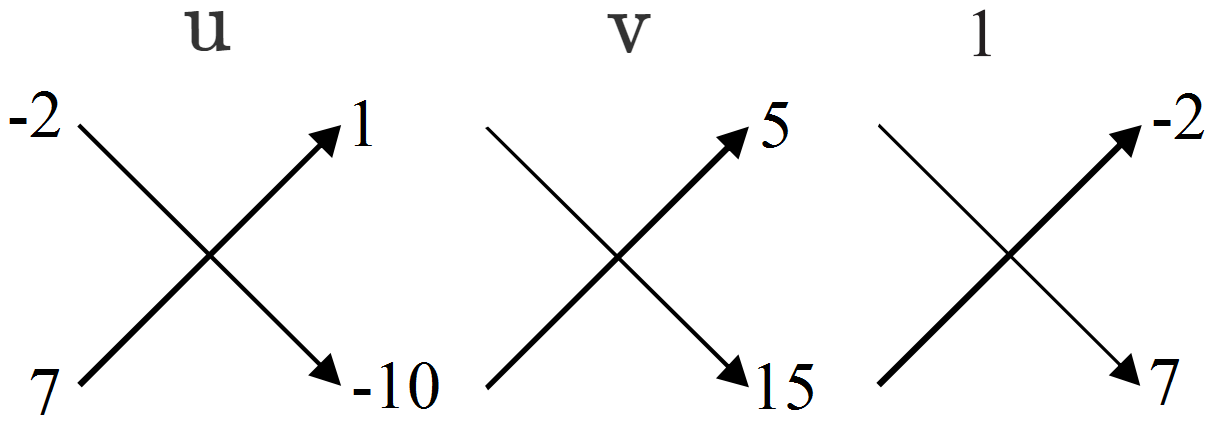
$\therefore\frac{\text{u}}{[-2\times(-10)-1\times7]}=\frac{\text{v}}{[1\times15-(-10)\times5]}=\frac{1}{[35+30]}$
$\Rightarrow\frac{\text{u}}{20-7}=\frac{\text{v}}{15+50}=\frac{1}{65}$
$\Rightarrow\frac{\text{u}}{13}=\frac{\text{v}}{65}=\frac{1}{65}$
$\Rightarrow\text{u}=\frac{13}{65}=\frac{1}{5},\ \text{v}=\frac{65}{65}=1$
$\Rightarrow\frac{1}{\text{x}+\text{y}}=\frac{1}{5},\ \frac{1}{\text{x}-\text{y}}=1$
So, $(x + y) = 5 ...(iii)$
and $(x - y) = 1 ...(iv)$
Again, the above equations $(iii)$ and $(iv)$ may be written as:
$x + y - 5 = 0 ...(v)$
$x - y - 1 = 0 ...(vi)$
Here, $a_1=1, b_1=1, c_1=-5, a_2=1, b_2=-1$ and $c_2=-1$
By cross multiplication, we have:

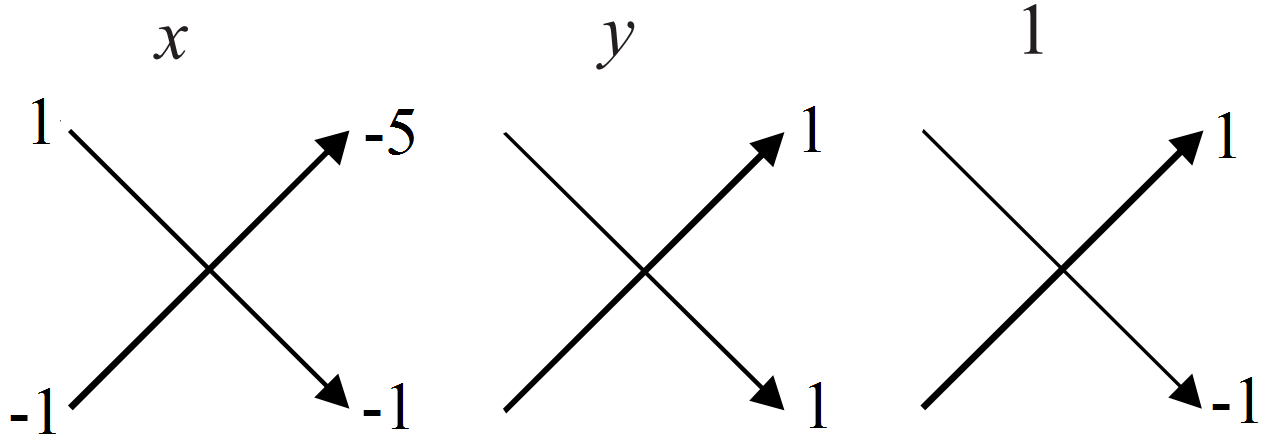
$\therefore\frac{\text{x}}{[1\times(-1)-(-5)\times(-1)]}=\frac{\text{y}}{(-5)\times1-(-1)\times1}=\frac{1}{[1\times(-1)-1\times1]}$
$\Rightarrow\frac{\text{x}}{(-1-5)}=\frac{\text{y}}{(-5+1)}=\frac{1}{(-1-1)}$
$\Rightarrow\frac{\text{x}}{-6}=\frac{\text{y}}{-4}=\frac{1}{-2}$
$\Rightarrow\text{u}=\frac{-6}{-2}=3,\ \text{y}=\frac{-4}{-2}=2$
Hence, $x = 3$ and $y = 2$ is the required solution.

Need a full question paper?

Generate a complete, print-ready paper with questions like this in minutes — across 16+ boards, with answer keys.

Start Generating Free

Similar questions

The first and the last terms of an $AP$ are $5$ and $45$ respectively. If the sum of all its term is $400$, find the common difference and the number of terms.
A man invested an amount at $10\%$ per annum and another amount at $8\%$ per annum simple interest. Thus, he received $₹ 1350$ as annual interest. Had he interchanged the amounts invested, he would have received $₹ 45$ less as interest. What amounts did he invest at different rates?
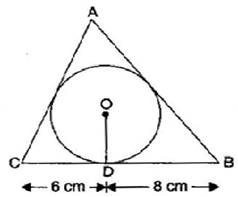
A triangle $ABC$ is drawn to circumscribe a circle of radius $4\ cm$ such that the segments $BD$ and $DC$ into which $BC$ is divided by the point of contact $D$ are of lengths $8\ cm$ and $6 \ cm$ respectively (see figure). Find the sides $AB$ and $AC$.
The following frequency distribution gives the monthly consumption of electricity of $68$ consumers of a locality. Find the median, mean and mode of the data and compare them:
Monthly consumption $($in units$)$ $65-85$ $85-105$ $105-125$ $125-145$ $145-165$ $165-185$ $185-205$
No. of consumers $4$ $5$ $13$ $20$ $14$ $8$ $4$
Prove the following identities:
$\sin^2\theta+\cos^4\theta=\cos^2\theta+\sin^4\theta$
A pole has to be erected at a point on the boundary of a circular park of diameter $13$ metres in such a way that the difference of its distances from two diametrically opposite fixed gates $A$ and $B$ on the boundary is $7$ metres. Is it possible to do so$?$ If yes, at what distances from the two gates should the pole be erected$?$
The coordinates of the point $P$ are $(-3, 2)$. Find the coordinates of the point $Q$ which lies on the line joining $P$ and origin such that $OP = OQ.$
If $\cot\theta=\frac{3}{4},$ show that $\sqrt{\frac{\sec\theta-\text{cosec}\theta}{\sec\theta+\text{cosec}\theta}}=\frac{1}{\sqrt{7}}.$
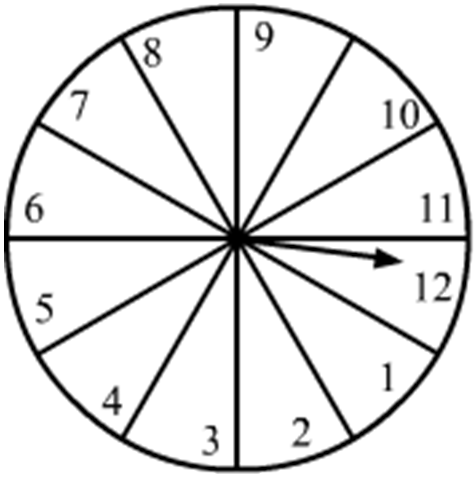
A game of chance consists of spinning an arrow which is equally likely to come to rest pointing to one of the number $1, 2, 3, ....., 12$ as shown in following figure. What is the probability that it will point to:
  1. $10?$
  2. An odd number?
  3. A number which is multiple of $3?$
  4. An even number?
The sum of first $9$ terms of an $A.P.$ is $162.$ The ratio of its $6^{th}$ term to its $13^{th}$ term is $1 : 2$. Find the first and $15^{th}$ term of the $A.P?$