Question 14 Marks
Solve for $x$ and $y$
$x + y = a + b,$
$a x-b y=a^2-b^2$
Answer$x + y = a + b ...(i)$
$a x-b y=a^2-b^2...(ii)$
Multiplying $(i)$ by b adding it to $(ii)$, we get
$\Rightarrow b x+a x=a b+b^2+a^2-b^2$
$⇒ x(a + b) = a(a + b)$
$⇒ x = a$
Substitute $x = a$ in $(i),$ we get $y = b.$
So, $x = a $ and $y = b$
View full question & answer→Question 24 Marks
Solve the following systems of equations by using the method of cross multiplication:
$x + 2y + 1 = 0$
$2x - 3y - 12 = 0$
AnswerThe given equations are:
$x + 2y + 1 = 0 ...(i)$
$2x - 3y - 12 = 0 ...(ii)$
Here, $a_1=1, b_1=2, c_1=1, a_2=2, b_2=-3$ and $c_2=-12$
By cross multiplication, we have
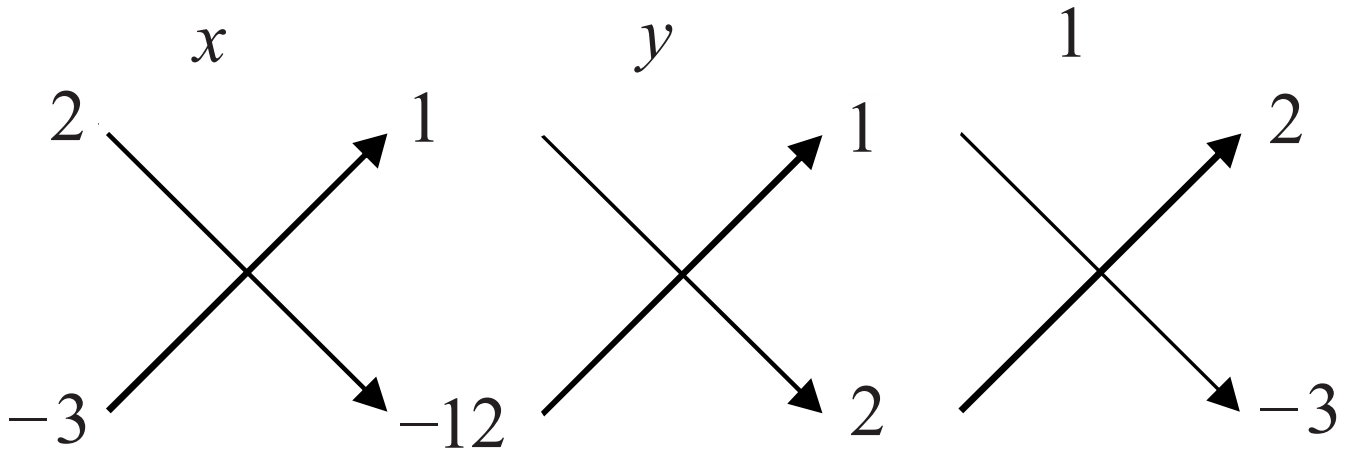
$\therefore\frac{\text{x}}{[2\times(-12)-1\times(-3)]}=\frac{{\text{y}}}{[1\times2-1\times(-12)]}=\frac{1}{[1\times(-3)-2\times2]}$
$\Rightarrow\frac{\text{x}}{(-24+3)}=\frac{\text{y}}{(2+12)}=\frac{1}{(-3-4)}$
$\Rightarrow\frac{\text{x}}{(-21)}=\frac{\text{y}}{(14)}=\frac{1}{(-7)}$
$\Rightarrow\text{x}=\frac{-21}{-7}=3,\ \text{y}=\frac{14}{-7}=-2$
Hence,$ x = 3$ and $y = -2$ is the required solution. View full question & answer→Question 34 Marks
Solve for $x$ and $y$
$7(y + 3) - 2(x + 2) = 14,$
$4(y - 2) + 3(x - 3) = 2$
AnswerThe given equations are:
$7(y + 3) - 2(x + 2) = 14$
$4(y - 2) + 3(x - 3) = 2$
$7(y + 3) - 2(x + 2) = 14$
$⇒ 7y + 21 - 2x - 4 = 14$
$⇒ 7y - 2x = 14 + 4 - 21$
$⇒ -2x + 7y = -3 ...(1)$
$4(y - 2) + 3(x - 3) = 2$
$⇒ 4y - 8 + 3x - 9 = 2$
$⇒ 4y + 3x = 2 + 8 + 9$
$⇒ 3x + 4y = 19 ...(2)$
Multiply $(1)$ by $4$ and $(2)$ by $7$, we get
$-8x + 28y = -12 ...(3)$
$21x + 28y = 133 ...(4)$
Subtracting $(3)$ and $(4),$ we get
$29x = 145$
$x = 5$
Substituting $x = 5$ in $(1)$, we get
$-2 × 5 + 7y = -3$
$⇒ 7y = -3 + 10$
$⇒ 7y = 7$
$⇒ y = 1$
$\therefore$ Solution is $x = 5$ and $y = 1$
View full question & answer→Question 44 Marks
Solve for $x$ and $y$
$3(2x + y) = 7xy,$
$3(x + 3y) = 11xy$ $(\text{x}\neq0\ \text{and}\ \text{y}\neq0)$
Answer$3(2x + y) = 7xy$ and $3(x + 3y) = 11xy$
Divide each equation by xy.
$\Rightarrow\frac{3}{\text{x}}+\frac{6}{\text{y}}=7\ \dots(\text{i})$ and $\frac{9}{\text{x}}+\frac{3}{\text{y}}=11\ \dots({\text{ii}})$
Multiply (i) by 3 and subtract from (ii).
$\frac{18}{\text{y}}-\frac{3}{\text{y}}=10$
$\Rightarrow\text{y}=\frac{15}{10}=\frac{3}{2}$
Substituting $\text{y}=\frac{3}{2}$ in (i), we have
$\frac{3}{\text{x}}+\frac{6}{\frac{3}{2}}=7$
$\Rightarrow\frac{3}{\text{x}}+4=7$
$\Rightarrow\frac{3}{\text{x}}=3$
$\Rightarrow\text{x}=1$
So, $x = 1$ and $\text{y}=\frac{3}{2}$
View full question & answer→Question 54 Marks
Solve the following systems of equations by using the method of cross multiplication:
$3x - 2y + 3 = 0$
$4x + 3y - 47 = 0$
AnswerThe given equations are:
$3x - 2y + 3 = 0 ...(i)$
$4x + 3y - 47 = 0 ...(ii)$
Here, $a_1=3, b_1=-2, c_1=3, a_2=4, b_2=3$ and $c_2=-47$
By cross multiplication, we have:
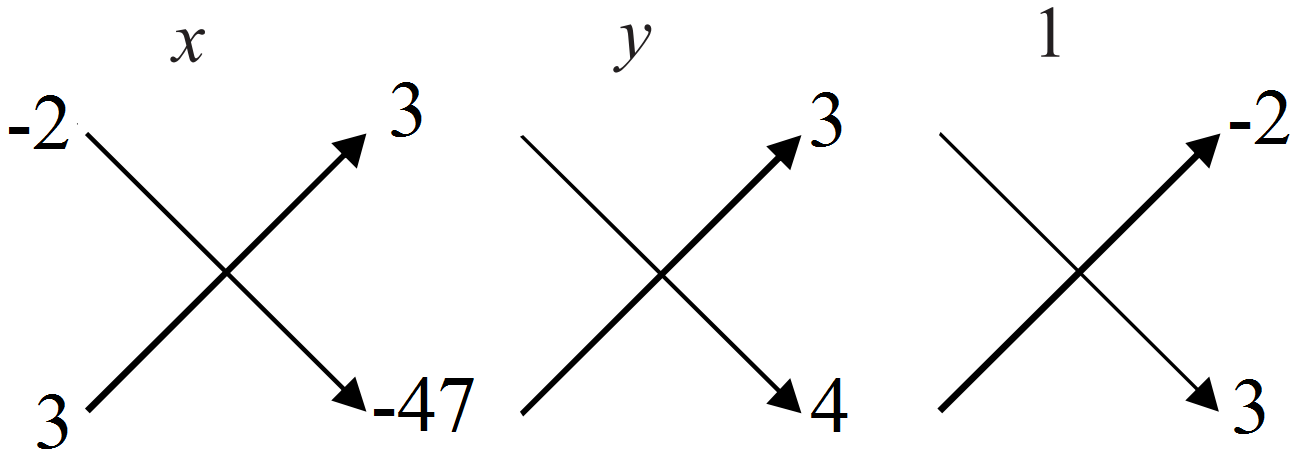
$\therefore\frac{\text{x}}{[(-2)\times(-47)-3\times3]}=\frac{{\text{y}}}{[3\times4-(-47)\times3]}=\frac{1}{[3\times3-(-2)\times4]}$
$\Rightarrow\frac{\text{x}}{(94-9)}=\frac{\text{y}}{(12+141)}=\frac{1}{(9+8)}$
$\Rightarrow\frac{\text{x}}{85}=\frac{\text{y}}{153}=\frac{1}{17}$
$\Rightarrow\text{x}=\frac{85}{17}=5,\ \text{y}=\frac{153}{17}=9$
Hence,$ x = 5$ and $y = 9$ is the required solution. View full question & answer→Question 64 Marks
Solve for $x$ and $y$
$\frac{1}{(3\text{x}+\text{y)}}+\frac{1}{(3\text{x}-\text{y)}}=\frac{3}{4},$
$\frac{1}{2(3\text{x}+\text{y)}}-\frac{1}{2(3\text{x}-\text{y)}}=\frac{-1}{8}$
Answer$\frac{1}{(3\text{x}+\text{y)}}+\frac{1}{(3\text{x}-\text{y)}}=\frac{3}{4},$
$\frac{1}{2(3\text{x}+\text{y)}}-\frac{1}{2(3\text{x}-\text{y)}}=\frac{-1}{8}$
$\Rightarrow\frac{1}{(3\text{x}+\text{y)}}-\frac{1}{(3\text{x}-\text{y)}}=\frac{-1}{4}$
Put $\frac{1}{\text{3x}+\text{y}}=\text{u}$ and $\frac{1}{\text{3x}-\text{y}}=\text{v}$
So, we get
$\text{u}+\text{v}=\frac{3}{4}\ \dots(\text{i})$ and $\text{u}-\text{v}=\frac{-1}{4}\ \dots(\text{ii})$
Adding $(i)$ and $(ii)$, we get
$\Rightarrow\text{2u}=\frac{1}{2}$
$\Rightarrow\text{u}=\frac{1}{4}$
Substituting $\text{u}=\frac{1}{4}$ in (i), we get $\text{v}=\frac{1}{2}$
$\Rightarrow\frac{1}{\text{3x}+\text{y}}=\frac{1}{4}$ and $\frac{1}{\text{3x}-\text{y}}=\frac{1}{2}$
$3x + y = 4 ...(iii)$ and $3x - y = 2 ...(iv)$
Adding$ (iii)$ and $(iv),$ we get
$6x = 6$
$x = 1$
Substituting $x = 1$ in $(iii)$, we get $y = 1$
Hence, $x = 1$ and $y = 1$
View full question & answer→Question 74 Marks
The sum of the numerator and denominator of a fraction is $4$ more than twice the numerator. If the numerator and denominator are increased by $3$, they are in the ratio $2 : 3$. Determine the fraction.
AnswerLet the fraction be $\frac{\text{x}}{\text{y}}$
According to the first condition,
$x + y - 2x + 4$
$\Rightarrow x - y = -4 ...(i)$
According to the second condition,
$\frac{\text{x}+3}{\text{y}+3}=\frac{2}{3}$
$\Rightarrow 3x + 9 = 2y + 6$
$\Rightarrow 3x - 2y = -3 ...(ii)$
Multiply $(i)$ by $-2$ and adding it to $(ii).$
$-2x + 2y - 8 $and $3x - 2y = -3$
$\Rightarrow x = 5$
Substituting $x = 5$ in $(i)$, we get
$y = 9$
So, the fraction is $\frac{5}{9}$
View full question & answer→Question 84 Marks
A two-digit number is $3$ more than $4$ times the sum of its digits. If $18$ is added to the number, the digits are reversed. Find the number.
AnswerLet the ten's and unit's of required number be $x$ and $y$ respectively.
Then required number $= 10x + y$
According to the given question:
$10x + y = 4(x + y) + 3$
$\Rightarrow 10x + y = 4x + 4y +3$
$\Rightarrow 6x - 3y = 3$
$\Rightarrow 2x - y = 1 ...(1)$
And
$\Rightarrow 10x + y + 18 = 10y + x$
$\Rightarrow 9x - 9y = -18$
$\Rightarrow 9(x - y) = -18$
$\Rightarrow(\text{x}-\text{y})=\frac{-18}{9}$
$\Rightarrow x - y = -2 ...(2)$
Subtracting $(2)$ from $(1)$, we get
$\therefore x = 3$
Putting $x = 3$ in $(1),$ we get
$2 \times 3 - y = 1$
$y = 6 - 1 = 5$
$\therefore x = 3, y = 5$
Required number $= 10x + y$
$= 10 \times 3 + 5$
$= 30 + 5$
$= 35$
Hence, required number is $35.$
View full question & answer→Question 94 Marks
Solve for $x$ and $y$
$\frac{\text{x}}{\text{a}}+\frac{\text{y}}{\text{b}}=2,$
$\text{ax}-\text{by}=\text{a}^2-\text{b}^2$
Answer$\frac{\text{x}}{\text{a}}+\frac{\text{y}}{\text{b}}=2$
$\frac{\text{bx}+\text{ay}}{\text{ab}}=2$
$ b x+a y=2 a b \ldots(1) $
$ a x-b y=\left(a^2-b^2\right) ...(2)$
Multiplying (1) by b and (2) by a
$ \Rightarrow b^2 x+b a y=2 a b^2 \ldots(3) $
$ \Rightarrow a^2 x-b a y=a\left(a^2-b^2\right) ...(4)$
Adding (3)and (4), we get
$ b^2 x+a^2 x=2 a b^2+a\left(a^2-b^2\right)$
$ x\left(b^2+a^2\right)=2 a b^2+a^3-a b^2$
$ x\left(b^2+a^2\right)=a b^2+a^3$
$ x\left(b^2+a^2\right)=a\left(b^2+a^2\right)$
$\text{x}=\frac{\text{a}\big(\text{b}^2+\text{a}^2\big)}{\big(\text{b}^2+\text{a}^2\big)}=\text{a}$
Putting $x = a$ in $(1)$, we get
$b × a + ay = 2ab$
$ay = 2ab - ab$
$ay = ab$ or $y = b$
$\therefore$ Solution is $x = a, y = b$
View full question & answer→Question 104 Marks
Solve the following systems of equations by using the method of cross multiplication:
$2x + y = 35,$
$3x + 4y = 65$
AnswerThe given equations may be written as:
$2x + y - 35 = 0 ...(i)$
$3x + 4y - 65 = 0 ...(ii)$
Here, $a_1=2, b_1=1, c_1=-35, a_2=3, b_2=4$ and $c_2=-65$
By cross multiplication, we have:
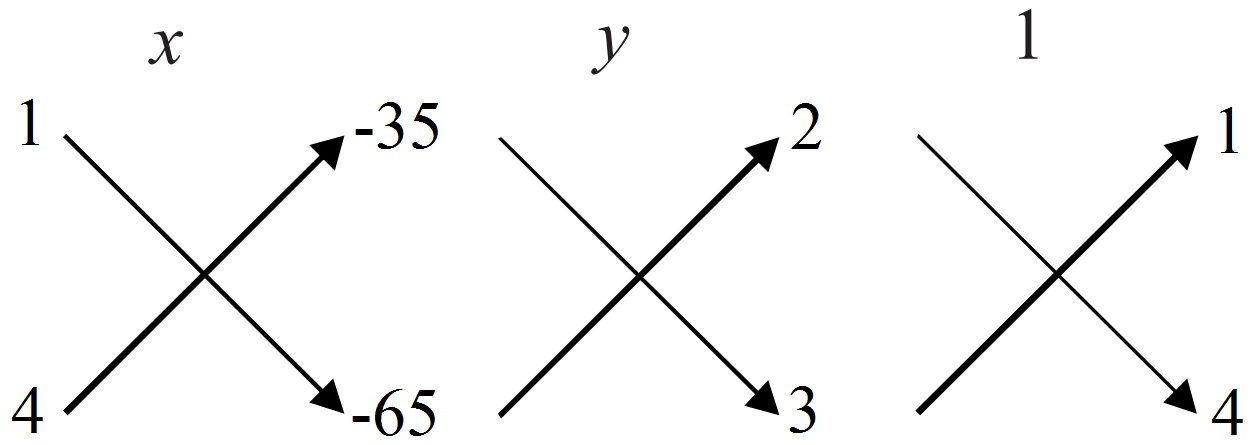
$\therefore\frac{\text{x}}{[1\times(-65)-4\times(-35)]}=\frac{{\text{y}}}{[(-35)\times3-(-65)\times2]}=\frac{1}{[2\times4-3\times1]}$
$\Rightarrow\frac{\text{x}}{(-65+140)}=\frac{\text{y}}{(-105+130)}=\frac{1}{(8-3)}$
$\Rightarrow\frac{\text{x}}{75}=\frac{\text{y}}{25}=\frac{1}{5}$
$\Rightarrow\text{x}=\frac{75}{5}=15,\ \text{y}=\frac{25}{5}=5$
Hence,$ x = 15$ and $y = 5$ is the required solution. View full question & answer→Question 114 Marks
Solve the following systems of equations by using the method of cross multiplication:
$\frac{1}{\text{x}}+\frac{1}{\text{y}}=7,$
$\frac{2}{\text{x}}-\frac{3}{\text{y}}=17 $ $(\text{x}\neq0,\ \text{y}\neq0).$
AnswerTaking $\frac{1}{\text{x}}=\text{u}$ and $\frac{1}{\text{y}}=\text{v},$ the given equations become:
$u + v = 7$
$2u + 3v = 17$
The given equations may be written as:
$u + v - 7 = 0 ...(i)$
$2u + 3v - 17 = 0 ...(ii)$
Here, $\mathrm{a}_1=1, \mathrm{~b}_1=1, \mathrm{c}_1=-7, \mathrm{a}_2=2, \mathrm{~b}_2=3$ and $\mathrm{c}_2=-17$
By cross multiplication, we have:
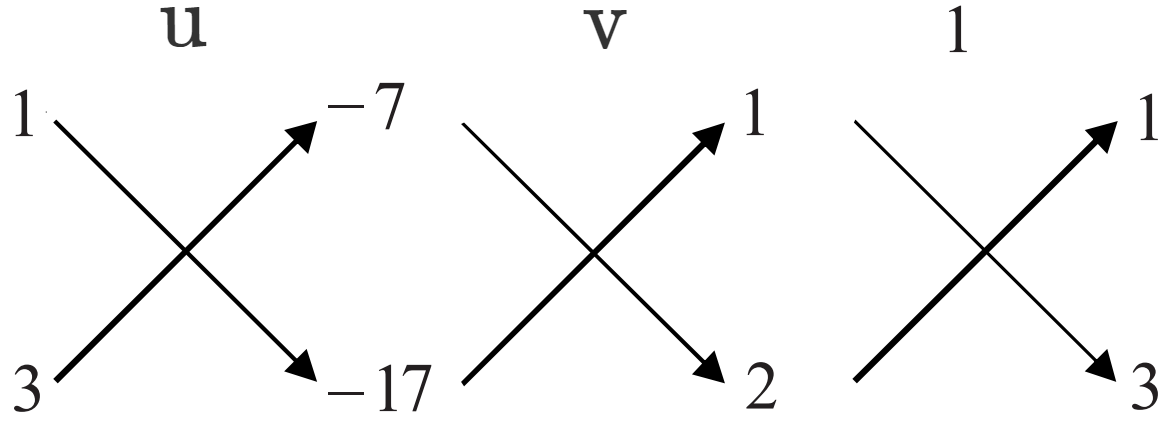
$\therefore\frac{\text{u}}{[1\times(-17)-3\times(-7)]}=\frac{\text{v}}{[(-7)\times2-1\times(-17)]}=\frac{1}{[3-2]}$
$\Rightarrow\frac{\text{u}}{-17+21}=\frac{\text{v}}{-14+17}=\frac{1}{1}$
$\Rightarrow\frac{\text{u}}{4}=\frac{\text{v}}3{}=\frac{1}{1}$
$\Rightarrow\text{u}=\frac{4}{1}=4,\ \text{v}=\frac{3}1{}=3$
$\Rightarrow\frac{1}{\text{x}}=4,\ \frac{1}{\text{y}}=3$
$\Rightarrow\text{x}=\frac{1}4{},\ \text{y}=\frac{1}3{}$
Hence, $\text{x}=\frac{1}4{}$ and $\text{y}=\frac{1}{3}$ is the required solution. View full question & answer→Question 124 Marks
A railway half ticket costs half the full fare and the reservation charge is the same on half ticket as on full ticket. One reserved first class ticket from Mumbai to Delhi costs $₹4,150$ while one full and one half reserved first class
tickets cost $₹6,255$. What is the basic first class full fare and what is the reservation charge?
AnswerLet the full fare be Rs. $x$ and the reservation charge be Rs. $y.$
Since one full ticket cost $₹ 4150,$
$x + y = 4150 ...(i)$
Since one full and one half reserved ticket cost ₹ $6255,$
$(\text{x}+\text{y})+\Big(\frac{1}{2}\text{x}+\text{y}\Big)=6255$
$\Rightarrow\frac{3}{2}\text{x}+\text{2y}=6255$
$\Rightarrow\text{3x}+\text{4y}=12510\ \dots(\text{ii})$
Multiplying $(i)$ by $3$ and subtracting the resultant from $(ii)$, we get
$3x + 3y - 12450$
and $3x + 4y - 12510$
$\Rightarrow y = 60$
Substituting $y = 60$ in $(i),$ we get
$\Rightarrow x = 4090$
Hence, the full fare is $₹ 4090$ and the reservation charge is $₹ 60.$
View full question & answer→Question 134 Marks
The sum of the numerator and denominator of a fraction is $8$. If $3$ is added to both of the numerator and the denominator, the fraction becomes $\frac{3}{4}.$ Find the fraction.
AnswerLet the numerator and denominator of fraction be $x$ and $y$ respectively.
According to the question:
$x + y = 8 ...(1)$
And
$\therefore\frac{\text{x}+3}{\text{y}+3}=\frac{3}{4}$
$\Rightarrow 4x + 12 - 3y + 9$
$\Rightarrow 4x - 3y = -3 ...(2)$
Multiplying $(1)$ be $3$ and $(2)$ by $1$
$3x + 3y = 24 ...(3)$
$4x - 3y = -3 ...(4)$
Add $(3)$ and $(4)$, we get
$7x = 21$
$\Rightarrow\text{x}=\frac{21}{7}=3$
Putting $x = 3$ in $(1)$, we get
$3 + y = 8$
$\Rightarrow y = 8 - 3$
$\Rightarrow y = 5$
$\therefore x = 3, y = 5$
Hence, the fraction is $\frac{\text{x}}{\text{y}}=\frac{3}{5}$
View full question & answer→Question 144 Marks
The sum of a two-digit number and the number obtained by reversing the order of its digits is $121$, and the two digits differ by $3$. Find the number.
AnswerLet the two-digit number be $xy.$
The given number $= 10x + y$
The number obtained by interchanging the digits is $yx.$
According to the first condition,
$\Rightarrow 10x + y + 10y + x = 121$
$\Rightarrow 11x + 11y - 121$
$\Rightarrow x + y = 11 ...(i)$
According to the second condition,
$x - y = 3 ...(ii)$
Adding $(i)$ and $(ii)$, we get
$2x - 14$
$\Rightarrow x - 7$
Substituting $x = 7$ in $(i)$, we get
$y = 4$
So, the given number is $xy - 74$ or $47.$
View full question & answer→Question 154 Marks
If $2$ is added to the numerator of a fraction, it reduces to $\Big(\frac{1}{2}\Big)$ and if $1$ is subtracted from the denominator, it reduces to $\Big(\frac{1}{3}\Big).$ Find the fraction.
AnswerLet the numerator and denominator be $x$ and $y$ respectively.
Then the fraction is $\frac{\text{x}}{\text{y}}.$
$\therefore\frac{\text{x}+2}{\text{y}}=\frac{1}{2}$
$\Rightarrow 2x + 4 = y$
$\Rightarrow 2x - y = -4 ...(1)$
and $\frac{\text{x}}{\text{y}-1}=\frac{1}{3}$
$\Rightarrow 3x = y - 1$
$\Rightarrow 3x - y = -1 ...(2)$
Subtracting $(1)$ from $(2)$, we get
$x = 3$
Putting $x = 3$ in $(1)$, we get
$2 \times 3 - 4$
$\Rightarrow y = -4 - 6$
$\Rightarrow y = 10$
$\therefore x = 3$ and $y = 10$
Hence the fraction is $\frac{3}{10}$
View full question & answer→Question 164 Marks
Solve for $x$ and $y:$
$\frac{10}{\text{x}+\text{y}}+\frac{2}{\text{x}-\text{y}}=4,$
$\frac{15}{\text{x}+\text{y}}-\frac{9}{\text{x}-\text{y}}=-2$
Answer$\frac{10}{\text{x}+\text{y}}+\frac{2}{\text{x}-\text{y}}=4,$
$\frac{15}{\text{x}+\text{y}}-\frac{9}{\text{x}-\text{y}}=-2$
Put $\frac{1}{\text{x}+\text{y}}=\text{u}$ and $\frac{1}{\text{x}-\text{y}}=\text{v}$ in the equation, we get
$10u + 2v = 4 ...(i)$
$15u - 9v = -2 ...(ii)$
Multiply $(i)$ by $9$ and $(ii)$ by $2$, we get
$\Rightarrow 90u + 18v = 36$ and $30u - 18v = -4$
$\Rightarrow 120u = 32$
$\Rightarrow\text{u}=\frac{4}{15}$
Substituting $\text{u}=\frac{4}{15},$ in $(i)$, we get $\text{v}=\frac{2}{3}$
$\Rightarrow\frac{1}{\text{x}+\text{y}}=\frac{4}{15}$
and $\frac{1}{\text{x}-\text{y}}=\frac{2}{3}$
$\Rightarrow\text{x}+\text{y}=\frac{15}{4}\ \dots(\text{iii})$
and $\text{x}-\text{y}=\frac{3}{2}\ \dots(\text{iv})$
Adding $(iii)$ and $(iv)$, we get
$\text{2x}=\frac{21}{4}$
$\Rightarrow\text{x}= \frac{21}{8}$
Substituing $\text{x}=\frac{21}{2}$ in $(iii)$, we get $\text{y}=\frac{9}{8}$
So, $\text{x}=\frac{21}{2}$ and $\text{v}=\frac{9}{8}$
View full question & answer→Question 174 Marks
Solve for $x$ and $y:$
$71x + 37y = 253,$
$37x + 71y = 287$
AnswerThe given equations are:
$71x + 37y = 253 ...(1)$
$37x + 71y = 287 ...(2)$
Adding $(1)$ and $(2)$
$108x + 108y = 540$
$108(x + y) = 540$
$\therefore\text{x}+\text{y}=\frac{540}{108}=5\ \dots(3)$
Subtracting $(2)$ from $(1)$
$34x - 34y = 253 - 287 = -34$
$34(x - y) = -34$
$\therefore\text{x}-\text{y}=- \frac{34}{34}=-1\ \dots(4)$
Adding $(3)$ and $(4)$
$2x = 5 - 1 = 4$
$\Rightarrow x = 2$
Subtracting $(4)$ from $(3)$
$2y = 5 + 1 = 6$
$\Rightarrow y = 3$
$\therefore$ The solution is $x = 2, y = 3$
View full question & answer→Question 184 Marks
Solve for $x$ and $y:$
$6x + 5y = 7x + 3y + 1 = 2(x + 6y - 1)$
AnswerThe given equations are:
$6x + 5y = 7x + 3y + 1 = 2(x + 6y - 1)$
Therefore, we have
$6x + 5y = 2(x + 6y - 1)$
$\Rightarrow 6x + 5y = 2x + 12y - 2$
$\Rightarrow 6x - 2x + 5y - 12y = -2$
$4x - 7y = -2 ...(1)$
$7x + 3y + 1 = 2(x + 6y - 1)$
$\Rightarrow 7x + 3y + 1 = 2x + 12y - 2$
$\Rightarrow 7x - 2x + 13y - 12y = -2 - 1$
$5x - 9y = -3 ...(2)$
Multiply $(1)$ by $9$ and $(2)$ by $7$, we get
$36x - 63y = -18 ...(3)$
$35x - 63y = -21 ...(4)$
Subtracting $(4)$ from $(3)$, we get
$x = 3$
Substituting $x = 3$ in $(1)$, we get
$4 \times 3 - 7y = -2$
$\Rightarrow -7y = -2 - 12$
$\Rightarrow -7y = -14$
$\Rightarrow y = 2$
$\therefore$ Solution is $x = 3$ and $y = 2$
View full question & answer→Question 194 Marks
Find a fraction which becomes $\Big(\frac{1}{2}\Big)$ when $1$ is subtracted from the numerator and $2$ is added to the denominator, and the fraction becomes $\Big(\frac{1}{3}\Big)$ when $7$ is subtracted from the numerator and $2$ is subtracted from the denominator.
AnswerLet the numerator and denominator be $x$ and $y$ respectively.
Then the fraction is $\frac{\text{x}}{\text{y}}.$
$\therefore\frac{\text{x}-1}{\text{y}+2}=\frac{1}{2}$
$\Rightarrow 2x - 2 = y + 2$
$\Rightarrow 2x - y =4 ...(1)$
and $\therefore\frac{\text{x}-7}{\text{y}-2}=\frac{1}{3}$
$\Rightarrow 3x - 21 = y - 2$
$\Rightarrow 3x - y = 19 ...(2)$
Subtracting $(1)$ from $(2)$, we get
$x = 15$
Putting $x = 15$ in $(1)$, we get
$2 \times 15 - y = 4$
$\Rightarrow 30 - y = 4$
$\Rightarrow y = 26$
$\therefore x = 15$ and $y = 26$
Hence the given fraction is $\frac{15}{26}$
View full question & answer→Question 204 Marks
The denominator of a fraction is greater than its numerator by $11$. If $8$ is added to both its numerator and denominator, it becomes $\frac{3}{4}.$ Find the fraction.
AnswerLet the numerator and denominator be $x$ and $y$ respectively.
Then the fraction is $\frac{\text{x}}{\text{y}}.$
$y = x + 11$
$y - x = 11 ...(1)$
and
$\frac{\text{x}+8}{\text{y}+8}=\frac{3}{4}$
$\Rightarrow 4x + 32 = 3y + 24$
$\Rightarrow 4x - 3y = -8$
$\Rightarrow -3y + 4x = -8 ...(2)$
Multiplying $(1)$ by $4$ and $(2)$ by $1$
$4y - 4x = 44 ...(3)$
$-3y + 4x = -8 ...(4)$
Adding $(3)$ and $(4)$, we get
$y = 36$
Putting $y = 36$ in $(1),$ we get
$y - x = 11$
$\Rightarrow 36 - x = 11$
$\Rightarrow x = 25$
$\therefore x = 25, y = 36$
Hence the fraction is $\frac{25}{36}$
View full question & answer→Question 214 Marks
A number consists of two digits. When it is divided by the sum of its digits, the quotient is $6$ with no remainder. When the number is diminished by $9$, the digits are reversed. Find the number.
AnswerLet the ten's and unit's digits of the required number be $x$ and $y$ respectively.
Then, $xy = 35$
Required number $= 10x + y$
Also,
$(10x + y) + 18 = 10y + x$
$\Rightarrow 9x - 9y = -18$
$\Rightarrow 9(y - x) = 18 ...(1)$
$\Rightarrow y - x = 2$
Now,
$(y+x)^2-(y-x)^2=4 x y$
$\Rightarrow\text{y}+\text{x}=\sqrt{(\text{y}-\text{x})^2+\text{4xy}}$
$=\sqrt{4+4\times35}$
$=\sqrt{144}$
$=12$
$y + x = 12 ...(2)$
Adding $(1)$ and $(2),$
$2y = 12 + 2 = 14$
$\Rightarrow y = 7$
Putting $y = 7$ in $(1),$
$7 - x = 2$
$\Rightarrow x = 5$
Hence, the required number $= 5\times 10 + 7 = 57$
View full question & answer→Question 224 Marks
Solve the following systems of equations by using the method of cross multiplication:
$2x + 5y = 1,$
$2x + 3y = 3$
AnswerThe given equations are:
$2x + 5y = 1 ...(i)$
$2x + 3y = 3 ...(ii)$
Here, $a_1=2, b_1=5, c_1=-1, a_2=2, b_2=3$ and $c_2=-3$
By cross multiplication, we have:
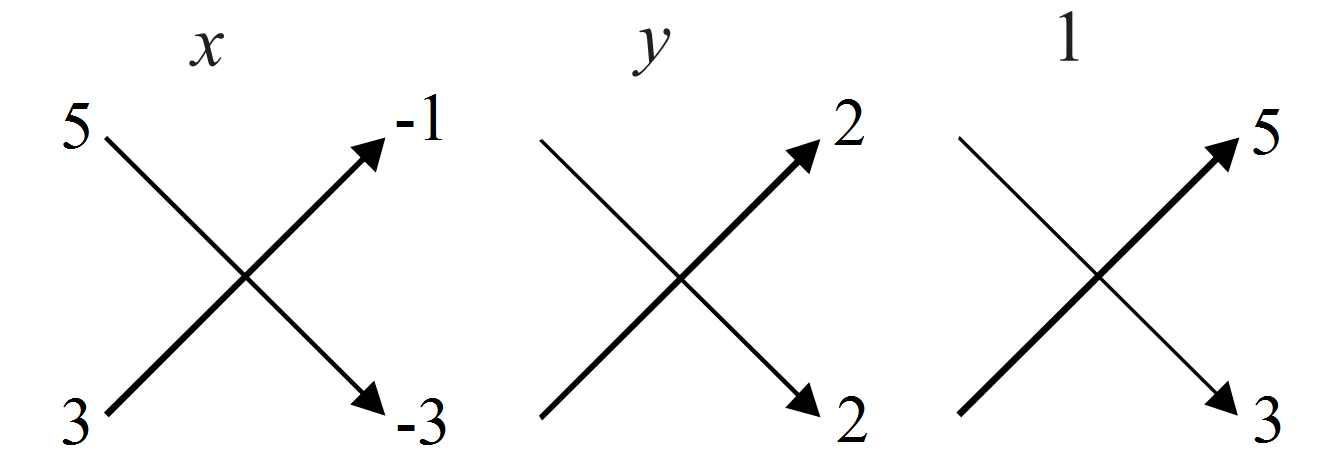
$\therefore\frac{\text{x}}{[5\times(-3)-3\times(-1)]}=\frac{{\text{y}}}{[(-1)\times2-(-3)\times2]}=\frac{1}{[2\times3-2\times5]}$
$\Rightarrow\frac{\text{x}}{(-15+3)}=\frac{\text{y}}{(-2+6)}=\frac{1}{(6-10)}$
$\Rightarrow\frac{\text{x}}{-12}=\frac{\text{y}}{4}=\frac{1}{-4}$
$\Rightarrow\text{x}=\frac{-12}{-4}=3,\ \text{y}=\frac{4}{-4}=-1$
Hence, $x = 3$ and $y = -1$ is the required solution. View full question & answer→Question 234 Marks
A number consists of two digits. When it is divided by the sum of its digits, the quotient is $6$ with no remainder. When the number is diminished by $9$, the digits are reversed. Find the number.
AnswerLet the ten's digit and unit's digit of required number be $x$ and $y$ respectively.
We know,
Dividend = (divisor \times quotient) + remainder
According to the given question:
$10x + y = 6 x (x + y) +0$
$\Rightarrow 10x - 6x + y-by = 0$
$\Rightarrow 4x - 5y = 0 ...(1)$
Number obtained by reversing the digits is $10y + x$
$10x + y - 9 = 10y + x$
$\Rightarrow 9x - 94 = 9$
$\Rightarrow 9(x - y) = 9$
$\Rightarrow (x - y) = 1 ...(2)$
Multiplying $(1)$ by $1$ and $(2)$ by $5,$ we get
$4x - 5y = 0 ...(3)$
$5x - 5y = 5 ...(4)$
Subtracting $(3)$ from $(4),$ we get
$\therefore x = 5$
Putting $x = 5$ in $(1),$ we get
$4 \times 5 - 5y = 0$
$\Rightarrow -5y = -20$
$\Rightarrow\text{y}=\frac{-20}{-5}=4$
$\therefore x = 5$ and $y = 4$
Hence, required number is $54$
View full question & answer→Question 244 Marks
Solve for $x$ and $y$:
$\frac{\text{2x}+\text{5y}}{\text{xy}}=6,$
$\frac{\text{4x}-\text{5y}}{\text{xy}}=-3$
AnswerThe given equations are:
$\frac{\text{2x}+\text{5y}}{\text{xy}}=6$
$\Rightarrow\frac{2}{\text{y}}+\frac{5}{\text{x}}=6\ \dots(\text{i})$
$\frac{\text{4x}-\text{5y}}{\text{xy}}=-3$
$\Rightarrow\frac{4}{\text{y}}-\frac{5}{\text{x}}=-3\ \dots(\text{ii})$
Adding $(i)$ and $(ii),$ we get
$\frac{6}{\text{y}}=3$
$\Rightarrow\text{y}=2$
Substituting $y = 2$ in $(i)$, we get $x = 1$
Hence, $x = 1$ and $y = 2$
View full question & answer→Question 254 Marks
Solve for $x$ and $y$:
$6(ax + by) = 3a + 2b,$
$6(bx - ay) = 3b - 2a$
Answer$6(ax + by) = 3a + 2b$
$6ax + 6bx = 3a + 2b ...(1)$
$6(bx - ay) = 3b - 2a$
$6bx - 6ay = 3b - 2a ...(2)$
$6ax + 6bx = 3a + 2b ...(1)$
$6bx - 6ay = 3b - 2a ...(2)$
Multiplying (1) by by a and (2) by b
$6 a^2 x+6 b^2 x=3 a^2+2 a b \ldots(3)$
$ 6 a^2 x-6 b^2 x=3 b^2-2 a b \ldots(4)$
Adding (3) and (4), we get
$ 6 a^2 x+6 b^2 x=3 a^2+3 b^2 $
$ 6\left(a^2+b^2\right) x=3\left(a^2+b^2\right)$
$\text{x}=\frac{3\big(\text{a}^2+\text{b}^2\big)}{6\big(\text{a}^2+\text{b}^2\big)}=\frac{3}{6}=\frac{1}{2}$
Substituting $\text{x}=\frac{1}{2}$ in (1), we get
$\text{6a}\times\frac{1}{2}+\text{6by}=\text{3a}+\text{2b}$
$\text{3a}+\text{6by}=\text{3a}+\text{2b}$
$\text{6by}=\text{3a}+\text{2b}-\text{3a}$
$\text{6by}=\text{2b}$
$\text{y}=\frac{\text{2b}}{\text{6b}}=\frac{1}{3}$
Hence, the solution is $\text{x}=\frac{1}{2},\ \text{y}=\frac{1}{3}$
View full question & answer→Question 264 Marks
Solve for $x$ and $y$:
$\frac{5}{\text{x}}+\text{6y}=13,$
$\frac{3}{\text{x}}+\text{4y}=7\ (\text{x}\neq0).$
AnswerPutting $\frac{1}{\text{x}}=\text{u}$ the given equations become
$5u + 6y = 13 ...(1)$
$3u + 4y = 7 ...(2)$
Multiplying $(1)$ by $4$ and $(2)$ by $6$, we get
$20u + 24y = 52 ...(3)$
$18u + 24y = 42 ...(4)$
Subtracting $(4)$ from $(3),$ we get
$2u = 10$
$\Rightarrow x = 5$
Substituting $u = 5$ in $(1),$ we get
$5 \times 5 + 6y = 13$
$\Rightarrow 6y = 13 - 25$
$\Rightarrow 6y = -12$
$\Rightarrow y = -2$
$u = 5$
$\Rightarrow\frac{1}{\text{x}}=5$
$\Rightarrow\text{5x}=1$
$\Rightarrow\text{x}=\frac{1}{5}$
$\therefore$ The solution is $\text{x}=\frac{1}{5}$ and $y = -2$
View full question & answer→Question 274 Marks
The sum of the digits of a two-digit number is $15$. The number obtained by interchanging the digits exceeds the given number by $9$. Find the number.
AnswerLet the ten's digit and unit's digits of required number be $x$ and $y$ respectively.
$x + y = 15 ...(1)$
Required number $= 10x + y$
Number obtained by interchanging the digits $= 10y + x$
$\therefore 10y + x - (10x + y) = 9$
$10y + x - 10x - y = 9$
$9y - 9x = 9$
$9(y - x) = 9$
$\Rightarrow\text{y}-\text{x}=\frac{9}{9}$
$\Rightarrow y - x = 1$
$-x + y = 1 ...(2)$
Add $(1)$ and $(2),$ we get
$\text{2y}=16$
$\Rightarrow\text{y}=\frac{16}{2}=8$
Putting $y = 8$ in $(1),$ we get
$x + 8 = 15$
$x = 15 - 8 = 7$
Required number $= 10x + y$
$= 10 x 7 + 8$
$= 70 + 8$
$= 78$
Hence the required number is $78.$
View full question & answer→Question 284 Marks
Solve for $x$ and $y$:
$\frac{\text{bx}}{\text{a}}+\frac{\text{ay}}{\text{b}}=\text{a}^2+\text{b}^2,$
$\text{x}+\text{y}=\text{2ab}$
Answer$\frac{\text{bx}}{\text{a}}-\frac{\text{ax}}{\text{b}}+\text{a}^2+\text{b}^2$
By taking $L.C.M$., we get
$\frac{\text{b}^2\text{x}+\text{a}^2\text{y}}{\text{ab}}=\text{a}^2+\text{b}^2$
$b^2x + a^2y = ab(a^2 + b^2) ...(1)$
$x + y = 2ab ...(2)$
Multiplying $(1)$ by $1$ and $(2)$ by $a^2$
$b^2x + a^2y = a^3b + ab^3 ...(3)$
$a^2x + a^2y = 2a^3b ...(4)$
Subtracting $(4)$ from $(3)$, we get
$b^2x - a^2x = a^3b + ab^3 - 2a^3b$
$x(b^2 - a^2) = ab^3 - a^3b$
$x(b^2 - a^2) = ab(b^2 - a^2)$
$\therefore\ \text{x}=\frac{\text{ab}(\text{b}^2-\text{a}^2)}{(\text{b}^2-\text{a}^2)}=\text{ab}$
Substituting $x = ab$, in $(3)$, we get
$b^2(ab) + a^2y = a^3b + ab^3$
$b^3a + a^2y = a^3b + ab^3$
$a^2y = a^3b + ab^3 - b^3a$
$a^2y = a^3b$
$\Rightarrow\text{y}=\frac{\text{a}^3\text{b}}{\text{a}^3}=\text{ab}$
$\therefore$ solution is $x = ab, y = ab$
View full question & answer→Question 294 Marks
Solve for $x$ and $y$:
$\frac{\text{x}}{\text{a}}+\frac{\text{y}}{\text{b}}=\frac{\text{a}+\text{b}}{\text{b}}$
$\frac{\text{x}}{\text{a}^2}+\frac{\text{y}}{\text{b}^2}=2$
Answer$\frac{\text{x}}{\text{a}}+\frac{\text{y}}{\text{b}}=\frac{\text{a}+\text{b}}{\text{b}}\dots(\text{i})$
$\frac{\text{x}}{\text{a}^2}+\frac{\text{y}}{\text{b}^2}=2\ \dots(\text{ii})$
Multiplying $(i)$ by $b$ and $(ii)$ by $b^2$ and subtract, we get
$\Rightarrow\frac{\text{bx}}{\text{a}}-\frac{\text{b}^2\text{x}}{\text{a}^2}=\text{ab}+\text{b}^2-\text{2b}^2$
$\Rightarrow\text{x}=\frac{\big(\text{a}\text{b}-\text{b}^2\big)\text{a}^2}{\big(\text{ab}-\text{b}^2\big)}$
$\Rightarrow\text{x}=\text{a}^2$
Substituting $x = a^2$ in $(i)$, we get
$\text{a}+\frac{\text{y}}{\text{b}}=\frac{\text{a}+\text{b}}{\text{b}}$
$\Rightarrow\frac{\text{y}}{\text{b}}=\frac{\text{a}+\text{b}}{\text{b}}-\text{a}$
$\Rightarrow\text{y}=\text{b}^2$
So, $x = a^2$ and $y = b^2$
View full question & answer→Question 304 Marks
A two-digit number is such that the product of its digit is $18.$ When $63$ is subtracted from the number, the digits interchange their places. Find the number.
AnswerLet the ten's and unit's digits of the required number be $x$ and $y$ respectively.
Then, $xy = 18$
Required number $= 10x + y$
Number obtained on reversing its digits $= 10y + x$
$\therefore (10x + y) - 63 = (10y + x)$
$\Rightarrow 9x - 9y = 63$
$\Rightarrow x - y = 7 ...(1)$
Now,
$\Rightarrow (x + y)^2- (x - y)^2= 4xy$
$\Rightarrow(\text{x}+\text{y})=\sqrt{(\text{x}-\text{y})^2+\text{4xy}}$
$\Rightarrow\text{x}+\text{y}=\sqrt{(7)^2+4\times18}$
$=\sqrt{49+72}$
$=\sqrt{121}$
$x + y = 11 ...(2)$
Adding $(1)$ and $(2)$, we get
$\text{2x}=18$
$\Rightarrow\text{x}=\frac{18}{2}=9$
Putting $x = 9$ in $(1)$, we get
$9 - y = 7$
$\Rightarrow y = 9 - 7$
$\Rightarrow y = 2$
$\therefore x = 9, y = 2$
Hence, the required number $= 9 \times 10 + 2$
$= 92.$
View full question & answer→Question 314 Marks
Solve for $x$ and $y$:
$\frac{3}{\text{x}+\text{y}}+\frac{2}{\text{x}-\text{y}}=2,$
$\frac{9}{\text{x}+\text{y}}-\frac{4}{\text{x}-\text{y}}=1$
AnswerPutting $\frac{1}{\text{x}+\text{y}}=\text{u}$ and $\frac{1}{\text{x}-\text{y}}=\text{v}$
$3u + 2v = 2 ...(1)$
$9u - 4v = 1 ...(2)$
Multiply $(1)$ by $2$ and $(2)$ by $1$, we get
$6u + 4v = 4 ...(3)$
$9u - 4v = 1 ...(4)$
Adding $(3)$ and $(4)$, we get
$\text{15u}=5,$
$\text{u}=\frac{5}{15}=\frac{1}{3}$
Putting $\text{u}=\frac{1}{3}$ in $(i),$ we get
$3\times\frac{1}{3}+\text{2v}=2$
$\Rightarrow1+\text{2v}=2$
$\Rightarrow\text{2v}=1$
$\text{v}=\frac{1}{2}$
Now, $\text{u}=\frac{1}{3}$
$\Rightarrow\frac{1}{\text{x}+\text{y}}=\frac{1}{3}$
$\Rightarrow\text{x}+\text{y}=3\ \dots(5)$
and $\text{v}=\frac{1}{2}$
$\Rightarrow\frac{1}{\text{x}-\text{y}}=\frac{1}{2}$
$\Rightarrow\text{x}-\text{y}=2\ \dots(6)$
Adding $(5)$ and $(6)$, we get
$\text{2x}=5$
$\Rightarrow\text{x}= \frac{5}{2}$
Putting $\text{x}=\frac{5}{2}$ in $(5)$, we get
$\frac{5}{2}+\text{y}=3$
$\Rightarrow\text{y}=3-\frac{5}{2}=\frac{6-5}{2}=\frac{1}{2}$
$\therefore$ the solution is $\text{x}=\frac{5}{2}$ and $\text{y}=\frac{1}2{}$
View full question & answer→Question 324 Marks
Solve for $x$ and $y$:
$a^2 x+b^2 y=c^2,$
$ b^2 x+a^2 y=d^2$
Answer$a^2 x+b^2 y=c^2,...(i)$
$b^2 x+a^2 y=d^2 ...(ii)$
Multiplying $(i)$ by $a^2$ and $(ii)$ by $b^2$ and subtracting, we get
$\Rightarrow\text{a}^4\text{x} - \text{b}^4\text{x} = \text{a}^2\text{b}^2 - \text{b}^2\text{d}^2$
$\Rightarrow\text{x}=\frac{\text{a}^2\text{c}^2-\text{b}^2\text{d}^2}{\text{a}^4-\text{b}^4}$
Multiplying $(i)$ by $b^2$ and $(ii)$ by $a^2$ and subtracting, we get
$\Rightarrow\text{b}^4\text{y} - \text{a}^4\text{y} = \text{b}^2\text{c}^2 - \text{a}^2\text{d}^2$
$\Rightarrow\text{y}=\frac{\text{b}^2\text{c}^2-\text{a}^2\text{d}^2}{\text{b}^4-\text{a}^4}$
So, $\text{x}=\frac{\text{a}^2\text{c}^2-\text{b}^2\text{d}^2}{\text{a}^4-\text{b}^4}$ and $\text{y}=\frac{\text{b}^2\text{c}^2-\text{a}^2\text{d}^2}{\text{b}^4-\text{a}^4}$
View full question & answer→Question 334 Marks
Solve for $x$ and $y$:
$x + y = a + b,$
$a x-b y=a^2-b^2$
Answer$x + y = a + b ...(i)$
$a x-b y=a^2-b^2...(ii)$
Multiplying $(i)$ by b adding it to $(ii)$, we get
$\Rightarrow bx + ax = ab + b^2 + a^2 - b^2$
$\Rightarrow x(a + b) = a(a + b)$
$\Rightarrow x = a$
Substitute $x = a$ in $(i)$, we get $y = b.$
So, $x = a$ and $y = b.$
View full question & answer→Question 344 Marks
A lending library has a fixed charge for the first three days and an additional charge for each day thereafter. Mona paid $₹ 27$ for a book kept for $7$ days, while Tanvy paid $₹ 21$ for the book she kept for $5$ days. Find the fixed charge and the charge for each extra day.
AnswerLet the fixed charge be $₹ x$ and the extra charge per day be $₹ y.$
Given that,
Mona paid $₹ 27$ for a book kept for $7$ days,
$\Rightarrow x + 4y = 27 ...(i)$
Given that,
Tanvy paid $₹ 21$ for a book kept for $5$ days,
$\Rightarrow x + 2y = 21 ...(ii)$
Subtracting $(ii)$ from $(i)$, we get
$\Rightarrow 2y = 6$
$\Rightarrow y = 3$
Substituting $y = 3$ in $(ii),$ we get
$\Rightarrow x = 15.$
Hence, the fixed charge is $₹ 15$ and the charge per day is ₹ $3.$
View full question & answer→Question 354 Marks
The larger of the two supplementary angles exceeds the smaller by $18^\circ $. Find them.
AnswerLet the two supplementary angles be $x$ and $y$
where $x$ is the larger angle.
Accroding to the given condition,
$x = y + 18^\circ $
$\Rightarrow x - y = 18^\circ ...(i)$
Since the angles are supplementary,
$\Rightarrow x + y = 180^\circ ...(ii)$
Adding $(i)$ and $(ii)$, we get
$\Rightarrow 2x = 198$
$\Rightarrow x = 99$
Substituting $x = 99$ in $(i),$ we get
$\Rightarrow y = 81$.
Hence, the angles are $99^\circ $ and $81^\circ $
View full question & answer→Question 364 Marks
Solve the following system of equations graphically:
$2x - 3y + 13 = 0,$
$3x - 2y + 12 = 0$
Answer$\text{2x}-\text{3y}+13=0$
$\Rightarrow\text{y}=\frac{13+\text{2x}}{3}$
|
$x:$
|
$1$
|
$4$
|
|
$y:$
|
$5$
|
$7$
|
$\text{3x}-\text{2y}+12=0$
$\Rightarrow\text{y}=\frac{\text{12}+\text{3x}}{2}$
|
$x:$
|
$0$
|
$-4$
|
|
$y:$
|
$6$
|
$0$
|
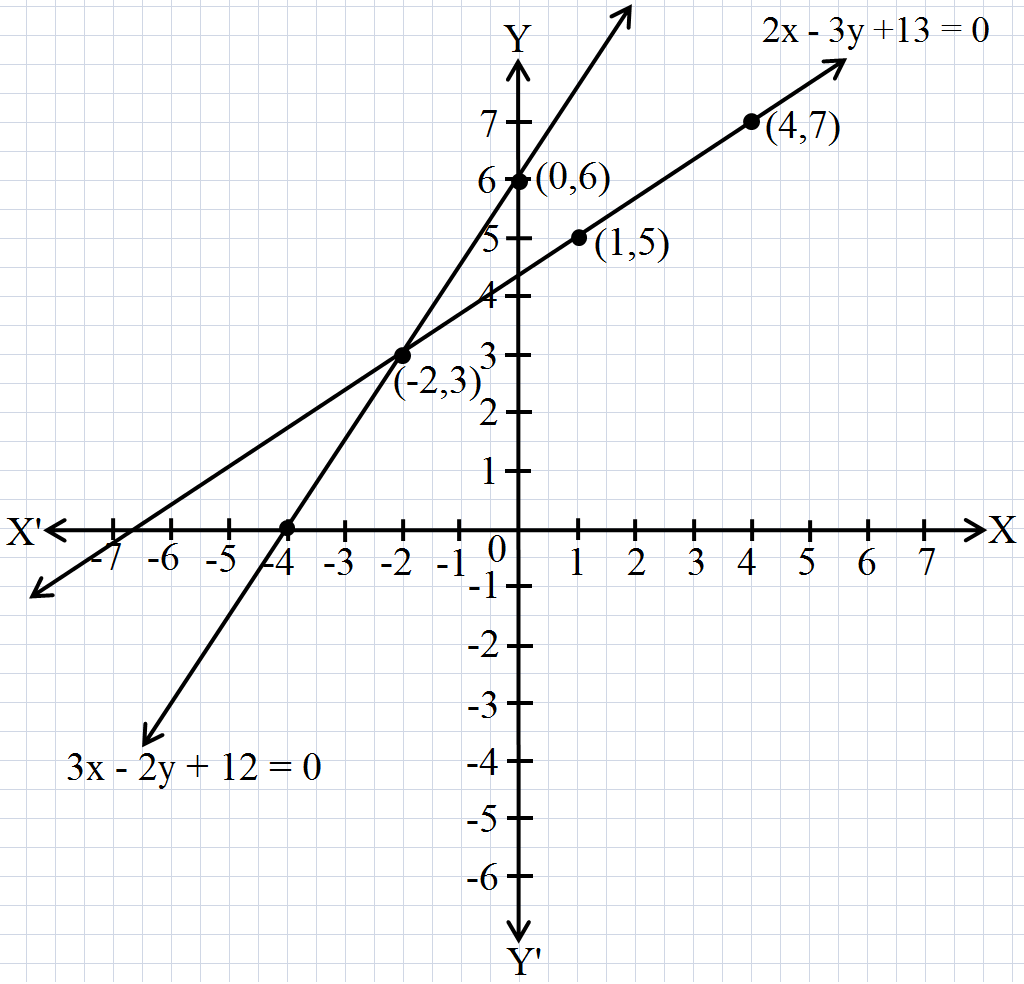
Since the two graph intersect at $(-2, 3),$
$x = -2$ and $y = 3$ View full question & answer→Question 374 Marks
A man sold a chair and a table together for $₹1520$, thereby making a profit of $25\%$ on chair and $10\%$ on table. By selling them together for $₹1535$, he would would have made a profit of $10\%$ on the chair and $25\%$ on the table. Find the cost of each.
AnswerLet the $CP$ of the chair and the table be Rs. $x$ and Rs. $y$ respectively.
Then, selling price of the chair + selling price of the table $= 1520$
$\Rightarrow\frac{100+25}{100}\text{x}+\frac{100+10}{100}\text{y}=1520$
$\Rightarrow\frac{125}{100}\text{x}+\frac{110}{100}\text{y}=1520$
$\Rightarrow\text{25x}+\text{22y}=30400\ \dots(\text{i})$
Given that by selling them together for Rs. $1535$, he would have made a profit of $10\%$ on the chair and $25\%$ on the table.
$\Rightarrow\frac{100+10}{100}\text{x}+\frac{100+25}{100}\text{y}=1535$
$\Rightarrow\frac{110}{100}\text{x}+\frac{125}{100}\text{y}=1535$
$\Rightarrow\text{22x}+\text{25y}=30700\ \dots(\text{ii})$
Adding $(i)$ and $(ii)$, we get
$47x + 47y = 61100$
$\Rightarrow x + y = 1300 ...(iii)$
Subtracting $(ii)$ from $(i)$, we get
$3x - 3y = -300$
$x - y = -100 ...(iv)$
Adding $(iii)$ and $(iv)$, we get
$\Rightarrow 2x = 1200$
$\Rightarrow x = 600$
Substituting $x = 600$ in $(iii)$, we get $y = 700$
Hence, cost of the chair is $Rs. 600$ and cost of the table is $Rs. 700$
View full question & answer→Question 384 Marks
Show graphically that each of the following given systems of equations is inconsistent, i.e., has no solutions:
$2x + 3y = 4, 4x + 6y = 12$
Answer$2\text{x}+\text{3y}=4$
$\Rightarrow\text{y}=\frac{-2\text{x}+\text{4}}{3}$
| $x:$ |
$2$ |
$-1$ |
| $y:$ |
$0$ |
$2$ |
$\text{4x}+\text{6y}=12$
$\Rightarrow\text{y}=\frac{-4\text{x}+12}{6}$
| $x:$ |
$3$ |
$0$ |
| $y:$ |
$0$ |
$2$ |
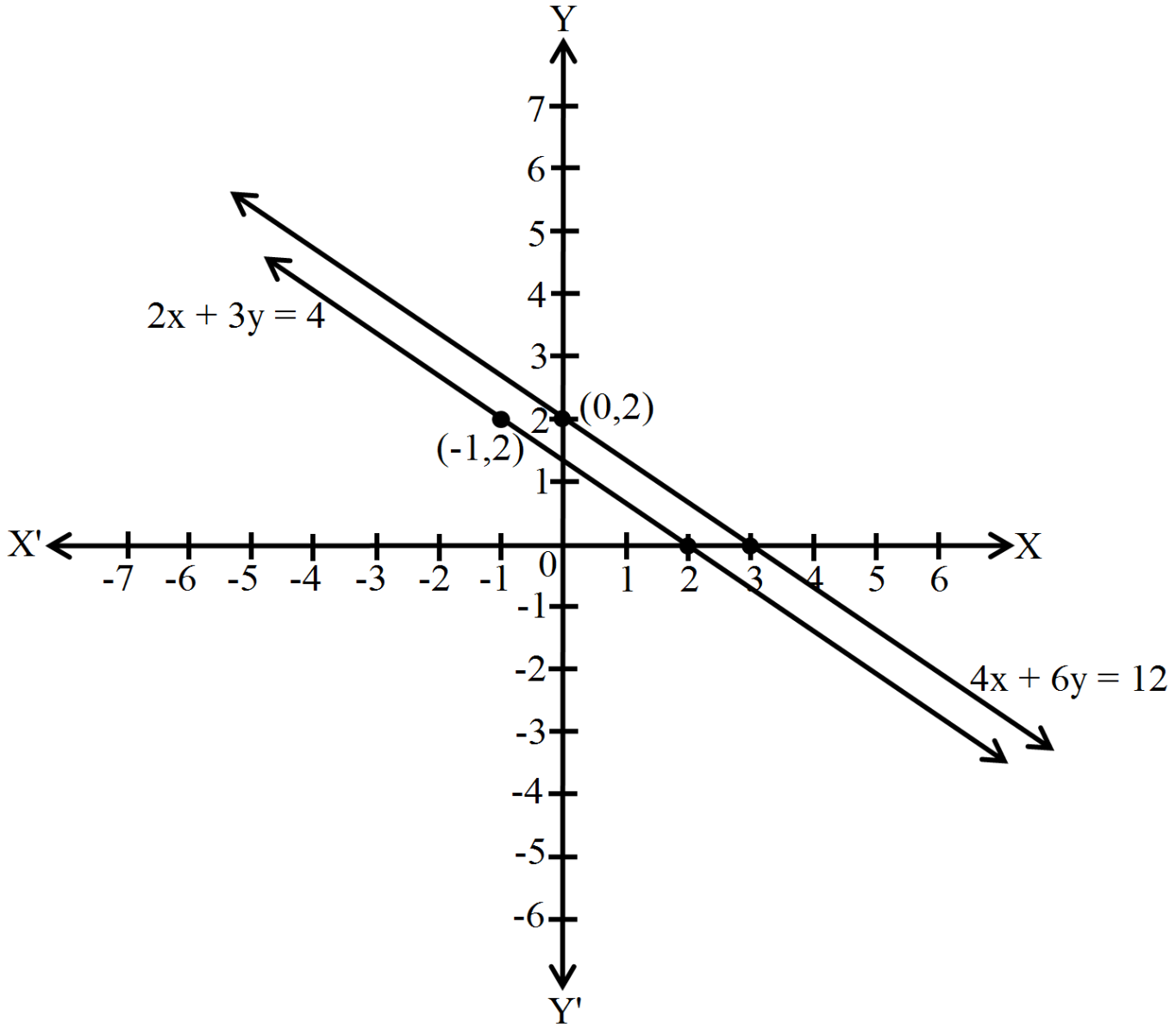
Since the two graph of the system of equations is parallel lines, the system has no solution and hence is inconsistent. View full question & answer→Question 394 Marks
A train covered a certain distance at a uniform speed. If the train had been $5$ kmph faster, it would have taken $3$ hours less than the scheduled time. And, If the train were slower by $4$ kmph, it would have taken $3$ hours more than the scheduled time. Find the length of the journey.
AnswerLet the original speed be $x \ km/h$ and time taken be $y$ hours
Then, length of journey $= xy \ km$
Case I:
Speed $= (x + 5)\ km/h$ and time taken $= (y - 3)$ hour
Distance covered $= (x + 5)(y - 3)km$
$\therefore (x + 5)(y - 3) = xy$
$\Rightarrow xy + 5y - 3x - 15 = xy$
$\Rightarrow 5y - 3x = 15 ...(1)$
Case II:
Speed $(x - 4)km/hr$ and time taken $= (y + 3)$ hours
Distance covered $= (x - 4)(y + 3)km$
$\therefore (x - 4)(y + 3) = xy$
$\Rightarrow xy - 4y + 3x - 12 = xy$
$\Rightarrow 3x - 4y = 12 ...(2)$
Multiplying $(1)$ by $4$ and $(2)$ by $5$, we get
$20y - 12x = 60 ...(3)$
$-20y + 15x = 60 ...(4)$
Adding $(3)$ and $(4)$, we get
$3x = 120$
$or x = 40$
Putting $x = 40$ in $(1)$, we get
$5y - 3 \times 40 = 15$
$\Rightarrow 5y = 135$
$\Rightarrow y = 27$
Hence, length of the journey is $(40 \times 27)\ km = 1080\ km.$
View full question & answer→Question 404 Marks
Solve the following system of equations graphically:
$3x + y + 1 = 0,$
$2x - 3y + 8 = 0$
AnswerOn a graph paper, draw a horizontal line $X^{\prime} O X$ and a vertical line $YOY$' representing the $x$-axis and $y$-axis, respectively. Given equations are $3 x+y+1=0$
and $2 x-3 y+8=0$
Graph of $3 x+y+1=0$ :
$3 x+y+1=0$
$\Rightarrow y=-3 x-1 \ldots(1)$
Thus, we have the following table for $3 x+y+1=0$
|
$x:$
|
$0$ |
$-1$
|
$1$
|
|
$y:$
|
$-1$
|
$2$
|
$-4$
|
On the graph paper plot the points $A (0,-1), B (-1,2)$ and $C (1,-4)$. Join $A B$ and $A C$ to get the graph line $B C$.
Thus, the line $B C$ is the graph of the equation of $3 x+y+1=0$.
Graph of $2 x-3 y+8=0$ :
For graph of $2 x-3 y+8=0$
$\Rightarrow y=\frac{2 x+8}{3} \ldots(2)$
Thus, we have the following table for equation $(2)$
|
$x:$
|
$-1$
|
$2$
|
$-4$
|
|
$y:$
|
$2$
|
$4$
|
$0$
|
Now, on the same graph paper plot the points $P(2,4)$ and $Q(-4,0)$. The point $B(-1,2)$ has already been plotted.
Join $PB$ and $B Q$ to get the line $PQ.$
Thus, line $PQ$ is the graph of the equation $2 x-3 y+8=0$.
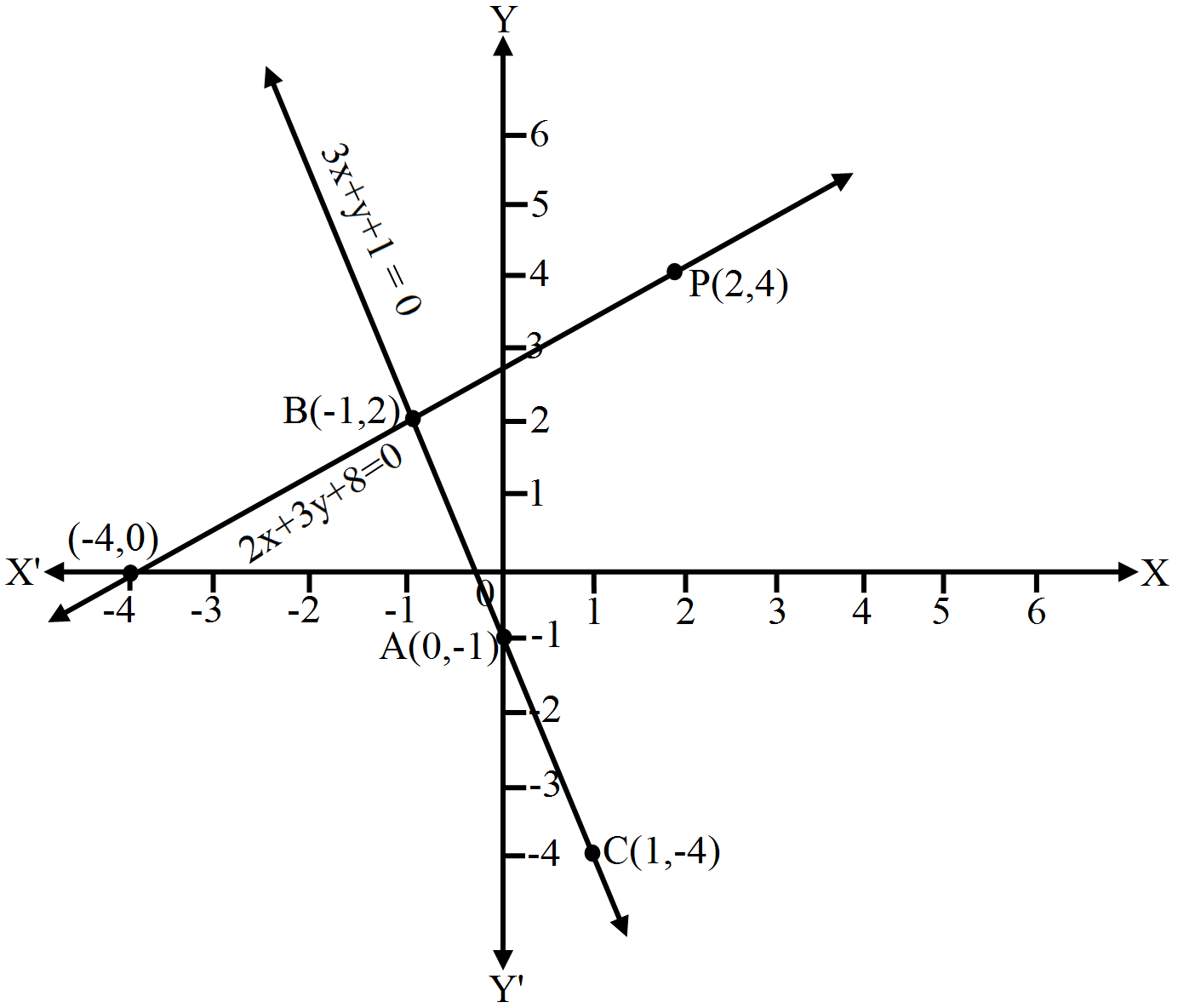
The two graph lines intersect at $B(-1, 2).$
$\therefore x = -1, y = 2$ is the solution of the given system of equations. View full question & answer→Question 414 Marks
Solve each of the following given systems of equations graphically and find the vertices and area of the triangle formed by these lines and the y-axis:
$4x - y - 4 = 0, 3x + 2y - 14 = 0$
Answer$4\text{x}-\text{y}-4 = 0$
$\Rightarrow\text{y}=\text{4x}-4$
| $x:$ |
$1$ |
$2$ |
| $y:$ |
$0$ |
$4$ |
$3\text{x} + 2\text{y} -14 = 0$
$\Rightarrow\text{y}=\frac{14-\text{3x}}{2}$
| $x:$ |
$0$ |
$4$ |
| $y:$ |
$7$ |
$1$ |
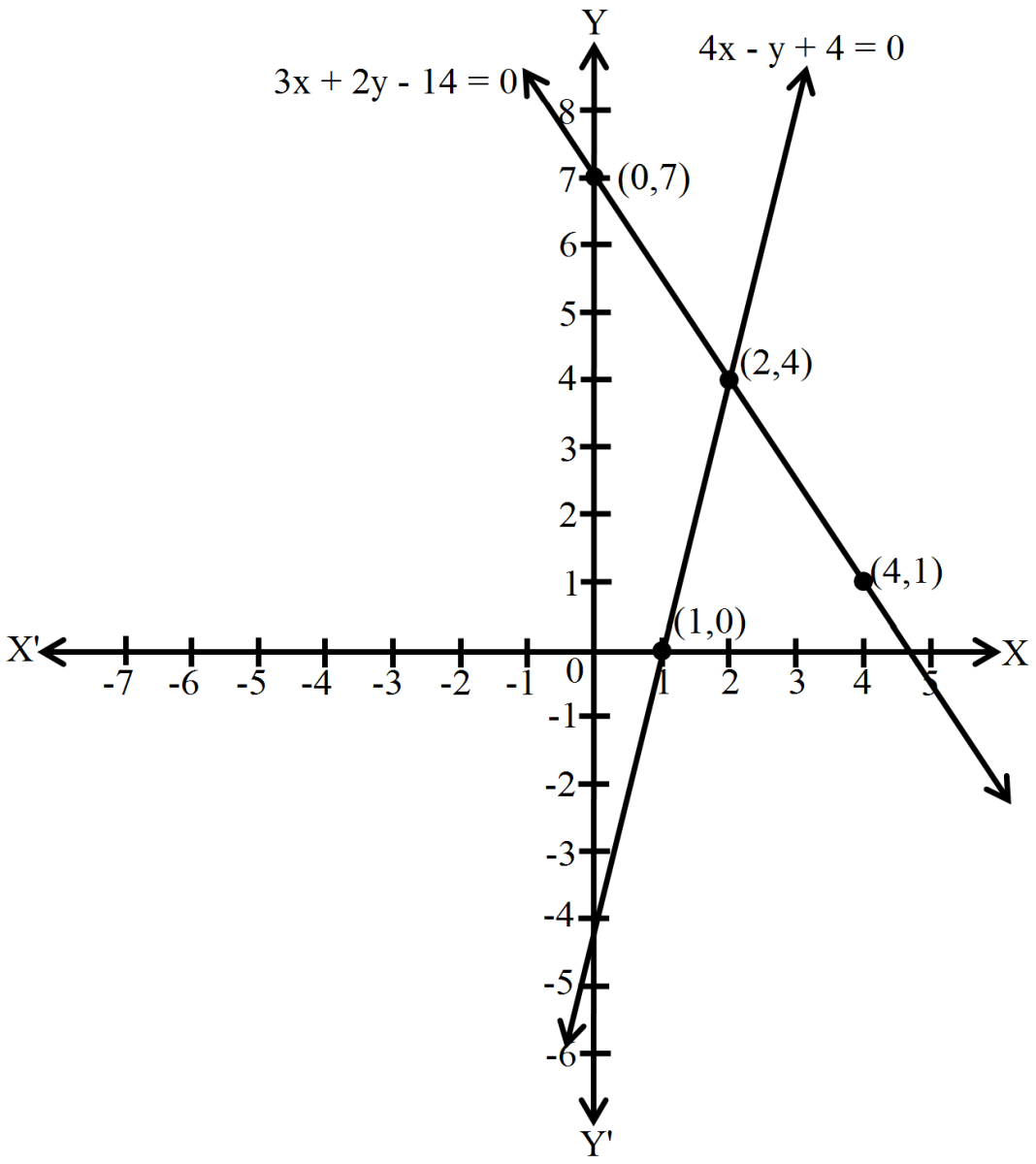
Since the two graph intersect at $(2,4)$,
$x=2 \text { and } y=4$
The vertices of the triangle formed by these lines and the $y$-axis are $(2,4),(0,7)$ and $(0,-4)$.
So, height of the triangle $=$ distance from $(2,4)$ to $y$-axis
$=2$ units
Base $=11$ units
Area of triangle $=\frac{1}{2} \times$ base $\times$ height
$=\frac{1}{2}\times11\times2$
$=11\ \text{sq. units}$ View full question & answer→Question 424 Marks
Solve for $x$ and $y$:
$4x + 6y = 3xy,$
$8x + 9y = 5xy$
$(\text{x}\neq0,\ \text{y}\neq0).$
Answer$\text{4x}+\text{6y}=\text{3xy}$
$\Rightarrow\frac{\text{4x}+\text{6y}}{\text{xy}}=3$
$\frac{4}{\text{y}}+\frac{6}{\text{x}}=3\ \dots(1)$
$\Rightarrow\frac{\text{8x}+\text{9y}}{\text{xy}}=5$
$\frac{8}{\text{y}}+\frac{9}{\text{x}}=4\ \dots(2)$
Putting $\frac{1}{\text{x}}=\text{u}$ and $\frac{1}{\text{y}}=\text{v}$ in $(1)$ and $(2)$, we get
$4v + 6u = 3 ...(3)$
$8v + 9u = 5 ...(4)$
Multiplying $(3)$ by $9$ and $(4)$ by $6$, we get
$36v + 54u = 27 ...(5)$
$48v + 54u = 30 ...(6)$
Subtracting $(3)$ from $(4)$, we get
$\text{12v}=3$
$ \text{v}=\frac{3}{12}=\frac{1}{4}$
Putting $\text{v}=\frac{1}{4}$ in $(3)$, we get
$4\times\frac{1}{4}+\text{6u}=3$
$1+\text{6u}=3 $
$\text{6u}=3-1=2$
$\text{u}=\frac{2}{6}=\frac{1}{3}$
Now, $\text{u}=\frac{1}{\text{x}}$
$\Rightarrow\frac{1}{\text{x}}=\frac{1}{3}$
$\Rightarrow\text{x}=3$
and $\text{v}=\frac{1}{\text{y}}$
$\Rightarrow\frac{1}{\text{y}}=\frac{1}{4}$
$\Rightarrow\text{y}=4$
$\therefore$ the solution is $x = 3, y = 4$
View full question & answer→Question 434 Marks
Solve each of the following given systems of equations graphically and find the vertices and area of the triangle formed by these lines and the y-axis:
$5x - y - 7 = 0, x - y + 1 = 0$
Answer$5x - y - 7 = 0$
$⇒ y = 5x - 7$
| $x:$ |
$2$ |
$1$ |
| $y:$ |
$3$ |
$-2$ |
$x - y + 1 = 0$
$⇒ y = x + 1$
| $x:$ |
$0$ |
$1$ |
| $y:$ |
$1$ |
$2$ |
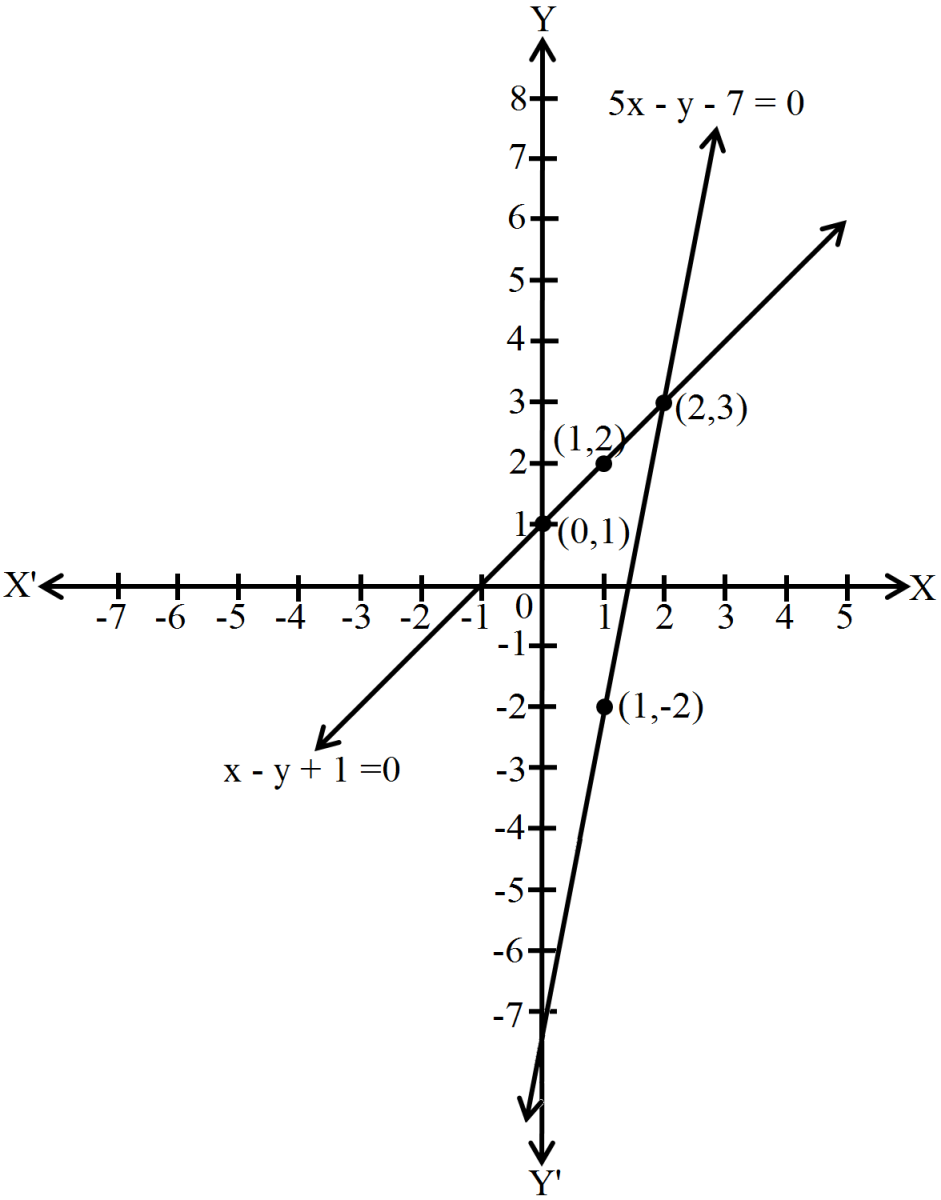
Since the two graph intersect at $(2,3)$,
$x=2 \text { and } y=3$
The vertices of the triangle formed by these lines and the $y$-axis are $(2,3),(0,1)$ and $(0,-7)$.
So, height of the triangle $=$ distance from $(2,3)$ to $y$-axis
$=2$ units
Base $=8$ units
Area of triangle $=\frac{1}{2} \times$ base $\times$ height
$=\frac{1}{2}\times8\times2$
$=8\ \text{sq. units}$ View full question & answer→Question 444 Marks
$2$ men and $5$ boys can finish a piece of work in $4$ days, while $3$ men and $6$ boys can finish it in $3$ days. Find the time taken by one man alone to finish the work and that taken by one boy alone to finish the work.
AnswerLet man's $1$ day's work be $\frac{1}{\text{x}}$ and $1$ boy's day's work be $\frac{1}{\text{y}}$
Also let $\frac{1}{\text{x}}=\text{u}$ and $\frac{1}{\text{y}}=\text{v}$
Then, $\frac{2}{\text{x}}+\frac{5}{\text{y}}=\frac{1}{4}$
$\Rightarrow\text{2u}+\text{5v}=\frac{1}{4}\ \dots(1)$
and $\frac{3}{\text{x}}+\frac{6}{\text{y}}=\frac{1}{3}$
$\Rightarrow\text{3u}+\text{6v}=\frac{1}{3}\ \dots(2)$
Multiplying $(1)$ by $6$ and $(2)$ by $5$, we get
$12\text{u}+\text{30v}=\frac{6}{4}\ \dots(3)$
$15\text{u}+\text{30v}=\frac{5}{3}\ \dots(4)$
Subtracting $(3)$ from $(4)$, we get
$\text{3u}=\frac{5}{3}-\frac{6}{4}$
$\Rightarrow\text{3u}=\frac{20-18}{12}$
$\Rightarrow\text{3u}=\frac{2}{12}$
$\Rightarrow\text{3u}=\frac{1}{6}$
$\Rightarrow\text{u}=\frac{1}{18}$
Putting $\text{u}=\frac{1}{18}$ in $(1)$, we get
$2\times\frac{1}{18}+\text{5v}=\frac{1}{4}$
$\Rightarrow\frac{1}{9}+\text{5v}=\frac{1}{4}$
$\Rightarrow\text{5v}=\frac{1}{4}-\frac{1}{9}$
$\Rightarrow\text{5v}=\frac{5}{36}$
$\Rightarrow\text{v}=\frac{1}{36}$
Now, $\text{u}=\frac{1}{18}$
$\Rightarrow\text{x}=\frac{1}{\text{u}}=18$
and $\text{v}=\frac{1}{36}$
$\Rightarrow\text{y}=\frac{1}{\text{v}}=36$
$\therefore$ $x = 18, y = 36$
The man will finish the work in $18$ days and the boy will finish the work in $36$ days when they work alone.
View full question & answer→Question 454 Marks
Solve each of the following given systems of equations graphically and find the vertices and area of the triangle formed by these lines and the x-axis:
$x - y + 1 = 0, 3x + 2y - 12 = 0$
AnswerOn a graph paper, draw a horizontal line $X^{\prime} O X$ and a vertical line $Y O Y^{\prime}$ representing the $x$-axis and $y$-axis, respectively. The given system equations is $x-y+1=0,3 x+2 y-12=0$
Graph of $x-y+1=0$ :
$x - y + 1 = 0$
$y = x + 1 ...(1)$
Thus, we have the following table for equation $(1)$
|
$x:$
|
$-1$ |
$1$
|
$2$
|
|
$y:$
|
$0$
|
$2$
|
$3$
|
On the graph paper plot the points $A(-1,0), B(1,2)$ and $C(2,3)$.
Join $A B$ and $B C$ to get the graph line $A C$.
Thus, the line $A C$ is the graph of the equation of $x-y+1=0$.
Graph of $3 x+2 y-12=0$ :
For graph of $3 x+2 y-12=0$
$\Rightarrow\text{y}=\frac{-\text{3x}+12}{2}\ \dots(2)$
Thus, we have the following table for equation $(2)$
|
$x:$
|
$0$
|
$2$
|
$4$
|
|
$y:$
|
$6$
|
$3$
|
$0$
|
Now, on the same graph paper plot the points $P(0,6)$ and $Q(4,0)$.
The third point $C(2,3)$ has already been plotted.
Join PC and $C Q$ to get the line $PQ.$
Thus, line $PQ$ is the graph of the equation $3 x+2 y-12=0$.
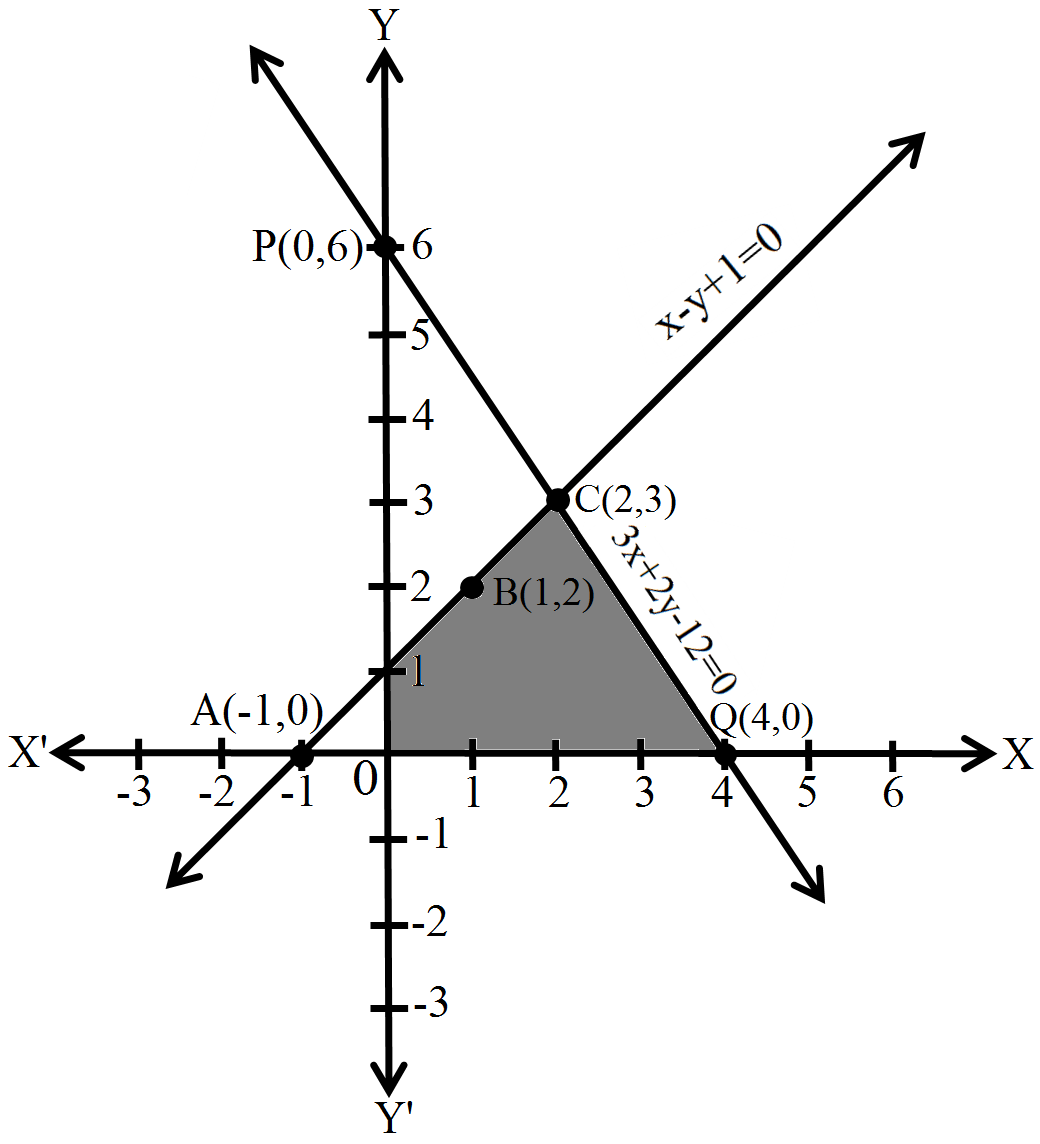
The two graph lines intersect at $C(2, 3).$
$\therefore x = 2, y = 3$ is the solution of the given system of equations.
Clearly, the vertices of $\triangle\text{ACQ}$ formed by these lines and the x-axis are $A(-1, 0), C(2, 3)$ and $Q(4, 0)$
Consider the triangle $\triangle\text{ACQ}:$
Height of the triangle $= 3$ units and base $(AQ) = 5$ units
Area of triangle $\triangle\text{ACQ}:$
Area of $\triangle\text{ACQ}=\Big(\frac{1}{2}\times\text{Base}\times\text{height}\Big)$
$=\Big(\frac{1}{2}\times3\times5\Big)\text{sq. units}$
Area of $\triangle\text{ACQ}=7.5\text{sq. }\text{units}$ View full question & answer→Question 464 Marks
The sum of the digits of a two-digit number is $12$. The number obtained by interchanging its digits exceeds the given number by $18$. Find the number.
AnswerLet the ten's digit be $x$ and units digit be $y$ respectively.
Then,
$x + y = 12 ...(1)$
$\therefore$ Required number $= 10x + y$
$\therefore$ Number obtained on reversing digits $= 10y + x$
According to the question:
$10y + x - (10x + y) = 18$
$10y + x - 10x - y = 18$
$9y - 9x = 18$
$y - x = 2 ...(2)$
Adding $(1)$ and $(2)$, we get
$2y = 14$
$\text{y}=\frac{14}{2}$
$y = 7$
Putting $y = 7$ in $(1)$, we get
$\Rightarrow x + 7 = 12$
$\Rightarrow x = 5$
$\therefore$ Number $= 10x + y$
$= 10 \times 5 + 7$
$= 50 + 7$
$= 57$
Hence, the number is $57.$
View full question & answer→Question 474 Marks
Solve for $x$ and $y$
$23x - 29y = 98,$
$29x - 23y = 110$
AnswerThe given equations are:
$23x - 29y = 98 ...(i)$
$29x - 23y = 110 ...(ii)$
Adding $(i)$ and $(ii)$, we get
$52x + 52y = 208$
$\Rightarrow x + y = 4 ...(iii)$
Subtract $(i)$ from $(ii)$, we get
$6x - 6y = 12$
$\Rightarrow x - y = 2 ...(iv)$
Adding $(iii)$ and $(iv)$, we get
$2x = 6$
$\Rightarrow x = 3$
Substituting $x = 3$ in $(iii)$, we get $y = 1$
Hence, $x = 3$ and $y = 1$
View full question & answer→Question 484 Marks
Show graphically that each of the following given systems of equations is inconsistent, i.e., has no solutions:
$2x + y = 6, 6x + 3y = 20$
Answer$2\text{x}+\text{y}=6$
$\Rightarrow\text{y}=6-\text{2x}$
| $x:$ |
$2$ |
$4$ |
| $y:$ |
$2$ |
$-2$ |
$\text{6x}+\text{3y}=20$
$\Rightarrow\text{y}=\frac{20-\text{6x}}{3}$
| $x$: |
$0$ |
$\frac{10}{3}$ |
| $y:$ |
$\frac{20}{3}$ |
$0$ |
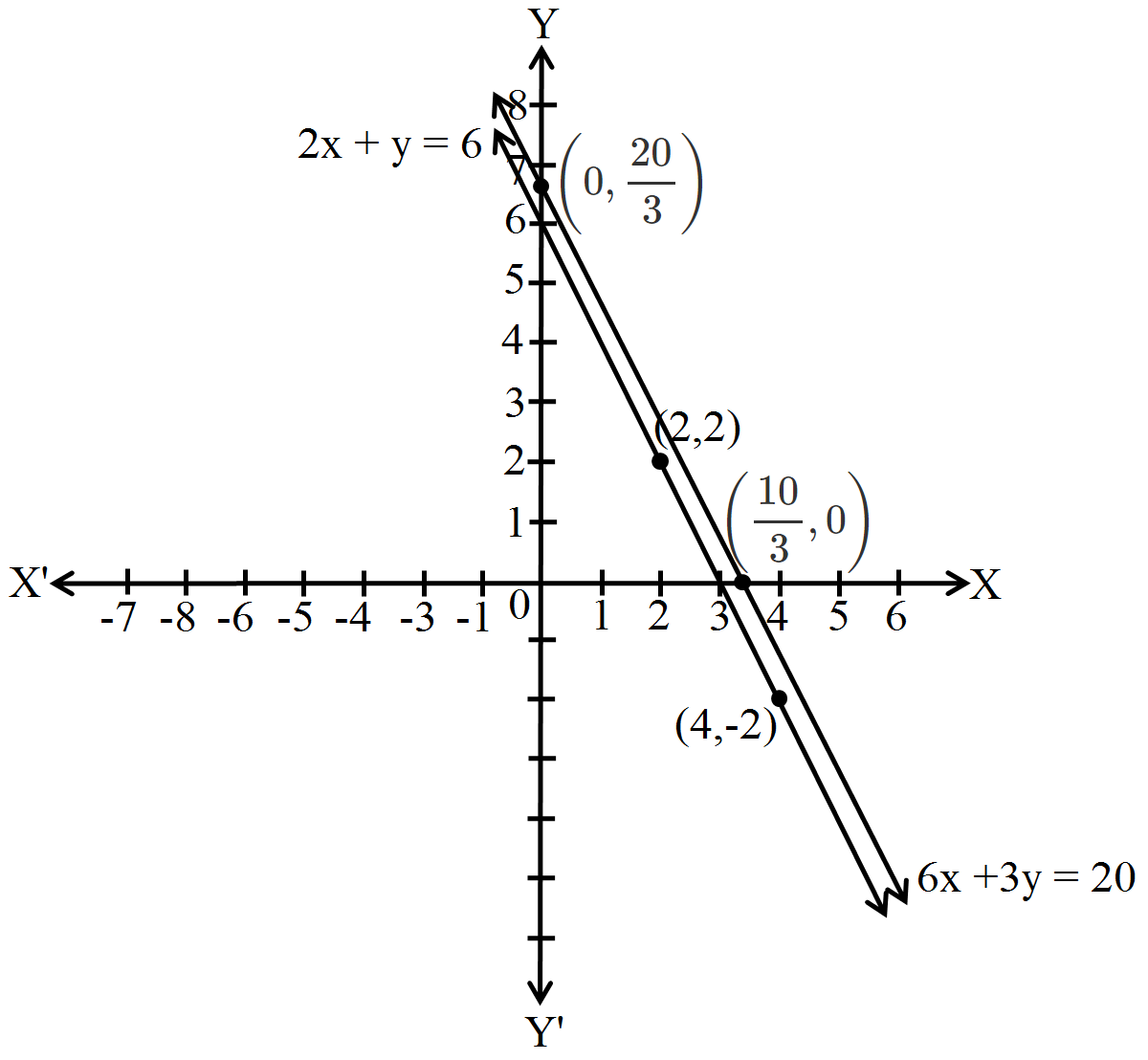
Since the two graph of the system of equations is parallel lines, the system has no solution and hence is inconsistent. View full question & answer→Question 494 Marks
Solve each of the following given systems of equations graphically and find the vertices and area of the triangle formed by these lines and the x-axis:
$2x - 3y + 4 = 0, x + 2y - 5 = 0$
Answer$2\text{x}-3\text{y}+ 4 = 0$
$\Rightarrow\text{y}=\frac{\text{2x}+4}{3}$
| $x:$ |
$-2$ |
$1$ |
| $y:$ |
$0$ |
$2$ |
$\text{x} + 2\text{y} - 5 = 0$
$\Rightarrow\text{y}=\frac{4-\text{2x}}{3}$
| $x:$ |
$1$ |
$5$ |
| $y:$ |
$2$ |
$0$ |
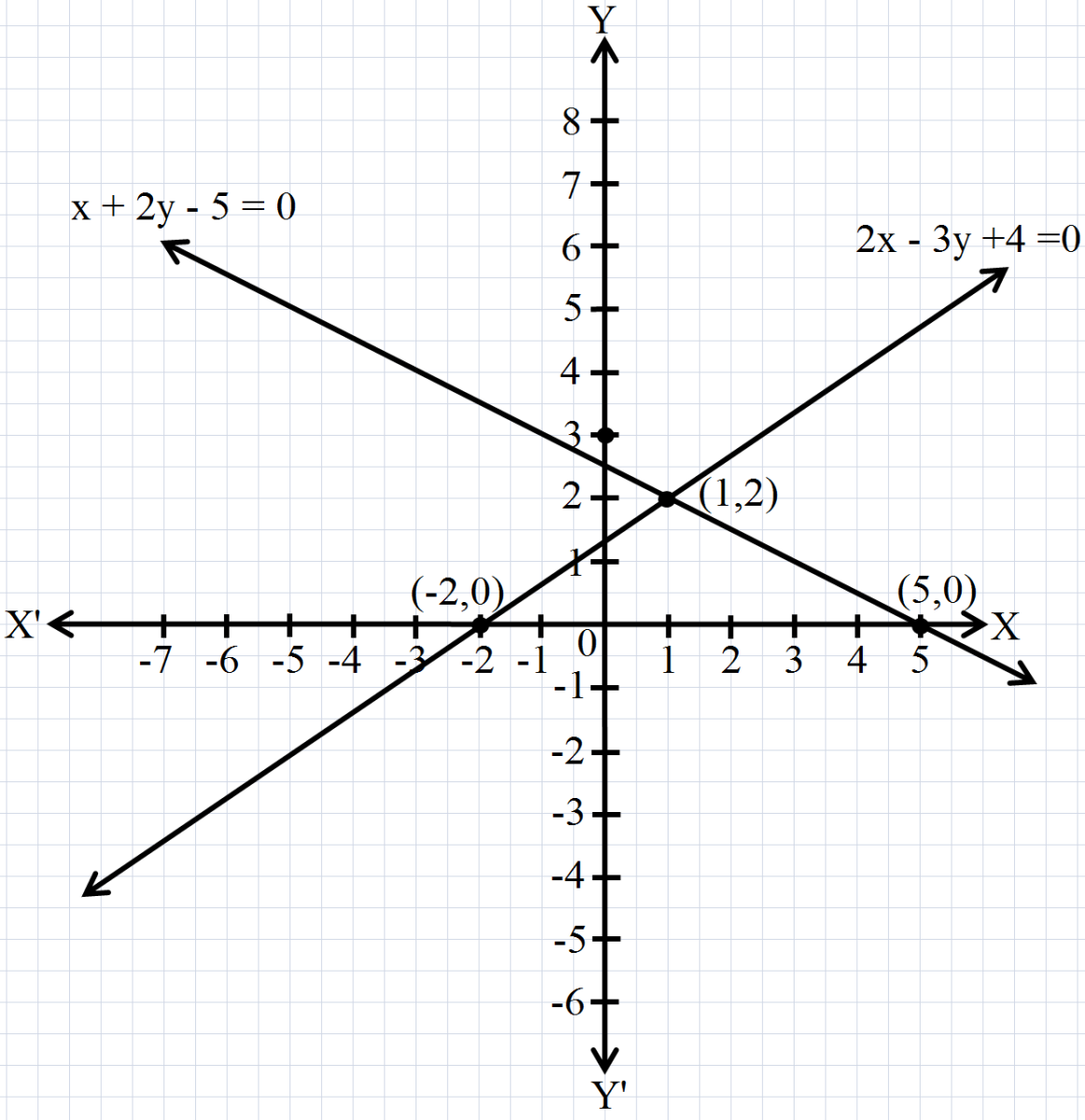
Since the two graph intersect at $(1,2)$,
$x=1 \text { and } y=2$
The vertices of the triangle formed by these lines and the $x$-axis are $(-2,0),(1,2)$ and $(5,0)$.
So, height of the triangle $=$ distance from $(1,2)$ to $x$-axis
$=2$ units
Base $=7$ units
Area of triangle $=\frac{1}{2}\times$ base $\times $ height
$=\frac{1}{2}\times7\times2$
$=7\ \text{sq. units}$ View full question & answer→Question 504 Marks
The sum of two numbers is $137$ and their difference is $43$. Find the numbers.
AnswerLet the two numbers be $x$ and $y$ respectively.
Given:
$x + y = 137 ...(i)$
$x - y = 43 ...(ii)$
Adding $(i)$ and $(ii)$, we get
$2x = 180$
$\text{x}=\frac{180}{2}=90$
Putting $x = 90$ in $(i)$, we get
$90 + y = 137$
$y = 137 - 90$
$y = 47$
Hence, the two numbers are $90$ and $47.$
View full question & answer→