Question
Solve the following systems of inequations graphically: $\text{x}+2\text{y}\leq40,3\text{x}+\text{y}\geq30,4\text{x}+3\text{y}\geq60,\text{x}\geq0,\text{y}\geq0$
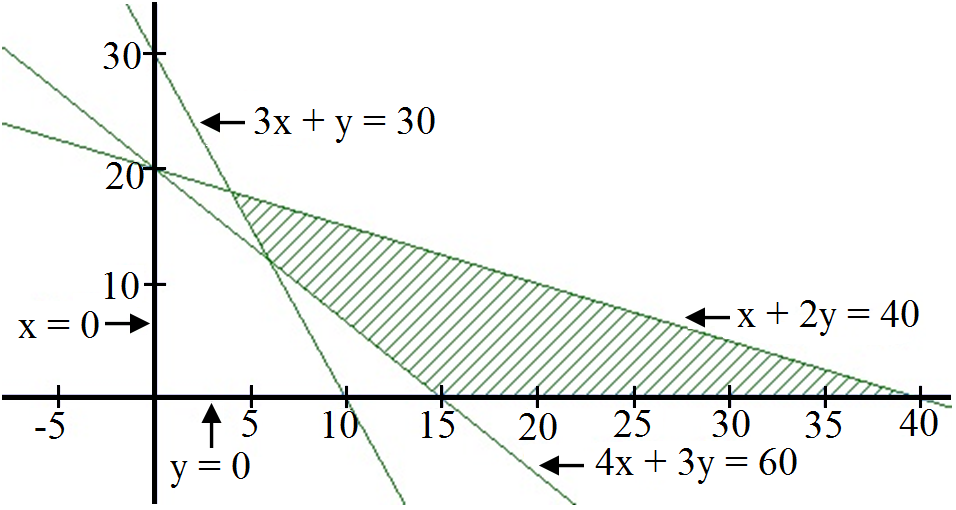
Answer


We have,
$\text{x}+2\text{y}\leq40,3\text{x}+\text{y}\geq30,4\text{x}+3\text{y}\geq60,\text{x}\geq0,\text{y}\geq0$
Converting the inequations into equations, we obtain,
x + 2y = 40, 3x + y = 30, 4x + 3y = 60, x = 0 and y = 0
Region represented by $\text{x} + 2\text{y} \leq 40:$
Putting x = 0 in x +2y = 40, we get $\text{y}=\frac{40}{2}=20$
Putting y - 0 in x + 2y = 40, we get x = 40
$\therefore$ The line x + 2y = 40, meets the coordinate axes at (0, 20) and (40, 0). Join these points by a thick line.
Now, putting x = 0 and y = 0 in $\text{x} + 2\text{y} \leq 40$ we get $0\leq40$
Therefore, (0, 0) satisfies the inequality $\text{x} + 2\text{y} \leq 40$ so, the portion containing the origin represents the solution set of the inequation $\text{x} + 2\text{y} \leq 40$
Region represented by $3\text{x} + \text{y} \geq 30$
Putting x = 0 in $3\text{x} + \text{y} \leq 30$ we get y = 30
Putting y = 0 in 3x + y = 30, we get, $\text{x}=\frac{30}{3}=10$
$\therefore$ The line 3x + y = 30 meets the coordinate axes at (0, 30) and (10, 0). Joining these points by a thick line.
Now, putting x = 0 and y = 0 in $3\text{x}+\text{y}\geq30$ we get, $0\geq30$ This is not possible.
Therefore (0, 0) does not satisfies the inequality $3\text{x} +\text {y} \geq 30.$ so, the portion not containing the origin is represented by the inequation $3\text{x} +\text {y} \geq 30.$
Region represented by 4x + 3y > 60:
Putting x = 0 in 4x + 3y = 60, we get, $\text{y}=\frac{60}{3}=20$
Putting y = 0 in 4x + 3y = 60, we get, $\text{x}=\frac{60}{4}=15.$
$\therefore$ The line 4x + 3y = 60 meets the coordinate axes at (0, 20) and (15, 0). Join these points by a thick line.
Now, putting x = 0, y = 0 in $4\text{x} + 3\text{y} \geq260,$ we get $0\geq60.$
This is not possible. Therefore, (0, 0) does not satisfies the inequality $4\text{x}+3\text{y}\geq60$ so, the portion not containing the origin is represented by the inequation $4\text{x}+3\text{y}\geq60$

Need a full question paper?

Generate a complete, print-ready paper with questions like this in minutes — across 16+ boards, with answer keys.

Start Generating Free

Similar questions

$\text{a}\sin\frac{\text{A}}{2}\sin\Big(\frac{\text{B}-\text{C}}{2}\Big)+\text{b}\sin\frac{\text{B}}{2}\sin\Big(\frac{\text{C}-\text{A}}{2}\Big)+\text{c}\sin\frac{\text{C}}{2}\sin\Big(\frac{\text{A}-\text{B}}{2}\Big)=0.$
If in a $\triangle\text{ABC},\cos^2\text{A}+\cos^2\text{B}+\cos^2\text{C}=1,$ prove that the triangle is right angled.
If X lies in the first quadrant and $\cos\text{x}=\frac{8}{17},$ then prove that $\cos\Big(\frac{\pi}{6}+\text{x}\Big) +\cos\Big(\frac{\pi}{4}-\text{x}\Big)+\cos\Big(\frac{2\pi}{3}-\text{x}\Big)=\Big(\frac{\sqrt{3}-1}{2}+\frac{1}{\sqrt{2}}\Big)\frac{23}{17}$
Find the equation to the ellipse in the following case:Foci $(\pm3, 0), a = 4$
In a survey it was found that 21 persons liked product P1, 26 liked product P2 and 29 liked product P3. If 14 persons liked products P1 and P2; 12 persons liked product P3 and P1; 14 persons liked products P2 and P3 and 8 liked all the three products. Find how many liked product P3 only.
$\text{If}\ \cos(\text{A+B})\sin(\text{C}-\text{D})=\cos(\text{A}-\text{B})\sin(\text{C+D}),$ prove that $\tan\text{A}\tan\text{B}\tan\text{C}+\tan\text{D}=0$
For the parabola $y^2 = 4px$ find the extremitiJs of a double ordinate of length $8p$. Prove that the lines from the vertex to its extremities are at right angles.
Find the equation of the hyperbola whoseFoci are (6, 4) and (-4, 4) and eccentricity is 2.
The line 2x + 3y = 12 meets the x-axis at A and y-axis at B. The line through (5, 5) perpendicular to AB meets the x-axis and the line AB at C and E respectively. If O is the origin of coordinates, find the area of figure OCEB.
Prove the following identities: $\Big(\frac{1}{\sec^2\text{x}-\cos^\text{x}}+\frac{1}{\text{Cosec}^2\text{x}-\sin^2\text{x}}\Big)\sin^2\text{x}\cos^2\text{x}=\frac{1-\sin^2\text{x}\cos^2\text{x}}{2+\sin^2\text{x}\cos^2\text{x}}$