Question
Solve the following systems of linear inequations graphically: $\text{x}+\text{y}\geq1,7\text{x}+9\text{y}\leq63,\text{x}\leq6,\text{y}\leq5,\text{x}\geq0,\text{y}\geq0$
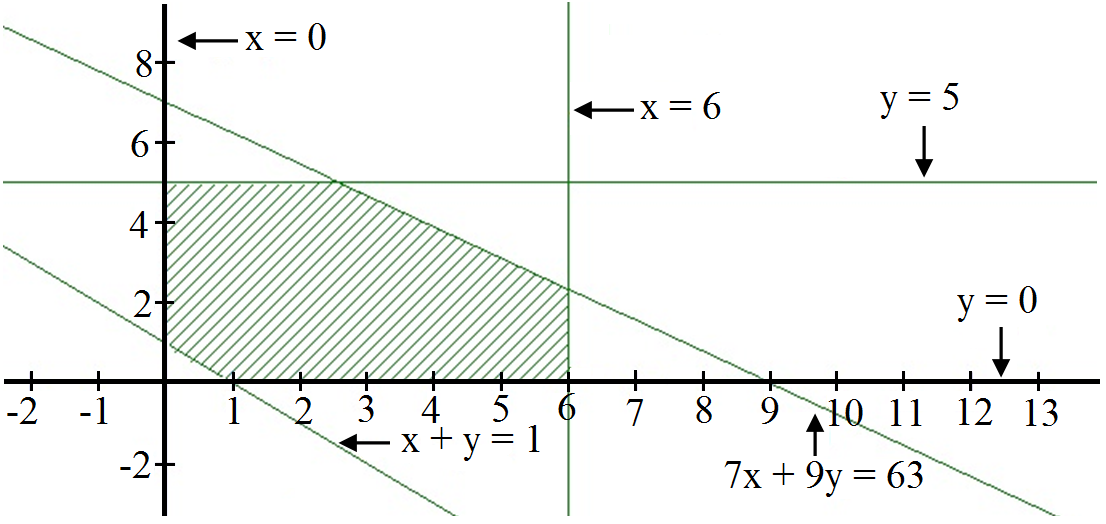
Answer


We have,
$\text{x}+\text{y}\geq1,7\text{x}+9\text{y}\leq63,\text{x}\leq6,\\\text{y}\leq5\text{x}\geq0\ \text{and }\text{y}\geq0$
Converting the inequations into equations, we obtain
x + y = 1, 7x + 9y = 63, x = 6, y = 5, x = 0 and y = 0.
Region represented by x + y > 1:
Putting x = 0 in x + y = 1, we get y = 1
Putting y = 0 in x + y = 1, we get x = 1
$\therefore$ The line x + y = 1 meets the coordinate axes at (0, 1) and (1, 0) join these point by a thick line.
Now, putting X = 0 and y = 0 in x + y > 1, we get $0\geq1$
This is not possible
$\therefore$ (0, 0) is not satisfies the inequality x + y > 1. So, the portion not containing the origin is represented by the inequation $\text{x}+\text{y}\geq1.$
Region represented by 7x + 9y = 63
Putting x = 0 in 7x +9y = 63, we get, $\text{y}=\frac{63}{9}=7.$
Putting y = 0 in 7x + 9y = 63 we get, $\text{y}=\frac{63}{7}=9.$
$\therefore$ The line 7x + 9y = 63 meets the coordinete axes of (0, 7) and (9, 0). Join these points by a thick line.
Now, putting x = 0 and y = 0 in $7\text{x}+9\text{y}\leq63,$ we get, $0\leq63$
$\therefore$ we find (0, 0) satisfies the inequality $7\text{x}+9\text{y}\leq63,$ So, the portion containing the origin represents the solution set of the inequation $7\text{x}+9\text{y}\leq63,$
Region represented by $\text{x}\leq6$: Clearly, x = 6 is a line parallel to y-axis at a distance of 6 units from the origin. Since (0, 0) satisfies the inequation X $ 6. so, the portion lying on the left side of x = 6 is the region represented by $\text{x}\leq6$
Region represented by $\text{y}\leq5$ Clearly, y = 5 is a line parallel to x-axis at a distance 5 from it. since (0, 0) satisfies by the given inequation.
Region represented by $\text{x}\geq0$ and $\text{y}\geq0$: cearly, $\text{x}\geq0$ and $\text{x}\geq0$ represent the first quadrant.
The common region of the above six regions represents the solution set of the given inequation as shown below.

Need a full question paper?

Generate a complete, print-ready paper with questions like this in minutes — across 16+ boards, with answer keys.

Start Generating Free