Question
Solve the linear programming problem and determine the maximum profit to the manufacturer.
Answer

We have Maximise Z = 100x + 170y Subject to
$3\text{x}+2\text{y}\leq3600,\text{x}+4\text{y}\leq1800,\text{x}\geq0,\text{y}\geq0$
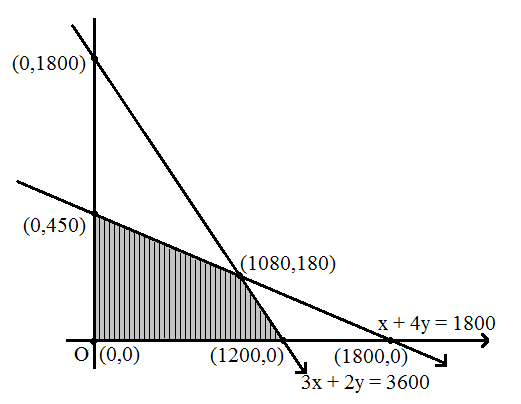
From the shaded feasible region it is clear that the coordinates of corner points are (0, 0), (1200, 0), (1080, 180) and (0, 450).
On solving x + 4y = 1800 and 3x + 2y = 3600, we get x = 1080 and y = 180.
Corner points
Corresponding value of Z = 100x + 170y
(0, 0)
(1200, 0)
(1080, 180)
(0, 450)
0
1200 ×100 = 12000
100 × 1080 + 170 × 180 = 138600 (maximum)
0 + 170 × 450 = 76500
 Hence, the maximum profit to the manufacture is 138600.

Need a full question paper?

Generate a complete, print-ready paper with questions like this in minutes — across 16+ boards, with answer keys.

Start Generating Free

Similar questions

Using differentials, find the approximate values of the following:
$\frac{1}{(2.002)^2}$
Differentiate the following functions from first principles:
$\text{e}^{\sqrt{2\text{x}}}$
Solve the following initial value problems:
$\text{x}\frac{\text{dy}}{\text{dx}}+\text{y}=\text{x}\cos\text{x}+\sin\text{x},\text{ y}\Big(\frac{\pi}{2}\Big)=1$
Differentiate the following functions with respect to x:
$\log\Big(\frac{\sin\text{x}}{1+\cos\text{x}}\Big)$
Find the area of a parallelogram ABCD whose side AB and the diagonal DB are given by the vectors $5\hat{\text{i}} + 7\hat{\text{k}}\ \text{and}\ 2\hat{\text{i}}+2\hat{\text{j}}+3\hat{\text{k}}$ respectively.
Solve the following differential equations $\frac{\text{dy}}{\text{dx}}=\frac{2\text{x}(\log\text{x}+1)}{\sin\text{y+y}\cos\text{y}},$ given that $\text{y}=0,$ when $\text{x}=1.$
An automobile manufacturer makes automobiles and trucks in a factory that is divided into two shops. Shop A, which performs the basic assembly operation, must work 5 man-days on each truck but only 2 man-days on each automobile. Shop B, which performs finishing operations, must work 3 man-days for each automobile or truck that it produces. Because of men and machine limitations, shop A has 180 man-days per week available while shop B has 135 man-days per week. If the manufacturer makes a profit of Rs 30000 on each truck and Rs 2000 on each automobile, how many of each should he produce to maximize his profit? Formulate this as a LPP.
Evaluate the following:
$\int\frac{\text{x}}{\sqrt{\text{x}}+1}\text{dx}$
Hint: Put $\sqrt{\text{x}}=\text{z}$
Solve the following systems of linear equations by cramer's rule:
3x + y = 19,
3x - y = 23
Evaluate the following integrals:$\int\frac{\text{x}^2\tan^{-1}\text{x}}{1+\text{x}^2}\text{dx}$