Question
Solve the previous problem if the coefficient of restitution is e. Use $\theta=45^\circ,\ \text{e}=\frac{3}{4}$ and h = 5m

Answer

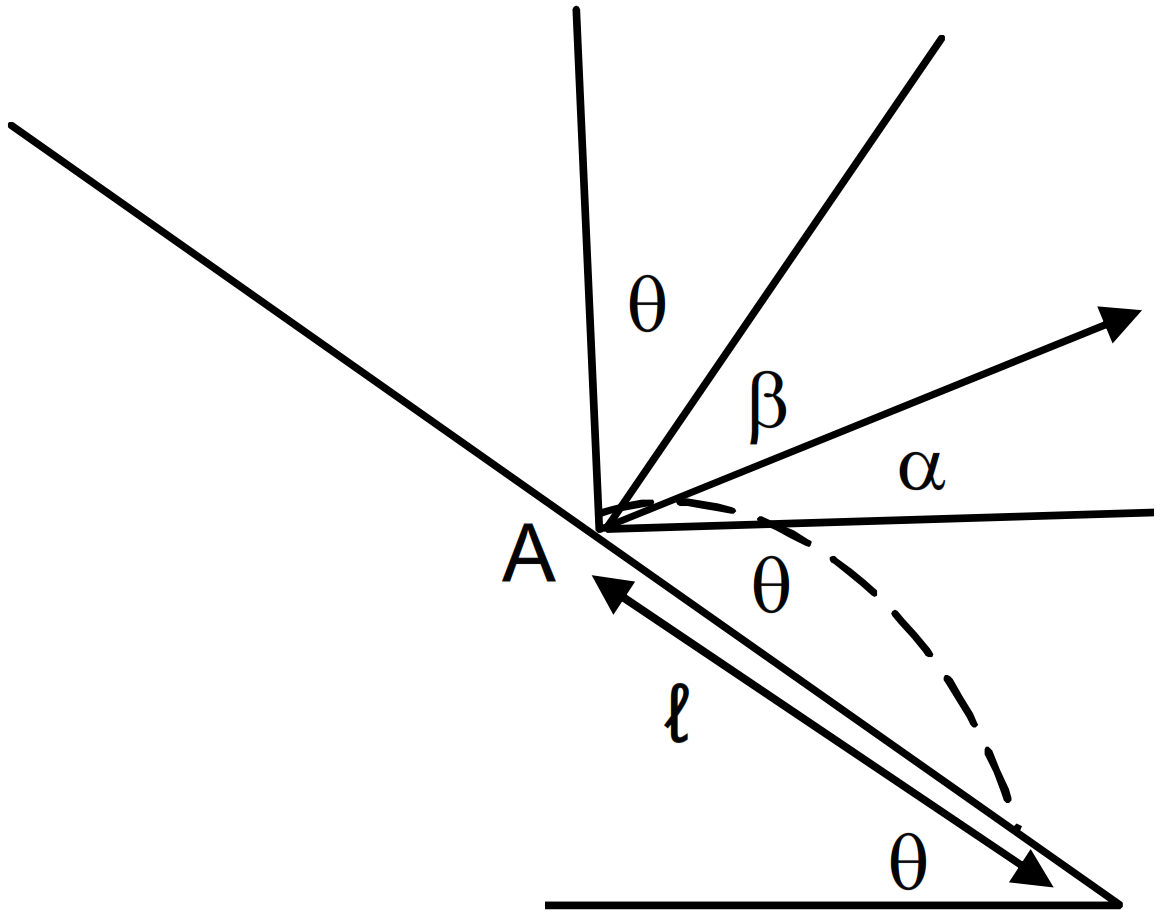
$\text{h}=5\text{m},\ \theta=45^\circ,\ \text{e}=\Big(\frac{3}4{}\Big)$Here the velocity with which it would strike $=\text{v}=\sqrt{\text{2g}\times5}=10\text{m/sec}$
After collision, let it make an angle $\beta$ with horizontal. The horizontal component of velocity $10\cos45^\circ$ will remain unchanged and the velocity in the perpendicular direction to the plane after wllisine.

$\Rightarrow\text{V}_{\text{y}}=\text{e}\times10\sin45^\circ$
$=\Big(\frac{3}{4}\Big)\times10\times\frac{1}{\sqrt2}=(3.75)\sqrt2\text{m/sec}$
$\Rightarrow\text{V}_{\text{x}}=10\cos45^\circ=5\sqrt2\text{m/sec}$
So, $\text{u}=\sqrt{\text{V}_{\text{x}}^2+\text{V}_{\text{y}}^2}$
$=\sqrt{50+28.125}=\sqrt{78.125}=8.83\text{m/sec}$
Angle of reflection from the wall $\beta=\tan^{-1}\Big(\frac{3.75\sqrt2}{5\sqrt2}\Big)=\tan^{-1}\Big(\frac{3}{4}\Big)=37^\circ$
⇒ Angle of projection $\alpha=90-(\theta+\beta)=90-(45^\circ+37^\circ)=8^\circ$
Let the distance where it falls = L
$\Rightarrow\text{x}=\text{L}\cos\theta,\ \text{y}=-\text{L}\sin\theta$
Angle of projection $(\alpha)=-8^\circ$
Using equation of trajectory, $\text{y}=\text{x}\tan\alpha-\frac{\text{gx}^2\sec^2\alpha}{2\text{u}^2}$
$\Rightarrow-\ell\sin\theta=\ell\cos\theta-\tan8^\circ-\frac{\text{g}}{2}\times\frac{\ell\cos^2\theta\sec^28^\circ}{\text{u}^2}$
$\Rightarrow-\sin45^\circ=\cos45^\circ-\tan8^\circ-\frac{10\cos^245^\circ\sec8^\circ}{(8.83)^2}(\ell)$
Solving the above equation we get,
$\ell=18.5\text{m}$

Need a full question paper?

Generate a complete, print-ready paper with questions like this in minutes — across 16+ boards, with answer keys.
Start Generating Free

Similar questions

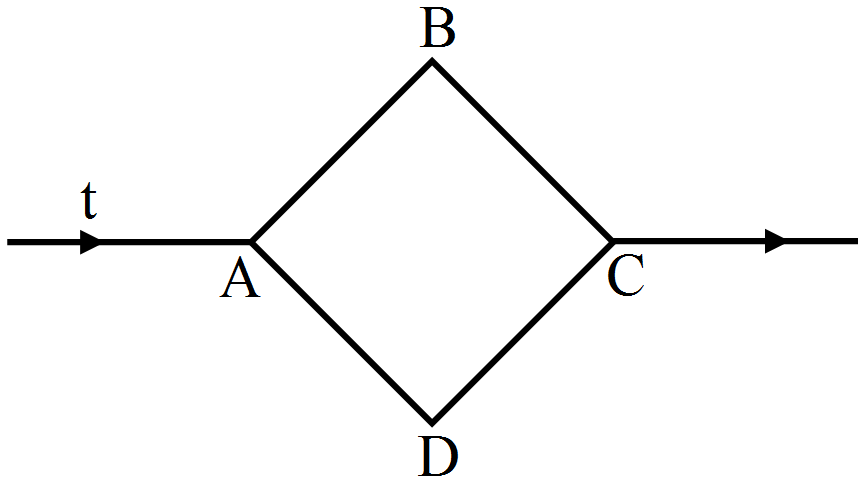
Figure shows a square loop ABCD with edgelength a. The resistance of the wire ABC is r and that of ADC is 2r. Find the magnetic field B at the centre of the loop assuming uniform wires.
A capacitor of capacitance C is given a charge Q. At t = 0, it is connected to an uncharged capacitor of equal capacitance through a resistance R. Find the charge on the second capacitor as a function of time.
A travelling wave is produced on a long horizontal string by vibrating an end up and down sinusoidally. The amplitude of vibration is 1.0cm and the displacement becomes zero 200 times per second. The linear mass density of the string is 0.10kg/m and it is kept under a tension of 90N.
  1. Find the speed and the wavelength of the wave.
  2. Assume that the wave moves in the positive x-direction and at t = 0, the end x = 0 is at its positive extreme position. Write the wave equation.
  3. Find the velocity and acceleration of the particle at x - 50cm at time t = 10ms.
An ideal gas having density $1.7 \times 10^{-3}g-cm^{-3}$ at a pressure $1.5 \times 10^5Pa$ is filled in a Kundt tube. When the gas is resonated at a frequency of $3.0KHz$, nodes are formed at a separation of 6.0\ cm. Calculate the molar heat capacities $C_P$ and $C_v$ of the gas.
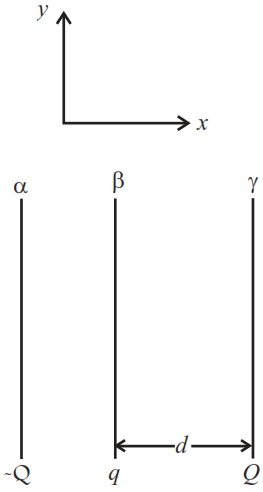
Two fixed, identical conducting plates $(\alpha\ \&\ \beta)$, each of surface area S are charged to -Q and q, respectively, where Q > q > 0. A third identical plate $(\gamma)$, free to move is located on the other side of the plate with charge q at a distance d (Fig.). The third plate is released and collides with the plate $\beta$. Assume the collision is elastic and the time of collision is sufficient to redistribute charge amongst $\beta\ \&\ \gamma$.

Find the electric field acting on the plate $\gamma$ before collision.
A capacitor of capacitance $5.00\mu\text{F}$ is charged to $24.0V$ and another capacitor of capacitance $6.0\mu\text{F}$ is charged to $12.0V$:
  1. Find the energy stored in each capacitor.
  2. The positive plate of the first capacitor is now connected to the negative plate of the second and vice versa. Find the new charges on the capacitors.
  3. Find the loss of electrostatic energy during the process.
  4. Where does this energy go?
When the sun is directly overhead, the surface of the earth receives $1.4 \times 10^3 W m^{-2}$ of sunlight. Assume that the light is monochromatic with average wavelength $500\ nm$ and that no light is absorbed in between the sun and the earth's surface. The distance between the sun and the earth is $1.5 \times 10^{11}m.$
  1. Calculate the number of photons falling per second on each square metre of earth's surface directly below the sun.
  2. How many photons are there in each cubic metre near the earth's surface at any instant?
  3. How many photons does the sun emit per second?
​​​​​​​
Two particles A and B, each having a charge Q, are placed a distance d apart. Where should a particle of charge q be placed on the perpendicular bisector of AB so that it experiences maximum force What is the magnitude of this maximum force?
A particle of mass $100g $ moving at an initial speed $u$ collides with another particle of same mass kept initially at rest. If the total kinetic energy becomes $0.2J$ after the collision, what could be the minimum and the maximum value of $u$.
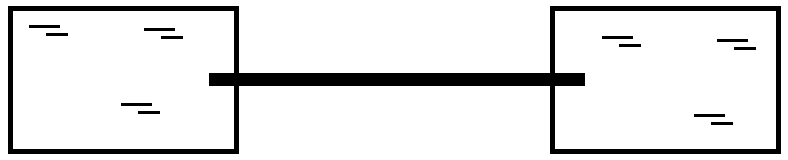
Figure, shows two adiabatic vessels, each containing a mass m of water at different temperatures. The ends of a metal rod of length L, area of cross section A and thermal conductivity K, are inserted in the water as shown in the figure. Find the time taken for the difference between the temperatures in the vessels to become half of the original value. The specific heat capacity of water is s. Neglect the heat capacity of the rod and the container and any loss of heat to the atmosphere.