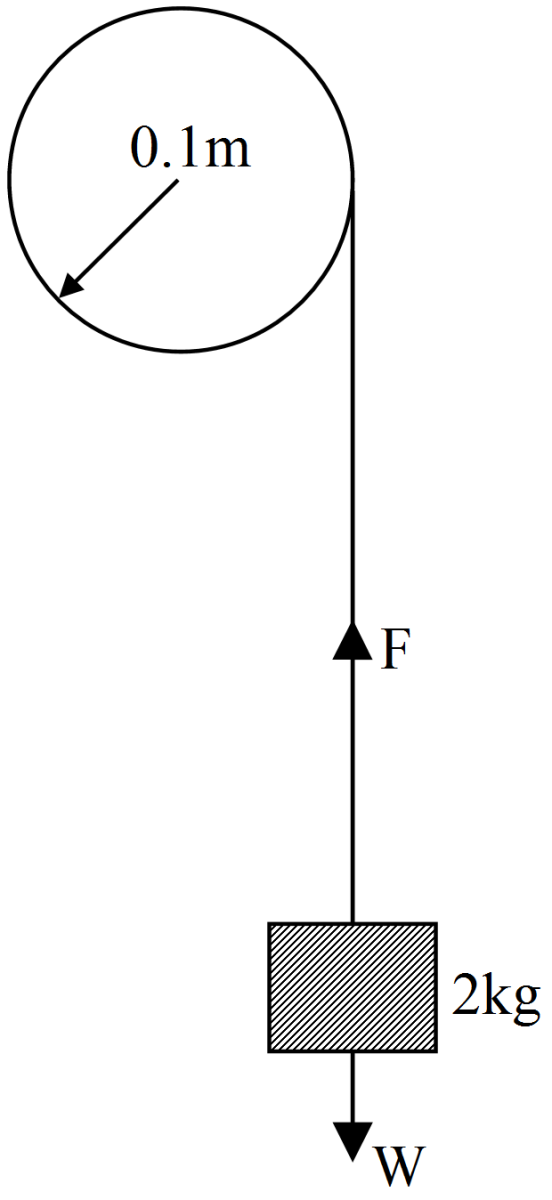
Question
Solve the previous problem if the friction coefficient between the $2.0kg$ block and the plane below it is $0.5$ and the plane below the $4.0kg$ block is frictionless.
Answer


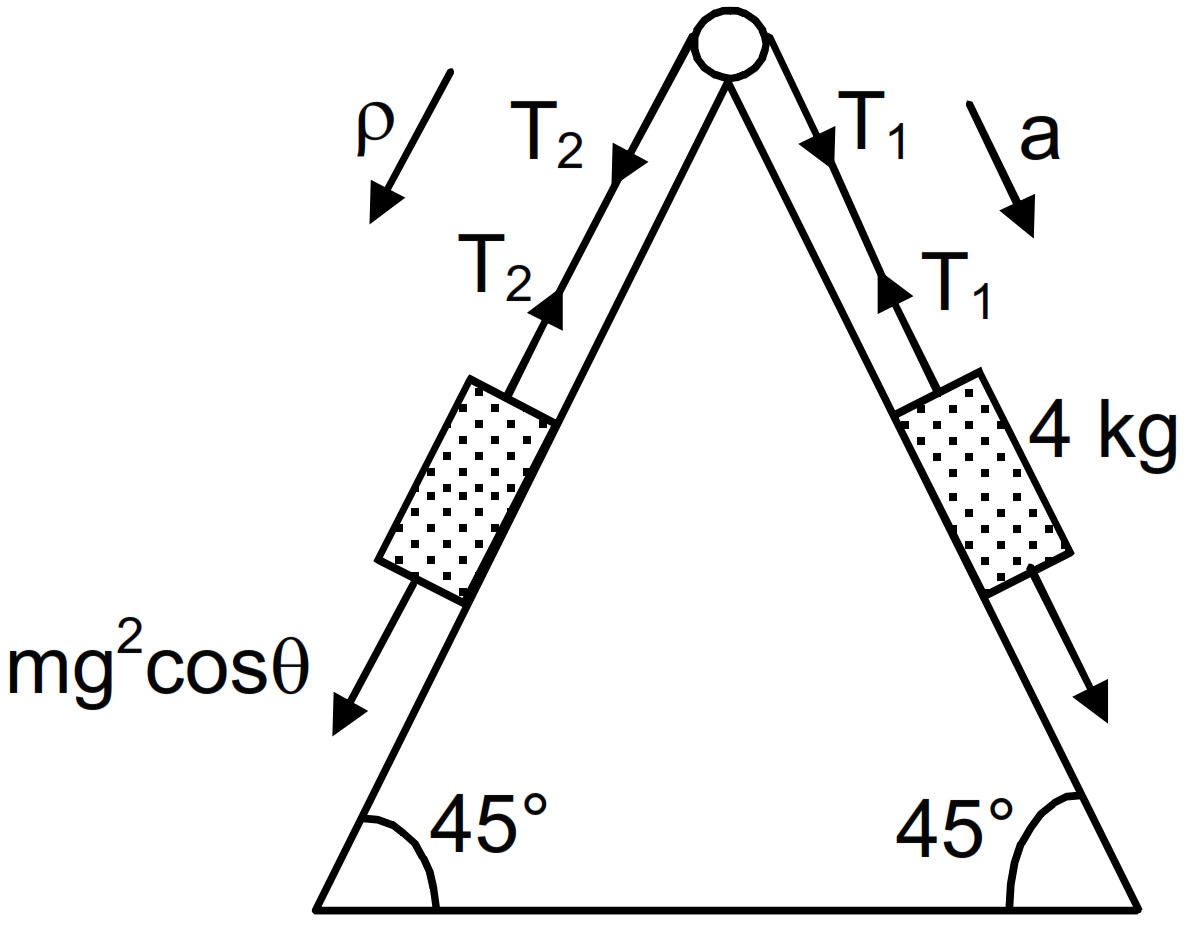
$m_1 = 4kg, m_2 = 2kg$
Frictional co-efficient between $2kg$ block and surface = $0.5$
$R = 10cm = 0.1m$
$I = 0.5kg-m^2$
$\text{m}_1\text{g}\sin\theta-\text{T}_1=\text{m}_1\text{a}\ \dots(1)$
$\text{T}_2-(\text{m}_2\text{g}\sin\theta+\mu\text{m}_2\text{g}\cos\theta)=\text{m}_2\text{a}\ \dots(2)$
$(\text{T}_1-\text{T}_2)=\frac{\text{la}}{\text{r}^2}$
Adding equation (1) and (2) we will get
$\text{m}_1\text{g}\sin\theta-(\text{m}_2\text{g}\sin\theta+\mu\text{m}_2\text{g}\cos\theta)+(\text{T}_1+\text{T}_2)=\text{m}_1\text{a}+\text{m}_2\text{a}$
$\Rightarrow4\times9.8\times\Big(\frac{1}{\sqrt2}\Big)-\Big\{\Big(2\times9.8\times\Big(\frac{1}{\sqrt2}\Big)+0.5\times2\times9.8\times\Big(\frac{1}{\sqrt2}\Big)\Big\}$
$=\Big(4+2+\frac{0.5}{0.01}\Big)\text{a}$
$\Rightarrow27.80-(13.90+6.95)=65\text{a}$
$\Rightarrow\text{a}=0.125\text{ms}^{-2}$

Need a full question paper?

Generate a complete, print-ready paper with questions like this in minutes — across 16+ boards, with answer keys.

Start Generating Free

Similar questions

Given below are some functions of x and t to represent the displacement of an elastic wave.$​​​​\text{y}=100\cos(100\pi\text{t+0.5x})$
  1. What is an adiabatic process? Derive expression for the work done during such process.
  2. A refrigerator is to maintain eatable kept inside at $9^\circ C$. If the room temperature is $36^\circ C$. Calculate the co-efficient of performance.
A block is kept on a horizontal table. The table is undergoing S.H.M. of frequency 3Hz in a horizontal plane. The coefficient of static friction between block and the table surface is 0.72. Find the maximum amplitude of the table at which the block does not slip on the surface.
Calculate the electric field in a copper wire of cross-sectional area $2.0mm^2$ carrying a current of 1A.
The resistivity of copper $=1.7\times10^{-8}\Omega\text{-m}.$
Write a detailed note on the use of dimensional equation.
Read statement below carefully and state with reasons and examples, if it is true or false; A particle in one-dimensional motion. With positive value of acceleration must be speeding up.
Given below are densities of some solids and liquids. Give rough estimates of the size of their atoms:
Substance
Atomic Mass(u)
Density $(10^3kgm^{-3})$
Carbon (diamond)
Gold
Nitrogen (liquid)
Lithium
Fluorine (liquid)
12.01
197.00
14.01
6.94
19.00
2.22
19.32
1.00
0.53
1.14
$\big[$Hint: Assume the atoms to be ‘tightly packed’ in a solid or liquid phase, and use the known value of Avogadro’s number. You should, however, not take the actual numbers you obtain for various atomic sizes too literally. Because of the crudeness of the tight packing approximation, the results only indicate that atomic sizes are in the range of a few $\mathring{\text{A}}\big].$
The number of harmonic components in the oscillations are represented by, $\text{y}=4\cos^2$ at $\sin4\text{t}$. What are What are their corresponding angular frequencies?
Two cylindrical hollow drums of radii R and 2R, and of a common height h, are rotating with angular velocities $\omega$ (anti-clockwise) and $\omega$ (clockwise), respectively. Their axes, fixed are parallel and in a horizontal plane separated by $(3\text{R}+\delta).$ They are now brought in contact $(\delta\rightarrow0){:}$
  1. Show the frictional forces just after contact.
  2. Identify forces and torques external to the system just after contact.
  3. What would be the ratio of final angular velocities when friction ceases?
The moment of inertia of a solid flywheel about its axis is $0.1kg-m^2$. A tangential force of $2kg/ wt$ is applied round the circumference of the flywheel with the help of a string and mass arrangement as shown in Fig. If the radius of the wheel is $0.1m$, find the acceleration of the mass.
​​​​​​​