Question
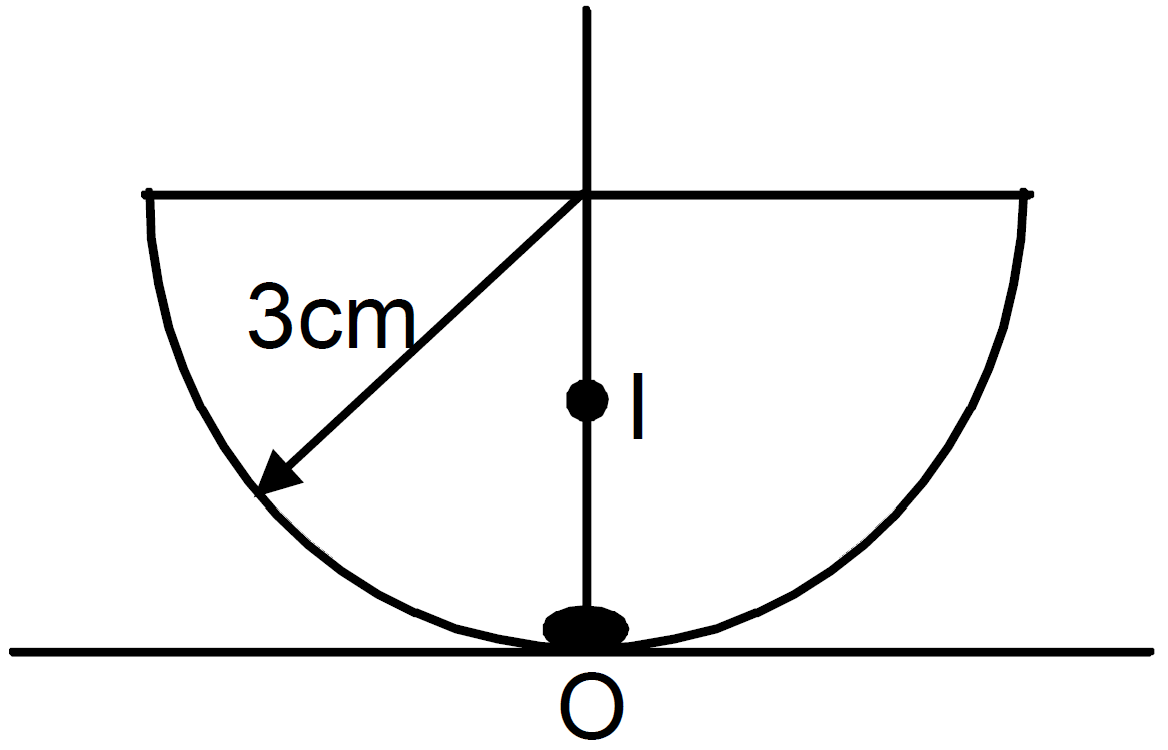
Solve the previous problem if the paperweight is inverted at its place so that the spherical surface touches the paper.

Answer


Thickness of glass $=3\text{cm}, \ \mu_{\text{g}}=1.5$
Image shif $=3\Big(1-\frac{1}{1.5}\Big)$
[Treating it as a simple refraction problem because the upper surface is flat and the spherical surface is in contact with the object]
$=3\times\frac{0.5}{1.5}=1\text{cm}.$
The image will appear 1 cm above the point P.

Need a full question paper?

Generate a complete, print-ready paper with questions like this in minutes — across 16+ boards, with answer keys.

Start Generating Free

Similar questions


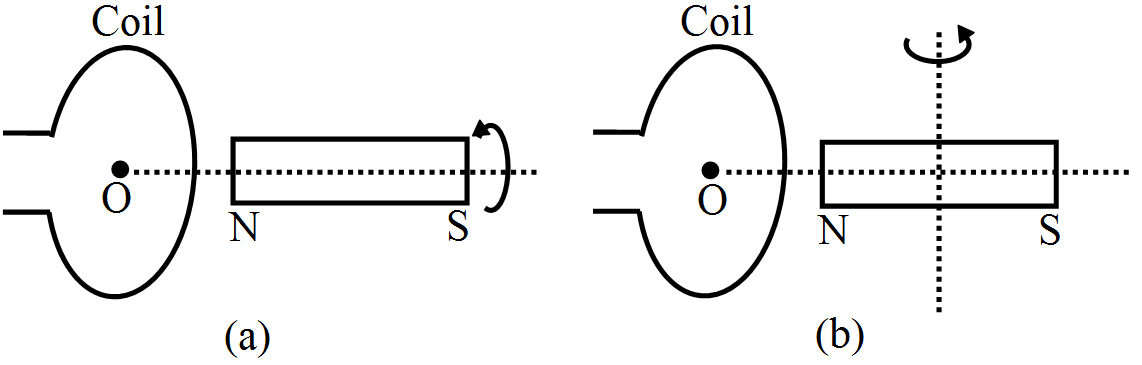
A cylindrical bar magnet is kept along the axis of a circular coil and near it as shown in figure. Will there be any induced emf at the terminals of the coil, when the magnet is rotated:
  1. About its own axis.
  2. About an axis perpendicular to the length of the magnet?
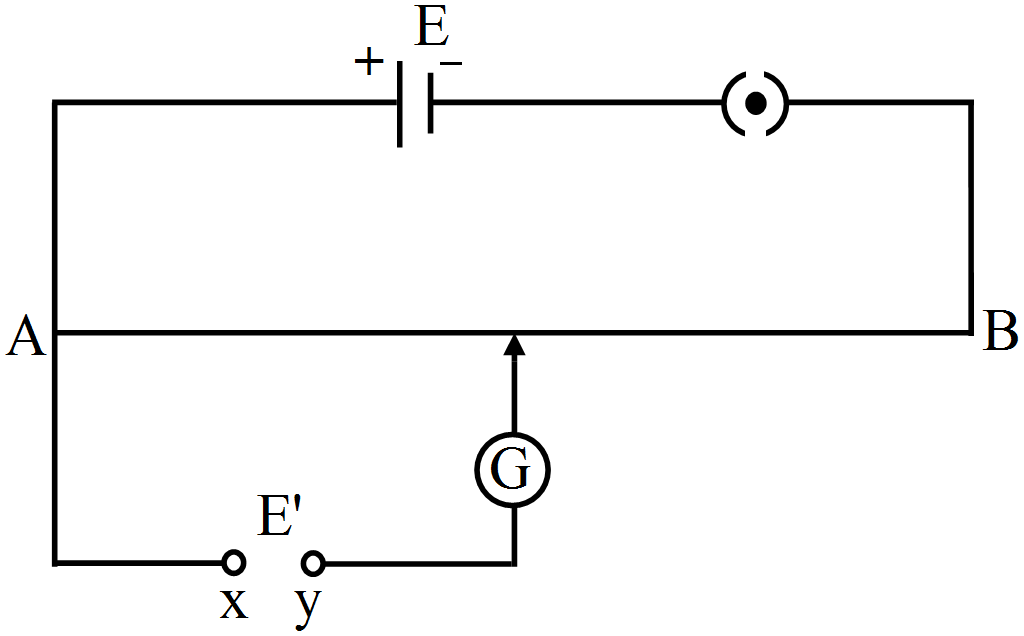
For the potentiometer circuit shown in the given figure, points X and Y represent the two terminals of an unknown emf E'. A student observed that when the jockey is moved from the end A to the end B of the potentiometer wire, the deflection in the galvanometer remains in the same direction.
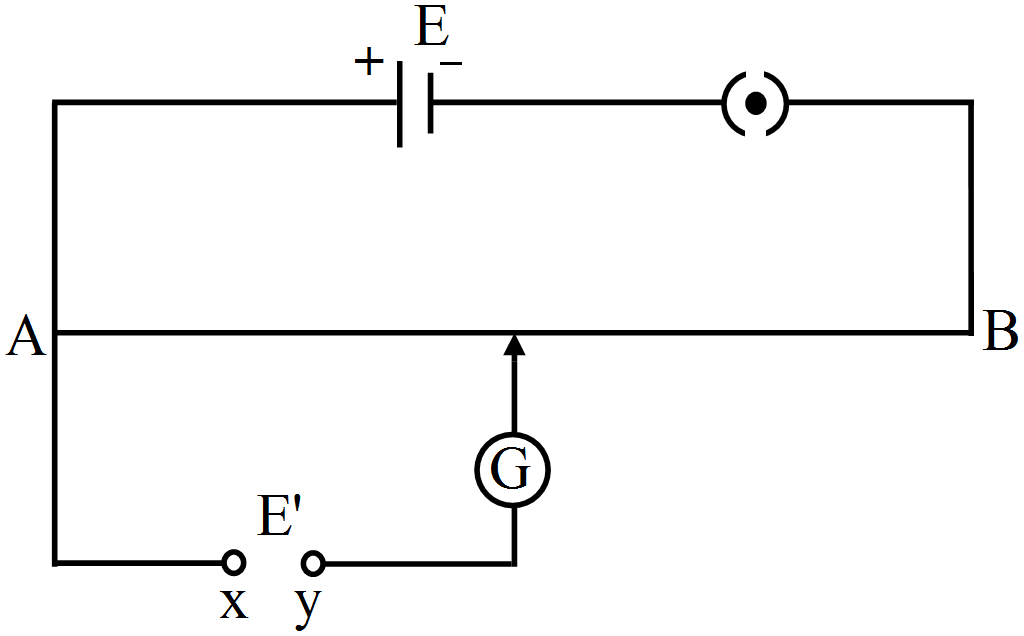
What may be the two possible faults in the circuit that could result in this observation? If the galvanometer deflection at the end B is (i) more, (ii) less than at the end A, which of the two faults, listed above, would be there in the circuit? Give reason in support of your answer in each case.
A person riding a car moving at 72km/h sounds a whistle emitting a wave of frequency 1250Hz. What frequency will be heard by another person standing on the road.
  1. In front of the car.
  2. Behind the car? Speed of sound in air = 340m/s.
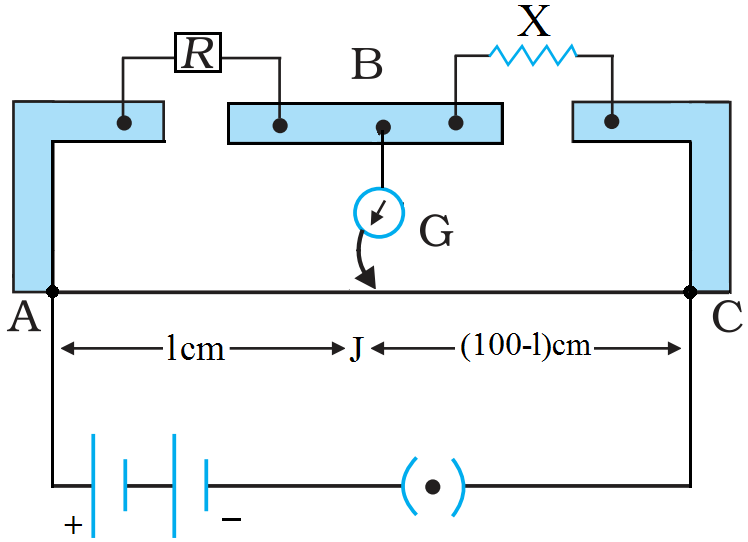
A resistance $\text{R}=4\Omega$ is connected to one of the gaps in a meter bridge, which uses a wire of length 1m. An unknown resistance $\text{x}>4\Omega$ is connected in the other gap as shown in the figure. The balance point is noticed at ‘l’ cm from the positive end of the battery. On interchanging R and X, it is found that the balance point further shifts by 20cm (away from the end A). Neglecting the end correction calculate the value of unknown resistance ‘X’ used.
Can an electromagnetic wave be polarised?
What is the parallel connection of cells ? Derive the formula for equivalent $\text{emf}$ and equivalent internal resistance for parallel connection of cell.
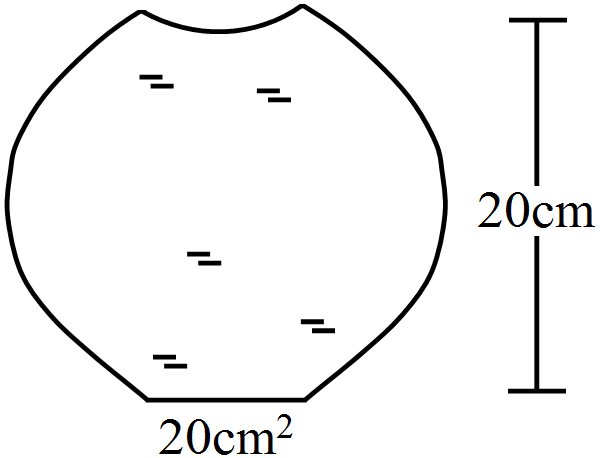
A glass full of water has a bottom of area $ 20cm^2,$ top of area $20cm^2$, height 20cm and volume half a litre.
  1. Find the force exerted by the water on the bottom.
  2. Considering the equilibrium of the water, find the.
Resultant force exerted by the sides of the glass on the water. Atmospheric pressure $= 1.0 \times 10^5N/m^2$. Density of water $= 1000kg/m^3$ and $g = 10m/s^2$. Take all numbers to be exact.
Explain with example, whether the neutron-proton ratio in a nucleus increases or decreases due to $\beta-$decay.
An ideal gas $\Big(\frac{\text{C}_\text{P}}{\text{C}_\text{V}}=\gamma\Big)$ is taken through a process in which the pressure and the volume vary as $p = aV^b$. Find the value of b for which the specific heat capacity in the process is zero.
What is the de Broglie wavelength associated with $(a)$ an electron moving with a speed of $5.4 \times 10^6 m / s$, and $(b)$ a ball of mass $150 g$ travelling at $30.0 m / s$ ?