Question
For the potentiometer circuit shown in the given figure, points X and Y represent the two terminals of an unknown emf E'. A student observed that when the jockey is moved from the end A to the end B of the potentiometer wire, the deflection in the galvanometer remains in the same direction.
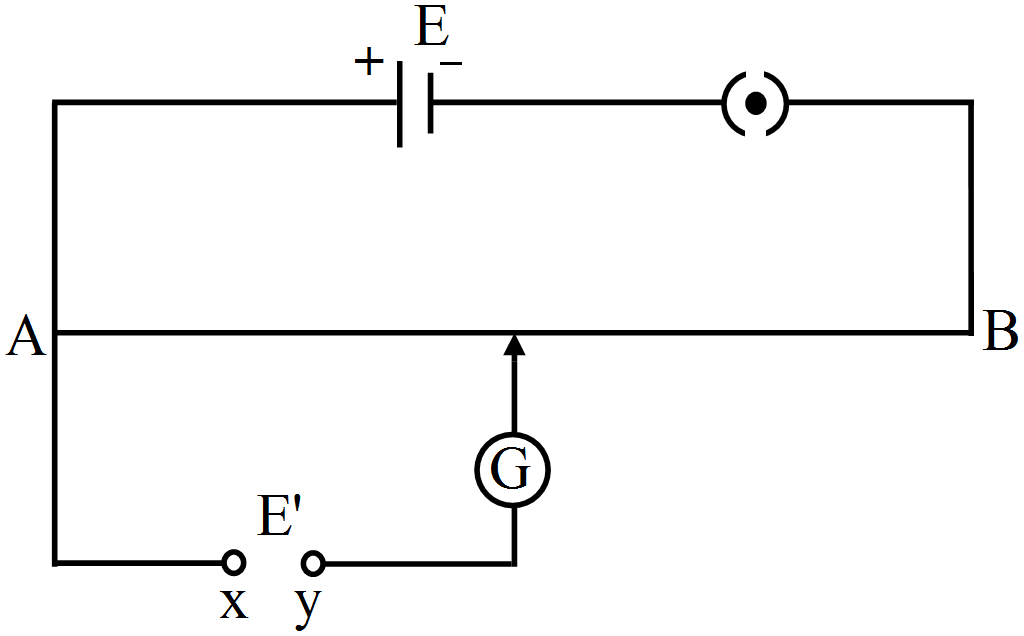
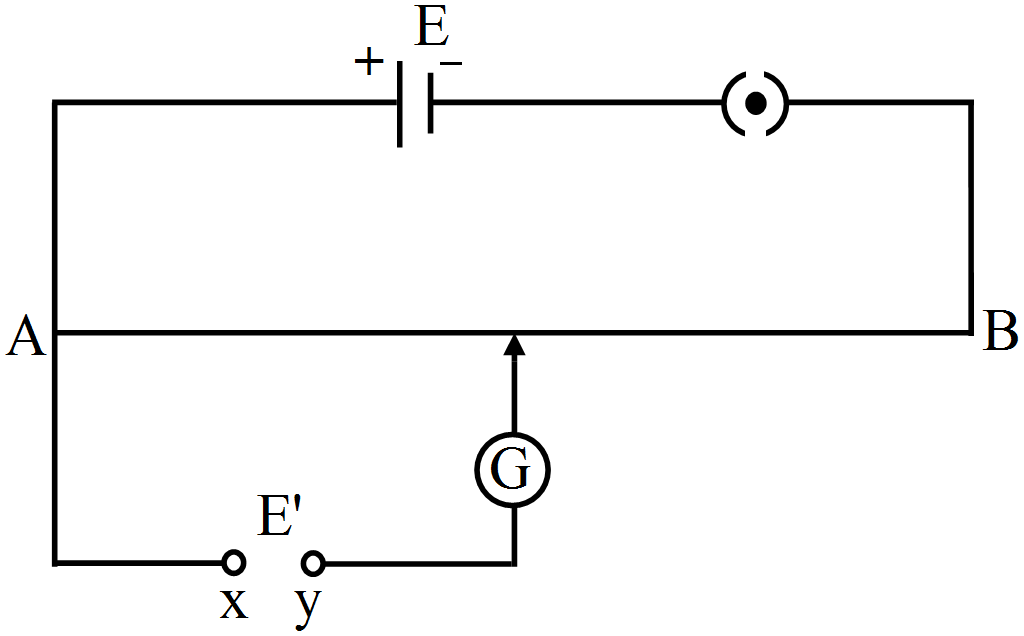
What may be the two possible faults in the circuit that could result in this observation? If the galvanometer deflection at the end B is (i) more, (ii) less than at the end A, which of the two faults, listed above, would be there in the circuit? Give reason in support of your answer in each case.
Answer

The two possible faults in the circuit may be (i) emf E′ is greater than emf E.
(ii) Terminal X of unknown emf is negative (while it should be positive).
If galvanometer deflection at end B is more than that at end A, then terminal X is negative, because in this case net current in galvanometer along AB due to both cells is additive.
If galvanometer deflection at end B is less than that at end A, then E′ > E, because net current in galvanometer due to both cells’ emfs E and E′ is subtractive.

Need a full question paper?

Generate a complete, print-ready paper with questions like this in minutes — across 16+ boards, with answer keys.

Start Generating Free

Similar questions

Why is it not possible to make permanent magnets from paramagnetic materials?
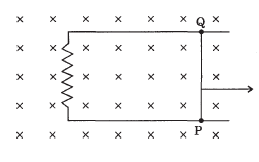
A 0’5 m long metal rod PQ completes the circuit as shown in the figure. The area of the circuit is perpendicular to the magnetic field of flux density 0-15 T. If the resistance of the total circuit is 3Ω, calcularod in the direction as indicated with a constant speed ofte the force needed to move the rod in the direction as indicated with a constant speed of 2ms−1.
Suppose the rod in the previous problem has a mass of 1kg distributed uniformly over its length:
  1. Find the initial angular acceleration of the rod.
  2. Find the tension in the supports to the blocks of mass 2kg and 5kg.
When we stir a liquid vigorously, it becomes warm. Is it a reversible process?
With what considerations in view, a photodiode is fabricated? State its working with the help of a suitable diagram. Eventhough the current in the forward bias is known to be more than in the reverse bias, yet the photodiode works in reverse bias. What is the reason?
What is the true weight of an object in a geostationary satellite that weighed exactly 10.0N at the north pole?
A homogeneous poorly conducting medium of resistivity fills up the space between two thin coaxial ideally conducting cylinders. The radii of the cylinders are equal to a and b with a < b, the length of each cylinder is l. Neglecting the edge effects, find the resistance of the medium between the cylinders.
Radioactive isotopes are produced in a nuclear physics experiment at a constant rate $\frac{\text{dN}}{\text{dt}}=\text{R}.$ An inductor of inductance 100mH, a resistor of resistance $100\Omega$ and a battery are connected to form a series circuit. The circuit is switched on at the instant the production of radioactive isotope starts. It is found that $\frac{\text{i}}{\text{N}}$ remains constant in time where i is the current in the circuit at time t and N is the number of active nuclei at time t. Find the half-life of the isotope.
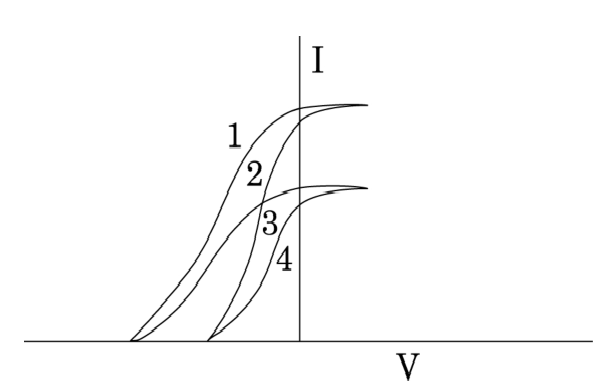
The given graph shows the variation of photo-electric currently) with the applied voltage(V) for two different materials and for two different intensities of the incident radiations. Identify and explain using Einstein's photo electric equation the pair of curves that correspond to (i) different materials but same intensity of incident radiation (ii) different intensities but same materials.
What is space wave propagation? State the factors which limit its range of propagation. Derive an expression for the maximum line of sight distance between two antennas for space wave propagation.