Question
Solve using the quadratic formula $x^2 – 4x + 1 = 0$

Answer

$x^2-4 x+1=0$
$a=1, b=-4, c=1$
$x=\frac{-b \pm \sqrt{b^2-4 a c}}{2 a}$
$=\frac{-(-4) \pm \sqrt{(-4)^2-4 \times 1 \times 1}}{2 \times 1} $
$=\frac{4 \pm \sqrt{16-4}}{2} $
$ =\frac{4+\sqrt{12}}{2}$
Taking $(+)$
$=\frac{4+2 \sqrt{3}}{2} $
$=2+\sqrt{3}$
$\therefore x = 2 + 1·732$
$= 3·732$
Taking $(-)$
or $x = \frac{4-\sqrt{12}}{2}$
$=\frac{4-2 \sqrt{3}}{2}$
$=2-\sqrt{3}$
$\therefore x = 2 - 1.732$
$= 0.268$
Hence, $x=2+\sqrt{3}$ and $2-\sqrt{3}$
or $3.732$ and $0.268$

Need a full question paper?

Generate a complete, print-ready paper with questions like this in minutes — across 16+ boards, with answer keys.
Start Generating Free

Similar questions

The total surface area of a right circular cone of slant height $13 \ cm$ is $90\pi \ cm^2.$ Calculate: its radius in $cm.$
The value of a 'Honda' bike depreciated by $16\%$ in the first year and by $13\%$ in the second year. Find the value of the bike if it depreciated by $Rs.7,098$ in the second year.
Prove that $(1+\cot \theta-\operatorname{cosec} \theta)(1+\tan \theta+\sec \theta)=2$.
The length (in cm) of the hypotenuse of a right-angled triangle exceeds the length of one side by 2 cm and exceeds twice the length of another side by 1 cm. Find the length of each side. Also, find the perimeter and the area of the triangle.
A cubical block of side $7$ cm is surmounted by a hemisphere of the largest size. Find the surfacearea of the resulting solid.
The mean monthly income of $10$ persons is Rs $8,670.$ If a new member with a monthly income of Rs $9, 000$ joins the group, find the new monthly income.
If $(x-2)$ is a factor of the expression, $2 x^3+a x^2+b x-14$ and when the expression is divided by $(x-3)$, it leaves a remainder 52 , find the values of $a$ and $b$.
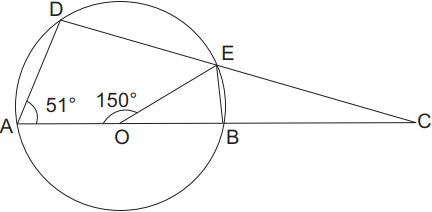
In the figure, $O$ is the centre of the circle.
$\angle \mathrm{AOE}=150^{\circ}, \angle \mathrm{DAO}=51^{\circ} .$
Calculate the measures of $\angle \mathrm{BEC}$ and $\angle \mathrm{EBC}$.
Image
The base BC of an equilateral triangle ABC lies on $y$-axis. The coordinates of point C are $(0,-3)$. If the origin is the mid-point of the base BC , find the coordinates of the points A and B .
Two vertices of a triangle are $( -1, 4)$ and $(5, 2).$ If the centroid is $(0, 3),$ find the third vertex.