Question 14 Marks
In each of the following, determine whether the given values are solution of the given equation or not:
$x=\frac{1}{x}=\frac{13}{6}, x=\frac{5}{6}, x=\frac{4}{3}$
Answer$x=\frac{1}{x}=\frac{13}{6}, x=\frac{5}{6}, x=\frac{4}{3} .$
$ \frac{x^2+1}{x}=\frac{13}{6}$
$\Rightarrow 6 x^2-12 x+6=0$
Now on substitute $x=\frac{5}{6}$ in equation
$\text { L.H.S. }=6 \times\left(\frac{5}{6}\right)^2-13 \times \frac{5}{6}+6 $
$ \Rightarrow=\frac{25}{6}-\frac{65}{6}+6 $
$ \Rightarrow=\frac{61}{6}-\frac{65}{6} \neq 0 \neq \text { R.H.S. }$
$\therefore x=\frac{5}{6}$ is not a solution of the given equation.
on substituting $x=\frac{4}{3}$ in L.H.S. of given equation
$\Rightarrow \text { L.H.S. }=6 \times\left(\frac{4}{3}\right)^2-13 \times \frac{4}{3}+6$
$ =\frac{32}{3}-\frac{52}{3}+6 $
$=\frac{50}{3}-\frac{52}{3} \neq 0 \neq \text { R.H.S. }$
Hence, $\frac{4}{3}$ is not a solution of the given equation.
View full question & answer→Question 24 Marks
In each of the following determine whether the given values are solutions of the equation or not.
$6 x^2-x-2=0 ; x=-\frac{1}{2}, x=\frac{2}{3}$
AnswerGiven equation
$6 x^2-x-2=0 ; x=-\frac{1}{2}, x=\frac{2}{3}$
Substitute $x=-\frac{1}{2}$ in $L.H.S.$
$L.H.S. =6\left(-\frac{1}{2}\right)^{\overline{2}}-\left(-\frac{1}{2}\right)-2$
$=6 \times \frac{1}{4}+\frac{1}{4}-2 $
$=2-2$
$ =0$
Hence, $x=-\frac{1}{2}$ is a solution of the given equation.
Also put $x=\frac{2}{3}$ in $L.H.S.$
$L.H.S. =6\left(\frac{2}{3}\right)^2-\frac{2}{3}-2$
$=6 \times \frac{4}{9}-\frac{2}{3}-2$
$=\frac{8}{3}-\frac{2}{3}-2 $
$ =\frac{6}{3}-2$
$ =2-2 $
$=0$
Hence, $x=\frac{2}{3}$ is a solution of the given equation.
View full question & answer→Question 34 Marks
If one root of the quadratic equation $a x^2+b x+c=0$ is double the other, prove that $2 b^2=9 a c$.
Answer$a x^2+b x+c=0$
Let the roots be $\alpha$ and $2\alpha$
$\text { Sum of roots }=\frac{-b}{a}$
$\Rightarrow \alpha+2 \alpha=\frac{-b}{a}$
$\Rightarrow 3 \alpha=\frac{-b}{a}$
$\Rightarrow \alpha=-\frac{b}{3 a}...(i)$
$\text { Product of root }=\frac{c}{a}$
$\Rightarrow 2 \alpha^2=\frac{c}{a}$
$\alpha^2=\frac{c}{2 a}, \alpha=\sqrt{\frac{c}{2 a}} $
Equation $( i )=( ii )$
$ \frac{-b}{3 a}=\sqrt{\frac{c}{2 a}} \ldots \text { (squaring both side) }$
$\frac{b^2}{9 a^2}=\frac{c}{2 a}$
$\Rightarrow 2 b ^2=9 ac . $
Hence Proved.
View full question & answer→Question 44 Marks
Solve the equation:
$6\left(x^2+\frac{1}{x^2}\right)-25\left(x-\frac{1}{x}\right)+12=0$.
AnswerGiven equation
$6\left(x^2+\frac{1}{x^2}\right)-25\left(x-\frac{1}{x}\right)+12=0$
Put $x -\frac{1}{x}=y$, squaring $\left(x-\frac{1}{x}\right)^2=y^2$
$\Rightarrow x^2+\frac{1}{x^2}-2=y^2 $
$ \Rightarrow x^2+\frac{1}{x^2}=y^2+2$
Now, given equation becomes
$6\left(y^2+2\right)-25 y+12=0 $
$ \Rightarrow 6 y^2+12-25+12=0 $
$ \Rightarrow 6 y^2-25 y+24=0 $
$ \Rightarrow 6 y^2-16 y-9 y+24=0$
$ \Rightarrow 2 y(3 y-8)-3(3 y-8)=0 $
$ \Rightarrow(3 y-8)(2 y-3)=0 $
$\Rightarrow 3 y-8=0 \text { or } 2 y-3=0$
$ \Rightarrow 3 y=8 \text { or } 2 y=3 $
$ \Rightarrow y=\frac{8}{3} \text { or } y=\frac{3}{2}$
But $x-\frac{1}{x}=y$
$\therefore x-\frac{1}{x}=\frac{8}{3} $
$\Rightarrow \frac{x^2-1}{x}=\frac{8}{3} $
$\Rightarrow 3 x^2-3=8 x $
$\Rightarrow 3 x^2-8 x -3=0 $
$\Rightarrow 3 x ^2-9 x + x -3=0 $
$\Rightarrow 3 x ( x -3)+1( x -3)=0 $
$\Rightarrow( x -3)(3 x +1)=0 $
$\Rightarrow x -3=0 \text { or } 3 x +1=0 $
$\Rightarrow x =3 \text { or } x =\frac{-1}{3}$
or
$x-\frac{1}{x}=\frac{3}{2} $
$ \Rightarrow \frac{x^2-1}{x}=\frac{3}{2}$
$ \Rightarrow 2 x^2-2=3 x $
$ \Rightarrow 2 x^2-3 x-2=0$
$ \Rightarrow 2 x^2-4 x+x-2=0 $
$\Rightarrow 2 x(x-2)+1(x-2)=0$
$ \Rightarrow(x-2)(2 x+1)=0 $
$\Rightarrow x-2=0 \text { or } 2 x+1=0 $
$ \Rightarrow x=2 \text { or } x=\frac{-1}{2} $
$\text { Hence, } x=3, \frac{-1}{3}, 2 \text { and } \frac{-1}{2} .$
View full question & answer→Question 54 Marks
Solve: x(x + 1) (x + 3) (x + 4) = 180.
AnswerGiven equation
$x(x+1)(x+3)(x+4)=180$
$\Rightarrow[(x+0)(x+4)][(x+1)(x+3)]=180$
$\Rightarrow\left(x^2+4 x\right)\left(x^2+4 x+3\right)-180=0$
$\text { Put } x^2+4 x=y$
then it becomes y(y + 3) - 180 = 0
$\Rightarrow y^2+3 y-180=0$
$\Rightarrow y^2+15 y-12 y-180=0$
$\Rightarrow y(y+15)-12(y+15)=0$
$\Rightarrow(y+15)(y-12)=0$
$\Rightarrow y=15=0 \text { or } y=12$
$\text { But } x^2+4 x=y$
$\text { Then } x^2+4 x=-15$
$x^2+4 x+15=0$
or
$x^2+4 x=12$
$\Rightarrow x^2+4 x-12=0$
$x^2+a x+15=0$ gives $x=\frac{-4 \pm \sqrt{(4)^2-4 \times 15}}{2}$
∴ Roots of the equation are imaginary hence not acceptable.
or
$ x ^2+4 x -12=0$
$\Rightarrow x ^2+6 x -2 x -12=0$
$\Rightarrow x ( x +6)-2( x +6)=0$
$\Rightarrow( x +6)( x -2)=0$
$\Rightarrow x +6=0 \text { or } x -2=0$
$\Rightarrow x =-6 \text { or } x =2$
View full question & answer→Question 64 Marks
Solve the following by reducing them to quadratic form:
$\sqrt{x^2-16}-(x-4)=\sqrt{x^2-5 x+4}$.
AnswerGiven equation
$\sqrt{x^2-16}-(x-4)=\sqrt{x^2-5 x+4} $
$ \Rightarrow \sqrt{(x+4)(x-4)}-(x-4)=\sqrt{(x-1)(x-4)}$
$ \Rightarrow \sqrt{x-4}[\sqrt{x+4}-\sqrt{x-4}-\sqrt{x-1}]=0 $
$\Rightarrow \text { Either, } \sqrt{x-4}=0 $
$ \Rightarrow x-4=0$
$ \Rightarrow x=4 \ldots \text { (By squaring on both sides) }$
or
$\sqrt{x+4}-\sqrt{x-4}-\sqrt{x-1}=0 $
$ \Rightarrow \sqrt{x+4}-\sqrt{x-4}=\sqrt{x-1}$
Squaring both sides we get
$x+4+x-4-2 \sqrt{(x+4)(x-4)}=x-1$
$\Rightarrow 2 x-2 \sqrt{x^2-16}$ $=x-1$
$=-(x+1)$
$\Rightarrow 2 \sqrt{x^2-16}$ $=x+1$
Squaring again, $4\left(x^2-16\right)=x^2+2 x+1$
$\Rightarrow 4 x^2-64-x^2-2 x-1=0 $
$ \Rightarrow 3 x^2-2 x-65=0 $
$ \Rightarrow 3 x^2-15 x+13 x-65=0 $
$\Rightarrow 3 x(x-5)+13(x-5)=0$
$ \Rightarrow(x-5)+(3 x+13)=0 $
$\Rightarrow x-5=0 \text { or } 3 x+13=0 $
$ \Rightarrow x=5 \text { or } x=\frac{-13}{3}$
$x=5$.
Hence, the solutions are $4, 5.$
View full question & answer→Question 74 Marks
Solve the following by reducing them to quadratic form:
$\sqrt{y+1}+\sqrt{2 y-5}=3, y \in R$.
AnswerGiven equation
$\sqrt{y+1}+\sqrt{2 y-5}=3$
$\Rightarrow \sqrt{y+1}=3-\sqrt{2 y-5}$
Squaring both sides, we get
$y+1=9+2 y-5-6 \sqrt{2 y-5} $
$ \Rightarrow y-2 y+1-4=-6 \sqrt{2 y-5} $
$ -y-3=-6 \sqrt{2 y-5} $
$ \Rightarrow y+3=6 \sqrt{2 y-5}$
On Squaring again, we get
$y^2+9+6 y=36(2 y-5) $
$ \Rightarrow y^2+9+6 y=72 y-180 $
$\Rightarrow y^2+6 y-72 y+9+180=0 $
$\Rightarrow y^2-66 y+189=0 $
$\therefore y^2-66 y+189=0$
Hence,$ a = 1, b = -66, c = 189$
Then, D
$=b^2-4 a c $
$ =(66)^2-4(1)(189) $
$=4356-756$
$ =3600>0$
Roots are real.
$\therefore y=\frac{-b \pm \sqrt{b^2-4 a c}}{2 a} $
$ y=\frac{-(-66) \pm \sqrt{3600}}{2 \times 1} $
$ y=\frac{66 \pm 60}{2} $
$y=\frac{66+60}{2}, \frac{66-60}{2} $
$ =\frac{126}{2}, \frac{6}{2} $
$=63,3$
$y = {63, 3}$
But $x = 63$ does not satisfy the given equation
Hence, the solution is $3.$
View full question & answer→Question 84 Marks
Solve $(x^2 + 3x)^2 - (x^2 + 3x) -6 = 0.$
Answer$\left(x^2+3 x\right)^2-\left(x^2+3 x\right)-6=0$
Putting $x^2+3 x=y$, the given equation becomes
$y^2-y-6=0$
$ \Rightarrow y^2-3 y+2 y-6=0 $
$ \Rightarrow y(y-3)+2(y-3)=0 $
$ \Rightarrow(y-3)(y+2)=0 $
$ \Rightarrow y-3=0 \text { or } y+2=0 $
$ \Rightarrow y=3 \text { or } y=-2$
$\text { But } x^2+3 x=y $
$x^2+3 x=3 $
$ \Rightarrow x^2+3 x-3=0$
$ \text { Here } a=1, b=3, c=-3$
$ \text { Then } x=\frac{-b \pm \sqrt{b^2-4 a c}}{2 a}$
$ x=\frac{-3 \pm \sqrt{9+12}}{2} $
$ x=\frac{-3 \pm \sqrt{21}}{2}$
or
$x^2+3 x=-2 $
$ x^2+3 x+2=0 $
$x^2+2 x+x+2=0$
$ x(x+2)+1(x+2)=0 $
$x+2=0 \text { or } x+1=0$
$x=-2 \text { or } x=-1$
Hence, roots are $\frac{-3 \pm \sqrt{21}}{2},-2,-1$.
View full question & answer→Question 94 Marks
Solve the following by reducing them to quadratic equations:
$\sqrt{\frac{x}{1-x}}+\sqrt{\frac{1-x}{x}}=\frac{13}{6}$.
AnswerGiven equation $\sqrt{\frac{x}{1-x}}+\sqrt{\frac{1-x}{x}}=\frac{13}{6}$
Putting $\sqrt{\frac{x}{1-x}}=y$, then given equation reducible to the form $y+\frac{1}{y}=\frac{13}{6}$
$\Rightarrow \frac{y^2+1}{y}=\frac{13}{6} $
$ \Rightarrow 6 y^2+6=13 y $
$ \Rightarrow 6 y^2-13 y+6=0 $
$ \Rightarrow 6 y^2-9 y-4 y+6=0 $
$ \Rightarrow 3 y(2 y-3)-2(2 y-3)=0 $
$ \Rightarrow(2 y-3)(3 y-2)=0 $
$ \Rightarrow 2 y-3=0 \text { or } 3 y-2=0 $
$ \Rightarrow y=3 / 2 \text { or } y=2 / 3$
$\text { But } \sqrt{\frac{x}{1-x}}=y $
$ \sqrt{\frac{x}{1-x}}=\frac{3}{2} $
$ \text { Squaring } \frac{x}{1-x}=\frac{9}{4} $
$ \Rightarrow 4 x=9-9 x $
$ \Rightarrow 13 x=9 $
$ \Rightarrow x=\frac{9}{13}$
or
$\sqrt{\frac{x}{1-x}}=\frac{2}{3} $
$ \text { Squaring } \frac{x}{1-x}=\frac{4}{9} $
$ \Rightarrow 9 x=4-4 x $
$ \Rightarrow 9 x+4 x=4 $
$ \Rightarrow 13 x=4 $
$ \Rightarrow x=\frac{4}{13}$
Hence, the required roots are $\left\{\frac{9}{13}, \frac{4}{13}\right\}$.
View full question & answer→Question 104 Marks
Solve the following by reducing them to quadratic equations:
$\left(\frac{7 y-1}{y}\right)^2-3\left(\frac{7 y-1}{y}\right)-18=0, y \neq 0$
AnswerThe given equation
$\left(\frac{7 y-1}{y}\right)^2-3\left(\frac{7 y-1}{y}\right)-18=0, y \neq 0$
Putting $\frac{7 y-1}{y}=z$, then given equation becomes
$z^2-3 z-18=0 $
$ \Rightarrow z^2-6 z+3 z-18=0 $
$ \Rightarrow z(z-6)+3(z-6)=0 $
$ \Rightarrow(z-6)(z+3)=0 $
$ \Rightarrow z-6=0 \text { or } z+3=0 $
$ \Rightarrow z=6 \text { or } z=-3$
$\text { But } \frac{7 y-1}{y}=z $
$ \therefore \frac{7 y-1}{y}=6 $
$ \Rightarrow 7 y-1 $
$ =6 y $
$ \Rightarrow 7 y-6 y $
$ =1 $
$ \Rightarrow y=1$
$\text { Also } \frac{7 y-1}{y} $
$ =-3 $
$ \Rightarrow 7 y-1 $
$ =-3 y $
$ \Rightarrow 7 y+3 y-1=0 $
$ \Rightarrow 10 y=1 $
$ \Rightarrow y=\frac{1}{10}$
Hence, the required roots are $\frac{1}{10}, 1$
View full question & answer→Question 114 Marks
Solve the following quadratic equation:
$\frac{1}{a+b+x}=\frac{1}{a}+\frac{1}{b}+\frac{1}{x}, a+b \neq 0$
Answer$\frac{1}{a+b+x}=\frac{1}{a}+\frac{1}{b}+\frac{1}{x} $
$ \Rightarrow \frac{1}{a+b+x}-\frac{1}{x}=\frac{1}{a}+\frac{1}{b} $
$ \Rightarrow \frac{x-a-b-x}{x(a+b+x)}=\frac{1}{a}+\frac{1}{b} $
$ \frac{-(a+b)}{x(a+b+x)}=\frac{a+b}{a b} $
$ \Rightarrow x(a+b+x)(a+b)=-(a+b) a b $
$ \Rightarrow x(a+b+x)(a+b)+a b(a+b)=0 $
$ \Rightarrow(a+b)\{x(a+b+x)+a b\}=0 $
$ \Rightarrow a+b \operatorname{or} x(a+b+x)+a b=0$
$\text { But } a+b \neq 0 $
$ \text { So } x(a+b+x)+a b=0 $
$ \Rightarrow x(a+b)+x^2+a b=0 $
$ \Rightarrow x^2+a x+b x+a b=0 $
$ \Rightarrow x(x+a)+b(x+a)=0 $
$ \Rightarrow(x+a)(x+b)=0 $
$ \Rightarrow x=-a \text { or } x=-b.$
View full question & answer→Question 124 Marks
Solve the following quadratic equation by factorisation method:
$\frac{x+3}{x-2}-\frac{1-x}{x}=\frac{17}{4}$
Answer$\frac{x+3}{x-2}-\frac{1-x}{x}=\frac{17}{4} $
$ \Rightarrow \frac{x^2+3 x-(x-2)(1-x)}{x(x-2)}=\frac{17}{4} $
$ \Rightarrow \frac{x^2+3 x-\left(x-x^2-2+2 x\right)}{x^2-2 x}=\frac{17}{4} $
$ \Rightarrow \frac{x^2+3 x-\left(-x^2+3 x-2\right)}{x^2-2 x}=\frac{17}{4} $
$ \Rightarrow \frac{x^2+3 x+x^2-3 x+2}{x^2-2 x}=\frac{17}{4} $
$ \Rightarrow \frac{2 x^2+2}{x^2-2 x}=\frac{17}{4}$
$\Rightarrow 17 x^2-34 x-8 x^2+8 $
$ \Rightarrow 9 x^2-34 x-8=0 $
$ \Rightarrow 9 x^2-36 x+2 x-8=0 $
$ \Rightarrow 9 x(x-4)+2(x-4)=0 $
$ \Rightarrow(x-4)(9 x+2)=0 $
$ \Rightarrow x-4=0 \text { or } 9 x+2=0 $
$ \Rightarrow x=4 \text { or } x=-\frac{2}{9} .$
View full question & answer→Question 134 Marks
Solve the following quadratic equation by factorisation method:
$\frac{x}{x+1}+\frac{x+1}{x}=\frac{34}{15} x \neq 0, x \neq-1$
AnswerWe have
$\frac{x}{x+1}+\frac{x+1}{x}=\frac{34}{15}$
$ \Rightarrow \frac{x^2+(x+1)^2}{x(x+1)}=\frac{34}{15} $
$\Rightarrow \frac{x^2+x^2+1+2 x}{x^2+x}=\frac{34}{15} $
$ \Rightarrow \frac{2 x^2+2 x+1}{x^2+x}=\frac{34}{15}$
$\Rightarrow 34 x^2+34 x=30 x^2+30 x+15 $
$ \Rightarrow 4 x^2+4 x-15=0$
$ \Rightarrow 4 x^2+10 x-6 x-15=0 $
$\Rightarrow 2 x(2 x+5)-3(2 x+5)=0 $
$\Rightarrow(2 x+5)(2 x-3)=0 $
$ \Rightarrow 2 x+5=0 \text { or } 2 x-3=0$
$ \Rightarrow 2 x=-5 \text { and } 2 x=3$
$ \Rightarrow x=-\frac{5}{2}, x=\frac{3}{2} .$
View full question & answer→Question 144 Marks
A shopkeeper purchases a certain number of books for Rs. 960. If the cost per book was Rs. 8 less, the number of books that could be purchased for Rs. 960 would be 4 more. Write an equation, taking the original cost of each book to be Rs. x, and Solve it to find the original cost of the books.
AnswerOriginal cost of each book
= ₹ $x$
∴ Number of books for ₹960 = $\frac{960}{x}$
Now, if cost of each book = ₹ $(x-8)$
Number of books for ₹960 = $\frac{960}{x-8}$
According to the question
$\frac{960}{x}+4=\frac{960}{x-8}$
or
$\frac{960}{(x-8)}-\frac{960}{x}=4$
$\frac{960 x-960 x+7,680}{x(x-8)}=4$
or
$7,680=4 x^2-32 x$
or
$x^2-8 x-1,920=0$
$x^2+40 x-48 x-1,920=0$
$x(x+40)-48(x+40)=0$
$(x+40)(x-48)=0$
$\Rightarrow x=-40,48$
as cost can't be - ve x = 48.
View full question & answer→Question 154 Marks
Car A travels x km for every litre of petrol, while car $B$ travels $(x + 5)$ km for every litre of petrol.
If car A use $4$ litre of petrol more than car $B$ in covering the $400 km$, write down and equation in x and solve it to determine the number of litre of petrol used by car $B$ for the journey.
AnswerGiven Distance $= 400 km$
Car $A$ travels x km/litre.
Car $B$ travels $(x + 5)$ km/litre.
Car $A$ uses $4$ litre more than car $B$
$\therefore \frac{400}{x}-\frac{400}{x+5}=4$
$400 (x + 5) - 400x = 4x(x + 5)$
$400x + 2000 - 400x = 4x^2 + 20x$
$4x^2 + 20x - 200 = 0$
$4 (x^2 + 5x - 500) = 0$
$x^2 + 25x - 20x - 500 = 0$
$x (x + 25) - 20 (x + 25) = 0$
$(x + 25) (x - 20) = 0$
$\therefore x = 20 - 25 ...$(inadmissible)
No. of litre of petrol used by car B
$=\frac{400}{20+5}$
$=\frac{800}{25}$
$= 16$
View full question & answer→Question 164 Marks
One fourth of a herd of camels was seen in the forest. Twice the square root of the herd had gone to mountains and the remaining $15$ camels were seen on the bank of a river. Find the total number of camels.
AnswerLet x be the total number of camels.
Number of camels seen in the forest $= \frac{x}{4}$
Number of camels gone to mountain $= 2 \sqrt{x}$
Number of camels on the bank of river $= 15$
Total number of camels $= \frac{x}{4}+2 \sqrt{x}+15=x$
$\Rightarrow x +8 \sqrt{x}+60=4 x$
$ \Rightarrow 3 x -8 \sqrt{x}-60=0 $
$\text { Put } \sqrt{x}=y $
$\Rightarrow 3 y ^2-8 y -60=0 $
$\Rightarrow 3 y ^2-18 y +10 y -60=0 $
$ \Rightarrow 3 y ( y =6)+10( y -6)=0$
$ \Rightarrow( y -6)(3 y +10)=0$
$ \Rightarrow y =6 \text { or } 3 y +10=0 $
$ \Rightarrow y =6 \text { or } y =-\frac{10}{3}$
Now $y = 6$
$\Rightarrow \sqrt{x}=6$
On squaring $x = 36$
Hence, total number of camels $= 36.$
View full question & answer→Question 174 Marks
A car covers a distance of $400\ km$ at a certain speed. Had the speed been $12\ km/hr$ more, the time taken for the journey would have been $1$ hour $40$ minutes less. Find the original speed of the car.
AnswerLet the original speed of the car be $x\ km/hr,$
So, Time taken by car = $\frac{400}{x} hrs$.
Again, S$=\frac{400}{x+12}$ Speed $= (x + 12)\ km/hr$
Time taken by car $=\frac{400}{x+12}$
So, $\frac{400}{x}-\frac{400}{x+12}=1 hr +\frac{40}{60}$
$400 \frac{(x+12-x)}{x(x+12)}=\frac{5}{3}$
$\frac{4800}{x^2+12 x}=\frac{5}{3}$
$\Rightarrow 5\left(x^2+12 x\right)=14,400$
$\Rightarrow x^2+12 x-2,880=0$
$\Rightarrow x^2+60 x-48 x-2,880=0$
$\Rightarrow x(x+60)-48(x+60)=0$
$\Rightarrow(x+60)(x-48)=0$
$\text { Either, } x+60=0$
$x = -60 ...$ (Neglect, Speed can't be negative)
or
$x - 48 = 0$
$x = 48$
$\Rightarrow$ Original speed of the car is $48\ km/hr.$
View full question & answer→Question 184 Marks
By increasing the speed of a car by 10 km/hr, the time of journey for a distance of 72 km. is reduced by 36 minutes. Find the original speed of the car.
AnswerLet original speed be x km/hr.
$\therefore$ Time $=\frac{72}{x} hr$.
New speed = x + 10 km/hr.
$\therefore$ New time $=\frac{72}{x+10} hr$.
Difference in time = 36 mins.
$\therefore \frac{72}{x}-\frac{72}{x+10}=\frac{36}{60}$
$\frac{72 x+720-72 x}{x(x+10)}=\frac{3}{5}$
5 x 720 = 3 $\left(x^2+10 x\right)$
$1,200=x^2+10 x$
$x^2+10 x-1,200=0$
$x^2+40 x-30 x-1,200=0$
$x(x+40)-30(x+40)=0$
$(x-30)(x+40)=0$
$\therefore x=30$
as x = -40 is not acceptable
∴ Original speed = 30km/hr.
View full question & answer→Question 194 Marks
$Rs. 480$ is divided equally among $‘x’$ children. If the number of children were $20$ more then each would have got $Rs. 12$ less. Find $‘x’.$
AnswerShare of each child $=$ ₹$\frac{480}{x}$
Now, number of children
$= x + 20$
$\because$ Share of each child
$=$ ₹$\frac{480}{x+20}$
Now, According to the question
$\frac{480}{x}-\frac{480}{x+20}=12$
$\Rightarrow \frac{480 x+9,600-480 x}{x(x+20)}=12$
$\Rightarrow 9,600=12 x(x+20)$
$\Rightarrow 800=x^2+20 x$
$\Rightarrow x^2+20 x-800=0$
$\Rightarrow x^2+40 x-20 x-800=0$
$\Rightarrow x(x+40)-20(x+40)=0$
$\Rightarrow(x-20)(x+40)=0$
$\Rightarrow x=20$
or
$\Rightarrow x = -40 ...$ (not possible)
$\thereforer x = 20$
View full question & answer→Question 204 Marks
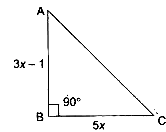
The side (in cm) of a triangle containing the right angle are $5x$ and $3x – 1.$ If the area of the triangle is $60\ cm^2.$ Find the sides of the triangle.
AnswerArea of the right triangle $ABC$
$=\frac{5 x(3 x-1)}{2}$
$\therefore \frac{5 x(3 x-1)}{2}=60$
$\Rightarrow 15 x^2-5 x=120$
$\Rightarrow 3 x^2-x=24$
$\Rightarrow 3 x^2-x-24=0$
$\Rightarrow 3 x^2-9 x+8 x-24=0$
$\Rightarrow 3 x(x-3)+8(x-3)=0$
$\Rightarrow(x-3)(3 x+8)=0$
$\Rightarrow x-3=0 \text { or } 3 x+8=0$
$\Rightarrow x=3$ or $x=\frac{-8}{3}$
But $x=\frac{-8}{3}$ is not possible as isde cannot be $- ve.$
Then $x = 3.$
Hence, sides are $AB = 3x - 1 = 8\ cm$
$BC = 5x = 15\ cm$
Also from $AC$
$=\sqrt{( AB )^2+( BC )^2} $
$=\sqrt{64+225} $
$ =\sqrt{289}$
$=17\ cm .$ View full question & answer→Question 214 Marks
A two digit number is such that the product of the digits is $12.$ When $36$ is added to this number the digits interchange their places. Determine the number.
AnswerLet a digit at unit's place be x and at ten's place by $y.$
then according to problem
Required no.
$= 10y + x$
On interchanging the digits
Number formed
$= 10 x + y$
$xy = 12$
$\therefore x=\frac{12}{y}$
$10 y+x+36=10 x+y$
$10 y+x-10 x-y=-36$
$9 y-9 x=-36$
$9(y-x)=-36$
$y-x=-\frac{36}{9}$
$y-x=-4$
On substituting value of $x =\frac{12}{y}$
$y-\frac{12}{y}=-4$
$\frac{y^2-12}{y}=-4$
$y^2+4 y-12=0$
$y^2+6 y-2 y-12=0$
$y(y+6)-2(y+6)=0$
$(y+6)(y-2)=0$
$y=-6,2$
When $y = 2$
$x=\frac{12}{2}=6$
Required no.
$= 10y + x$
$= 10 x 2 + 6$
$= 20 + 6$
$= 26.$
View full question & answer→Question 224 Marks
Solve: $(x + 2) (x - 5) (x - 6) (x + 1) = 144.$
Answer$(x + 2) (x - 5) (x - 6) (x + 1) = 144$
$\Rightarrow (x + 2) (x - 6) (x - 5) (x + 1)= 144$
$\Rightarrow (x^2 - 4x - 12) (x^2 - 4x - 5) = 144$
Put $x^2 - 4x = y$
Then $(y - 12) (y - 5) = 144$
$\Rightarrow y^2- 17y + 60 - 144 = 0$
$\Rightarrow y^2- 17y - 84 = 0$
$\Rightarrow y^2 - 21y + 4y - 84 = 0$
$\Rightarrow y(y - 21) + 4(y -21) = 0$
$\Rightarrow (y - 21) (y + 4) = 0$
$\Rightarrow y - 21 = 0 or y + 4 = 0$
$\Rightarrow y = 21 or y = -4$
But $x^2 - 4x = y$
$\therefore x^2 - 4x = 21$
$\Rightarrow x^2 - 4x - 21 = 0$
$\Rightarrow x^2 - 7x + 3x - 21 = 0$
$\Rightarrow x(x - 7) + 3(x - 7) = 0$
$\Rightarrow (x - 7) (x +3) = 0$
$\Rightarrow x - 7 = 0 or x + 3 = 0$
$\Rightarrow x = 7 or x = -3$
or
$x^2 - 4x = -4$
$\Rightarrow x^2 - 4x + 4 = 0$
$\Rightarrow (x - 2)^2 = 0$
$\Rightarrow x - 2 = 0$
$\Rightarrow x = 2$
Hence, $x = 7, -3$ and $2.$
View full question & answer→Question 234 Marks
Solve for $x: (x^2 - 5x)^2 - 7(x^2 - 5x) + 6 = 0; x \in R.$
AnswerGiven equation
$\left(x^2-5 x\right)^2-7\left(x^2-5 x\right)+6=0$
Put $x^2-5 x=y$
$\therefore$ The given equation becomes
$y^2-7 y+6=0$
$\Rightarrow y^2-6 y-y+6=0$
$\Rightarrow y(y-6)-1(y-6)=0$
$\Rightarrow y=1,6$
$\text { But } x^2-5 x=y$
$\therefore x^2-5 x=1$
$x^2-5 x-1=0$
$\text { Here } a=1, b=-5, c=-1$
$\therefore x=\frac{-b \pm \sqrt{b^2-4 a c}}{2 a} $
$ x=\frac{-(-5) \pm \sqrt{25+4}}{2} $
$x=\frac{5 \pm \sqrt{29}}{2}$
$x^2-5 x=6 \\ \Rightarrow x^2-5 x-6=0 $
$ \Rightarrow x^2-6 x+x-6=0$
$ \Rightarrow x(x-6)+1(x-6)=0$
$ \Rightarrow(x-6)(x+1)=0 $
$\Rightarrow x=6 \text { or } x=-1$
Hence, the roots are $-1, 6,$ $\frac{5 \pm \sqrt{29}}{2}$.
View full question & answer→Question 244 Marks
Without solving the following quadratic equation, find the value of 'm' for which the given equation has real and equal roots.
$x^2+ 2 (m - 1) x + (m + 5) = 0.$
Answer$x^2+ 2 (m - 1) x + (m + 5) = 0$
Equating with $ax^2 + bx + c = 0$
$a = 1, b = 2 (m - 1), c = (m + 5)$
Since equation has real and equal roots.
so, $D = 0$
$\Rightarrow b^2 - 4ac = 0$
$\Rightarrow [2 (m - 1)^2 - 4 x 1 x (m + 5) = 0$
$\Rightarrow 4 (m - 1)^2 - 4 (m + 5) = 0$
$\Rightarrow 4 [m^2- 2m + 1 - m - 5)] = 0$
$\Rightarrow m^2 - 3m - 4 = 0$
$\Rightarrow (m + 1) (m - 4) = 0$
Either $m + 1 = 0$
$m = -1$
or
$m - 4 = 0$
$m = 4$
$m = -1, 4$
View full question & answer→Question 254 Marks
Solve for x using the quadratic formula. Write your answer correct to two significant figures $(x -1)^2 – 3x + 4 = 0.$
Answer$(x-1)^2-3 x+4=0$
$x^2+1-2 x-3 x+4=0$
$x^2-5 x+5=0$
Comparing it with
$a x^2+b x+c=0$, we get
$a = 1, b = -5, c = 5$
By using the formula,
$x=\frac{-b \pm \sqrt{b^2-4 a c}}{2 a c}$
$=\frac{5 \pm \sqrt{25-20}}{2}$
$=\frac{5 \pm \sqrt{5}}{2}$
$x=\frac{5 \pm 2 \cdot 24}{2}$
$\text { Taking +ve sign } x=\frac{b+2 \cdot 24}{2} $
$ x=3.62$
Taking -ve sign $x=\frac{5-2 \cdot 25}{2}$
$=\frac{2 \cdot 76}{2}$
$=1.38$
Thus required value are $3.62$ and $1.38$
View full question & answer→Question 264 Marks
Solve the equation $2 x -\frac{1}{x}=7$. Write your answer correct to two decimal places.
AnswerSolve the equation $2 x-\frac{1}{x}=7$
$2 x^2-1=7 x $
$ 2 x^2-7 x-1=0$
For quadratic equation $a x^2+b x+c=0$
$x =\frac{-b \pm \sqrt{2^2-4 a c}}{2 a}$
Here, $a =2, b =-7, c =-1$
Therefore,
$x=\frac{-(-7) \pm \sqrt{(-7)^2-4 \times 2 \times(-1)}}{2 \times 2} $
$x=\frac{7 \pm \sqrt{49+8}}{4} $
$=\frac{7 \pm \sqrt{57}}{4}$
$=\frac{7+\sqrt{57}}{4} \text { or } x=\frac{7-\sqrt{57}}{4} $
$ x=\frac{7+7 \cdot 550}{4} \text { or } x=\frac{7-7 \cdot 550}{4}$
$x = 3.64$ or $x = -0.14$
View full question & answer→Question 274 Marks
Solve using the quadratic formula $x^2 – 4x + 1 = 0$
Answer$x^2-4 x+1=0$
$a=1, b=-4, c=1$
$x=\frac{-b \pm \sqrt{b^2-4 a c}}{2 a}$
$=\frac{-(-4) \pm \sqrt{(-4)^2-4 \times 1 \times 1}}{2 \times 1} $
$=\frac{4 \pm \sqrt{16-4}}{2} $
$ =\frac{4+\sqrt{12}}{2}$
Taking $(+)$
$=\frac{4+2 \sqrt{3}}{2} $
$=2+\sqrt{3}$
$\therefore x = 2 + 1·732$
$= 3·732$
Taking $(-)$
or $x = \frac{4-\sqrt{12}}{2}$
$=\frac{4-2 \sqrt{3}}{2}$
$=2-\sqrt{3}$
$\therefore x = 2 - 1.732$
$= 0.268$
Hence, $x=2+\sqrt{3}$ and $2-\sqrt{3}$
or $3.732$ and $0.268$
View full question & answer→Question 284 Marks
Solve the following equation and give your answer up to two decimal places:
$x^2 - 5x - 10 = 0$
AnswerGiven equation is $x^2-5 x-10=0$
On comparing with $a x^2+b x+c=0$
$a = 1, b = -5, c = -10$
$\because x =\frac{-b \pm \sqrt{b^2-4 a c}}{2 a}$
$\therefore x=\frac{5 \pm \sqrt{25+40}}{2}$
$x=\frac{5 \pm \sqrt{65}}{2}$
x = $\frac{5 \pm 8 \cdot 06}{2}$
$x=\frac{5+8 \cdot 06}{2} $
$ =\frac{13 \cdot 06}{2}$
$= 6.53$
and x = $\frac{5-8 \cdot 06}{2}$
$=\frac{-3 \cdot 06}{2}$
$= -1.53$
$x = 6.53, x = -1.53$
View full question & answer→Question 294 Marks
In a two digit number, the unit’s digit is twice the ten’s digit. If 27 is added to the number, the digit interchange their places. Find the number.
AnswerLet ten's digit = x
Unit's digit = 2x
Required number
= 10x + 2x
= 12x
On interchanging the digit's
Number formed
= 10 (2x) + x
= 21x
According given condition
12x + 27 = 21x
27 = 21x - 12x
27 = 9x
$\therefore x =\frac{27}{9}$
x = 3
∴ Required number
= 12 x 3
= 36
View full question & answer→Question 304 Marks
The sum of the squares of three consecutive natural numbers is $110$. Determine the numbers.
AnswerLet three consecutive natural numbers be $x, x + 1$ and $x + 2.$
Then according to problem
$(x)^2 = (x + 1)^2 + (x + 2)^2 = 110$
$\Rightarrow x^2 + x^2 + 1 + 2x + x^2 + 4 + 4x - 110 = 0$
$\Rightarrow 3x^2 + 6x - 105 = 0$
$\Rightarrow x^2 + 2x - 35 = 0$
$\Rightarrow x^2 + 7x - 5x - 35 = 0$
$\Rightarrow x(x + 7) - 5(x + 7) = 0$
$\Rightarrow (x + 7) (x - 5) = 0$
$\Rightarrow x + 7 = 0 or x - 5 = 0$
$\Rightarrow x = -7 or x = 5$
But $x = -7$ is rejected as it is not a natural number.
Then$ x = 5$
Hence, required numbers are $5, (5 + 1), (5 + 2) i.e., 5, 6$ and $7.$
View full question & answer→Question 314 Marks
The sum of two natural numbers is $15$ and the sum of their reciprocals is $\frac{3}{10}$. Find the numbers.
AnswerLet the two numbers be $x$ and $y.$
According to the question,
$x + y = 15$
$\Rightarrow y=15-x \ldots \text {..(i) }$
and $\frac{1}{x}+\frac{1}{y}=\frac{3}{10}$
$\Rightarrow \frac{1}{x}+\frac{1}{15-x}=\frac{3}{10}$ ..(From (i))
$\Rightarrow \frac{15-x+x}{x(15-x)}=\frac{3}{10}$
$\Rightarrow 15 \times 10=3 x(15-x)$
$\Rightarrow 150=45 x-3 x^2$
$\Rightarrow 3 x^2-45 x+150=0$
$\Rightarrow x^2-15 x+50=0$
$\Rightarrow x^2-10 x-5 x+50=0$
$\Rightarrow x(x-10)-5(x-10)=0$
$\Rightarrow x-10=0 \text { or } x-5=0$
$\Rightarrow x=10 \text { or } x=5$
Hence, the numbers are $10, 5.$
View full question & answer→Question 324 Marks
Solve the equation $x^4 + 2x^3- 13x^2 + 2x + 1 = 0.$
AnswerGiven equation
$x^4+2 x^3-13 x^2+2 x+1=0$
Dividing both sides by $x2,$ we get
$x ^2+2 x -13+\frac{2}{x}+\frac{1}{x^2}=0$
$\Rightarrow\left(x^2+\frac{1}{x^2}\right)+2\left(x+\frac{1}{x}\right)-13=0$
Put $x+\frac{1}{x}=y$, squaring $x^2+\frac{1}{x^2}+2=y^2$
$
\Rightarrow x^2+\frac{1}{x^2}=y^2-2
$
Then $y ^2-2+2 y -13=0$
$\Rightarrow y^2+2 y-15=0$
$\Rightarrow y^2+5 y-3 y-15=0$
$\Rightarrow y(y+5)-3(y+5)=0$
$\Rightarrow(y+5)(y-3)=0$
$\Rightarrow y+5=0 \text { or } y=-5$
or $y-3=0$ or $y=3$
But $x+\frac{1}{x}=-5$
Then $x+\frac{1}{x}=-5$
$\Rightarrow x^2+1=-5$
$\Rightarrow x^2+5 x+1=0$
$\Rightarrow x=\frac{-b \pm \sqrt{b^2-4 a c}}{2 a}$
$x=\frac{-5 \pm \sqrt{25-4}}{2 \times 1}$
$x=\frac{-5 \pm \sqrt{25-4}}{2}$
$x=\frac{-5 \pm \sqrt{21}}{2}$
or $x+\frac{1}{x}=3$
$\Rightarrow x^2+1=3$
$\Rightarrow x^2-3 x +1=0$
$\Rightarrow x =\frac{-b \pm \sqrt{b^2-4 a c}}{2 a}$
$x =\frac{-(-3) \pm \sqrt{9-4}}{2}$
$x =\frac{3 \pm \sqrt{5}}{2}$
Hence $x=\frac{-5 \pm \sqrt{21}}{2}, \frac{3 \pm \sqrt{5}}{2}$
View full question & answer→Question 334 Marks
Solve for $x: \left(x+\frac{1}{x}\right)^2-\frac{3}{2}\left(x-\frac{1}{x}\right)-4=0$
AnswerGiven equation
$\left(x+\frac{1}{x}\right)^2-\frac{3}{2}\left(x-\frac{1}{x}\right)-4=0$
Put $x-\frac{1}{x}=y$, squaring $x^2+\frac{1}{x^2}-2=y^2$
$\Rightarrow x^2+\frac{1}{x^2}=y^2+2$
Then given rquation becomes :
$x^2+\frac{1}{x^2}+2-\frac{3}{2}\left(x-\frac{1}{x}\right)-4=0$
$\Rightarrow y^2+2+2-\frac{3}{2} y-4=0$
$\Rightarrow y^2+4-\frac{3}{2} y-4=0$
$\Rightarrow 2 y^2-3 y=0$
$\Rightarrow y(2 y-3)=0$
$\Rightarrow y=0$ or $2 y-3=0$
i.e., $y=\frac{3}{2}$
But $x-\frac{1}{x}=y$
Then $x-\frac{1}{x}=0$
$\Rightarrow x 2-1=0$
$\Rightarrow x = \pm 1$
or
$x-\frac{1}{x}=\frac{3}{2}$
$\Rightarrow \frac{x^2-1}{x}=\frac{3}{2}$
$\Rightarrow 2 x^2-2=3 x$
$\Rightarrow 2 x^2-3 x-2=0$
$\Rightarrow 2 x^2-4 x+x-2=0$
$\Rightarrow 2 x(x-2)+1(x-2)=0$
$\Rightarrow(x-2)(2 x+1)=0$
$\Rightarrow x-2=0 \text { or } 2 x+1=0$
$\Rightarrow x=2 \text { or } x=-\frac{1}{2}$
Hence, $x= \pm 1,2,-\frac{1}{2} .$
View full question & answer→