MCQ
Sound waves travel fastest in
  • Solids
  • B
    Liquids
  • C
    Gases
  • D
    Vacuum

Answer

Correct option: A.
Solids
a
Sound waves travel fastest in solids

Need a full question paper?

Generate a complete, print-ready paper with questions like this in minutes — across 16+ boards, with answer keys.
Start Generating Free

Similar questions

An object kept in a large room having air temperature of $25^{\circ} \mathrm{C}$ takes $12$ minutes to cool from $80^{\circ} \mathrm{C}$ to $70^{\circ} \mathrm{C}$. The time taken to cool for the same object from $70^{\circ} \mathrm{C}$ to $60^{\circ} \mathrm{C}$ would be nearly.....$min$
$50\, gm$ of ice at $0°C$ is mixed with $50\, gm$ of water at $80°C,$ final temperature of mixture will be........ $^oC$
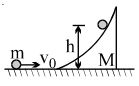
A particle of mass $m$ moving horizontally with $v_0$ strikes $a$ smooth wedge of mass $M$, as shown in figure. After collision, the ball starts moving up the inclined face of the wedge and rises to $a$ height $h$. Identify the correct statement $(s)$ related to the situation when the particle starts moving downward.
A person is standing in an elevator. In which situation, he experiences weight loss?
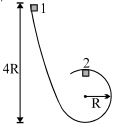
$A$ small cube with mass $M$ starts at rest at point $1$ at a height $4R$, where $R$ is the radius of the circular part of the track. The cube slides down the frictionless track and around the loop. The force that the track exerts on the cube at point $2$ is nearly ......... times the cube's weight $mg$.
Ultrasonic signal sent from $SONAR$ returns to it after reflection from a rock after a lapse of $1 \,sec.$ If the velocity of ultrasound in water is $1600 ms^{-1}$, the depth of the rock in water is ..... $m$
Some physical quantities are given in Column $I$ and some possible $SI$ units in which these quantities may be expressed are given in Column $II$. Match the physical quantities in Column $I$ with the units in Column $II$ and indicate your answer by darkening appropriate bubbles in the $4 \times 4$ matrix given in the $ORS$.

Column $I$ Column $II$

$(A)$ $\mathrm{GM}_e \mathrm{M}_5$

$\mathrm{G} \rightarrow$ universal gravitational constant, $\mathrm{M}_{\mathrm{e}} \rightarrow$ mass of the earth,

$\mathrm{M}_5 \rightarrow$ mass of the Sun

$(p)$ (volt) (coulomb) (metre)

$(B)$ $\frac{3 \mathrm{RT}}{\mathrm{M}} ; \mathrm{R} \rightarrow$ universal gas constant, $\mathrm{T} \rightarrow$ absolute temperature,

$\mathrm{M} \rightarrow$ molar mass

$(q)$ (kilogram) $(\text { metre) })^3$ (second) $)^{-2}$
$(C)$ $\frac{F^2}{q^2 B^2}$ ;$\quad F \rightarrow$ force, $q \rightarrow$ charge, $B \rightarrow$ magnetic field  $(r)$ $(\text { meter })^2$ (second) $)^{-2}$

$(D)$ $\frac{\mathrm{GM}_e}{\mathrm{R}_{\mathrm{e}}}, G \rightarrow$ universal gravitational constant,

$\mathrm{M}_{\mathrm{e}} \rightarrow$ mass of the earth, $\mathrm{R}_{\mathrm{e}} \rightarrow$ radius of the earth

$(s)$ (farad) $(\text { volt) })^2(\mathrm{~kg})^{-1}$
A ball is dropped from height $5\,\,m$. The time after which ball stops rebounding if coefficient of restitution between ball and ground $e = 1/2$, is ............. $\mathrm{sec}$
If the absorption and reflection co-efficients of a surface of a body are $0.4$ and $0.6$ respectively, then
In absence of torque the rotational frequency of a body changes from $1$ cy/sec to $16$ cy/sec, then ratio of radius of gyration in two cases will be :