MCQ
Speed of electromagnetic waves is the same:
- AFor all wavelengths.
- BIn all media.
- CFor all intensities.
- DFor all frequencies.
Explanation:
For any given medium, the speed (c) of an electromagnetic wave is given by,
$\text{C}=\text{v}\lambda$
Where,
V = Frequency of the electromagnetic wave.
$\lambda=$ wavelength of the electromagnetic wave.
As the frequency and wavelength are changed, the speed of the electromagnetic wave changes. So, the speed of an electromagnetic wave is not same for all wavelengths and all frequencies in any medium. The velocity of an electromagnetic wave changes with change in medium. Also, the speed of an electromagnetic wave is same for all the intensities in any medium.
Generate a complete, print-ready paper with questions like this in minutes — across 16+ boards, with answer keys.
Magnetic flux in a circuit containing a coil of resistance 2Ω changes from 2.0 Wb to 10 Wb in 0.2 sec. The charge passed through the coil in this time is
|
(a) 0.8 C |
(b) 1.0 C |
(c) 5.0 C |
(d) 4.0 C |
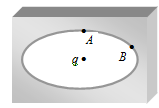
An ellipsoidal cavity is carved within a perfect conductor. A positive charge q is placed at the centre of the cavity. The points A and B are on the cavity surface as shown in the figure. Then
|
(a) Potential at A = Potential at B |
|
(b) Total electric field flux through the surface of the cavity is q/ |
|
(c) Electric field near A in the cavity = Electric field near B in the cavity |
|
(d) a, b |
A wire carrying a current i is placed in a uniform magnetic field in the form of the curve y = asin 0 ≤ x ≤ 2L. The force acting on the wire is

|
(a) |
(b) iBL |
(c) 2iBL |
(d) Zero |
When a potential difference is applied across, the current passing through
| (a) An insulator at 0 K is zero |
| (b) A semiconductor at 0 K is zero |
|
(c) A P-N diode at 300 K is finite, if it is reverse biased |
| (d) a, b, c |
A nucleus ruptures into two nuclear parts which have their velocity ratio equal to 2 : 1. What will be the ratio of their nuclear size (nuclear radius)
|
(a) |
(b) 1 : |
(c) |
(d) 1 : |
The de-Broglie wavelength l
|
(a) is proportional to mass |
(b) is proportional to impulse |
|
(c) Inversely proportional to impulse |
(d) does not depend on impulse |
A 25 watt, 220 volt bulb and a 100 watt, 220 volt bulb are connected in series across a 220 volt lines. Which electric bulb will glow more brightly
|
(a) 25 watt bulb |
(b) 100 watt bulb |
|
(c) First 25 watt and then 100 watt |
(d) Both with same brightness |
To an observer on the earth the stars appear to twinkle. This can be ascribed to
|
(a) The fact that stars do not emit light continuously |
|
(b) Frequent absorption of star light by their own atmosphere |
|
(c) Frequent absorption of star light by the earth's atmosphere |
|
(d) The refractive index fluctuations in the earth's atmosphere |


