MCQ
${{\sqrt {(5/2)} + \sqrt {(7 - 3\sqrt 5 )} } \over {\sqrt {(7/2)} + \sqrt {(16 - 5\sqrt 7 )} }}=$
  • Rational
  • B
    Surd
  • C
    Multiple of $\sqrt 7 $
  • D
    None of these

Answer

Correct option: A.
Rational
a
(a) ${{\sqrt {5/2} + \sqrt {7 - 3\sqrt 5 } } \over {\sqrt {7/2} + \sqrt {16 - 5\sqrt 7 } }} = {{\sqrt 5 + \sqrt {14 - 6\sqrt 5 } } \over {\sqrt 7 + \sqrt {32 - 10\sqrt 7 } }}$

$= {{\sqrt 5 + (3 - \sqrt {5)} } \over {\sqrt 7 + (5 - \sqrt 7 )}} = {3 \over 5}$, which is rational.

Need a full question paper?

Generate a complete, print-ready paper with questions like this in minutes — across 16+ boards, with answer keys.

Start Generating Free

Similar questions

Define $g(x)=\int \limits_{-3}^3 f(x-y) f(y) d y$, for all real $x$, where $f(t)=\left\{\begin{array}{ll}1, & 0 \leq t \leq 1 \\ 0, & \text { else where }\end{array}\right.$ Then,
If the shortest distance between the lines $\frac{x+2}{2}=\frac{y+3}{3}=\frac{z-5}{4}$ and $\frac{x-3}{1}=\frac{y-2}{-3}=\frac{z+4}{2}$ is $\frac{38}{3 \sqrt{5}} \mathrm{k}$ and $\int_0^{\mathrm{k}}\left[\mathrm{x}^2\right] \mathrm{dx}=\alpha-\sqrt{\alpha}$, where $[\mathrm{x}]$ denotes the greatest integer function, then $6 \alpha^3$ is equal to ............................
If the lines $\frac{{x - 1}}{{ - 3}} = \frac{{y - 2}}{{2k}} = \frac{{z - 3}}{2}$, $\frac{{x - 1}}{{3k}} = \frac{{y - 5}}{1} = \frac{{z - 6}}{{ - 5}}$ are at right angles, then $k =$
Solution set of equation

$\left| {1 - {{\log }_{\frac{1}{6}}}x} \right| + \left| {{{\log }_2}x} \right| + 2 = \left| {3 - {{\log }_{\frac{1}{6}}}x + {{\log }_{\frac{1}{2}}}x} \right|$ is $\left[ {\frac{a}{b},a} \right],a,b, \in N,$ then the value of $(a + b)$ is
A ball thrown vertically upwards falls back on the ground after  $6$ second. Assuming that the equation of motion is of the form $s = ut - 4.9{t^2}$, where s is in metre and  $t$ is in second, find the velocity at $t = 0$ .......... $m/s$.
Let $f : R \to R$ , where $f(x) = \frac{{a{x^2} + ax + b}}{{ax + b}}$ , then
If $\alpha, \beta, \gamma, \delta$ are the roots of the equation $x^{4}+x^{3}+x^{2}+x+1=0$, then $\alpha^{2021}+\beta^{2021}+\gamma^{2021}+\delta^{2021}$ is equal to
Suppose $a_1, a_2, 2, a_3, a_4$ be in an arithmeticogeometric progression. If the common ratio of the corresponding geometric progression is $2$ and the sum of all $5$ terms of the arithmetico-geometric progression is $\frac{49}{2}$, then $a_4$ is equal to $...........$.
Let $\theta=\frac{\pi}{5}$ and $A=\left[\begin{array}{cc}\cos \theta & \sin \theta \\ -\sin \theta & \cos \theta\end{array}\right] \cdot$ If $B=A + A ^{4},$ then $\operatorname{det}( B )$
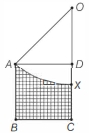
In the figure, $A B C D$ is a unit square. A circle is drawn with centre $O$ on the extended line $C D$ and passing through $A$. If the diagonal $A C$ is tangent to the circle, then the area of the shaded region is