MCQ
Starting at temperature $300\; \mathrm{K},$ one mole of an ideal diatomic gas $(\gamma=1.4)$ is first compressed adiabatically from volume $\mathrm{V}_{1}$ to $\mathrm{V}_{2}=\frac{\mathrm{V}_{1}}{16} .$ It is then allowed to expand isobarically to volume $2 \mathrm{V}_{2} \cdot$ If all the processes are the quasi-static then the final temperature of the gas (in $\left. \mathrm{K}\right)$ is (to the nearest integer)
  • $1818$
  • B
    $2020$
  • C
    $1576$
  • D
    $1734$

Answer

Correct option: A.
$1818$
a
$\mathrm{PV} ^\gamma=$ constant

$\mathrm{TV} ^{\gamma-1}=\mathrm{C}$

$300 \times \mathrm{V}^{\frac{7}{5}-1}=\mathrm{T}_{2}\left(\frac{\mathrm{V}}{16}\right)^{\frac{7}{5}-1}$

$300 \times 2^{4 \times \frac{2}{5}}=\mathrm{T}_{2}$

Isobaric process

$\mathrm{V}=\frac{\mathrm{nRT}}{\mathrm{P}}$

$\mathrm{V}_{2}=\mathrm{kT}_{2}$

$2 \mathrm{V}_{2}=\mathrm{KT}_{\mathrm{f}}$

$\frac{1}{2}=\frac{\mathrm{T}_{2}}{\mathrm{T}_{\mathrm{f}}} \Rightarrow \mathrm{T}_{\mathrm{f}}=2 \mathrm{T}_{2}$

$\mathrm{T}_{\mathrm{f}}=2 \times 300 \times 2^{\frac{8}{5}}=1818.85$

Need a full question paper?

Generate a complete, print-ready paper with questions like this in minutes — across 16+ boards, with answer keys.

Start Generating Free

Similar questions

Ice formed over lakes has
Surface of the lake is at $2°C$ . Find the temperature of the bottom of the lake..... $^oC$
A car is moving on a plane inclined at $30^{\circ}$ to the horizontal with an acceleration of $10\, {ms}^{-2}$ parallel to the plane upward. A bob is suspended by a string from the roof of the car.The angle in degrees which the string makes with the vertical is ...... . (Take ${g}=10\, {ms}^{-2}$ )
In Boyle's law what remains constant
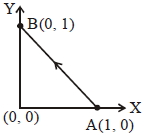
Consider a force $\overrightarrow{\mathrm{F}}=-\mathrm{x} \hat{\mathrm{i}}+\mathrm{y} \hat{\mathrm{j}}$. The work done by this force in moving a particle from point $\mathrm{A}(1,0)$ to $\mathrm{B}(0,1)$ along the line segment is 

(all quantities are in $SI$ units)

A ball is projected from the ground with a speed $15 \,ms ^{-1}$ at an angle $\theta$ with horizontal so that its range and maximum height are equal, then $tan\,\theta$ will be equal to 
One mole of monoatomic gas and three moles of diatomic gas are put together in a container. The molar specific heat (in $J\,{K^{ - 1}}\,mo{l^{ - 1}})$ at constant volume is $(R = 8.3\,J\,{K^{ - 1}}\,mo{l^{ - 1}})$
The internal energy of an ideal gas depends only on:
If mass of a body is $M$ on the earth surface, then the mass of the same body on the moon surface is
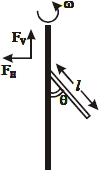
A uniform rod of length $'l'$ is pivoted at one of its ends on a vertical shaft of negligible radius When the shaft rotates at angular speed $\omega$ the rod makes an angle $\theta$ with it (see figure). To find $\theta$ equate the rate of change of angular momentum (direction going into the paper ) $\frac{ m \ell^{2}}{12} \omega^{2} \sin \theta \cos \theta$ about the centre of mass $(CM)$ to the torque provided by the horizontal and vertical forces $F_{H}$ and $F_{V}$ about the CM. The value of $\theta$ is then such that: