MCQ
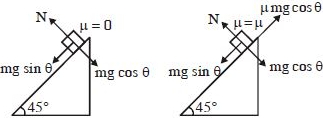
Starting from rest a body slides down a $45^o$ inclined plane in twice the time it takes to slide down the same distance in the absence of friction. The co-efficient of friction between the body and the inclined plane is 
  • $0.75$
  • B
    $0.33$
  • C
    $0.25$
  • D
    $0.80$

Answer

Correct option: A.
$0.75$
a
Let acceleration in $\mathrm{I}^{\mathrm{st}}$ case in $a_1$ and that in second

case is $a_2$

Now $\quad \frac{1}{2} a_{1} t^{2}=\frac{1}{2} a_{2}(2 t)^{2}$

$\Rightarrow \quad a_{2}=\frac{a_{1}}{4}$        $...(i)$

Clearly $a_{1}=\frac{\operatorname{mg} \sin \theta}{m}=g \sin \theta \quad$        $...(ii)$

and          $a_{2}=\frac{m g \sin \theta-\mu m g \cos \theta}{m}$     

$=g \sin \theta-\mu g \cos \theta$           $...(iii)$

From $(i),$ $(ii)$ and $(iii),$ we get

$\mu=0.75$

Need a full question paper?

Generate a complete, print-ready paper with questions like this in minutes — across 16+ boards, with answer keys.

Start Generating Free

Similar questions

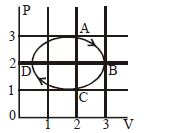
The figure shows the $P-V$ plot of an ideal gas taken through a cycle $ABCDA.$ The part $ABC$ is a semicircle and $CDA$ is half of an ellipse. Then,
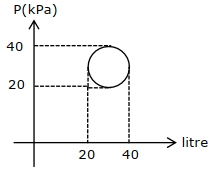
In the reported figure, heat energy absorbed by a system in going through a cyclic process is $......\,\pi J$
Assertion $(A):$ If there is not external torque on a body about its centre of mass, then the velocity of the centre of mass remains constant.

Reason $(R):$ The linear momentum of an isolated system remains constant.

The kinetic energy acquired by a mass $m$ in travelling a certain distance $d$ starting from rest under the action of a constant force is directly proportional to
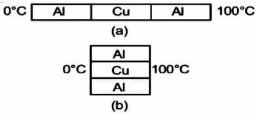
The three rods shown in figure have identical dimensions. Heat flows from the hot end at a rate of $40 \,W$ in the arrangement $(a)$. Find the rates of heat flow when the rods are joined as in arrangement $(b)$ is ......... $W$ (Assume $K_al=200 \,W / m ^{\circ} C$ and $\left.K_{c u}=400 \,W / m ^{\circ} C \right)$
Which is not a physical quantity
A ball is thrown up with a certain velocity at an angle $\theta$ to the horizontal. The kinetic energy $KE$ of the ball varies with horizontal displacement $x$ as
A particle moves in the $x-y$ plane under the action of a force $\,\vec F$ such that the value of its linear momentum $(\,\vec P)$ at anytime $t$ is $P_x = 2cost$ , $P_y = 2sint$ . The angle between $\,\vec F$ and $\,\vec P$ at a given time $t$ , will be 
A block is placed on a rough floor and a horizontal force $F$ is applied on it. The force of friction $f$ by the floor on the block is measured for different values of $F$ and a graph is plotted between them.
  1. The graph is a straight line of slope $45^\circ$ .
  2. The graph is a straight line parallel to the $F-$axis.
  3. The graph is a straight line of slope $45^\circ$ for small $F$ and a straight line parallel to the $F-$axis for large $F.$
  4. There is a small kink on the graph.
The amplitude of vibration of a particle is given by ${a_m} = ({a_0})/(a{\omega ^2} - b\omega + c);$ where ${a_0},a,b$ and $c$ are positive. The condition for a single resonant frequency is