MCQ
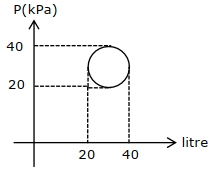
In the reported figure, heat energy absorbed by a system in going through a cyclic process is $......\,\pi J$
  • A
    $50$
  • B
    $150$
  • $100$
  • D
    $200$

Answer

Correct option: C.
$100$
c
For complete cyclic process

$\Delta U=0$

$\therefore \text { from } \Delta Q=\Delta U+W$

$=0+W$

$\Delta Q=W$

$=\text { Area }$

$=\pi r_{1} \cdot r_{2}$

$=\pi \times\left(10 \times 10^{3}\right)\left(10 \times 10^{-3}\right)$

$\Delta Q=100 \pi$

$\therefore \text { Ans. }=100$
Need a full question paper?

Generate a complete, print-ready paper with questions like this in minutes — across 16+ boards, with answer keys.
Start Generating Free

Similar questions

When there is no external force, the shape of a liquid drop is determined by
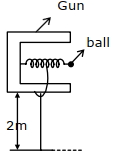
In a spring gun having spring constant $100\, {N} / {m}$ a small ball $'B'$ of mass $100\, {g}$ is put in its barrel (as shown in figure) by compressing the spring through $0.05\, {m}$. There should be a box placed at a distance $'d'$ on the ground so that the ball falls in it. If the ball leaves the gun horizontally at a height of $2\, {m}$ above the ground. The value of $d$ is $....{m} .$ $\left(g=10\, {m} / {s}^{2}\right)$
When temperature of an ideal gas is increased from $27^\circ C$ to $227^\circ C$, its $r.m.s.$ speed changed from $400\, metre/sec$ to ${V_s}.$ The ${V_s}$ is ........ $metre/sec$
If the kinetic energy of two objects is equal and the ratio of their masses is $1: 2$ then the ratio of their linear moment will be :
A block of mass $50\, kg$ slides over a horizontal distance of $1\, m$. If the coefficient of friction between their surfaces is $0.2$, then work done against friction is ......... $J$
Which of the following displacement $(X)$ time graphs is not possible?
Work done by a sample of an ideal gas in a process $A$ is double the work done in another process $B.$ The temperature rises through the same amount in the two processes. If $C_A$ and $C_B$ be the molar heat capacities for the two processes:
Two particles $A$ and $B$ initially at rest, move towards each other, under mutual force of attraction. At an instance when the speed of $A$ is $v$ and speed of $B$ is $2v,$ the speed of centre of mass $(CM)$ is:
Three particles, located initially on the vertices of an equilateral triangle of side $L,$ start moving with a constant tangential acceleration towards each other in a cyclic manner, forming spiral loci that coverage at the centroid of the triangle. The length of one such spiral locus will be
A whistle giving out $450 Hz$ approaches a stationary observer at a speed of $33 m/s.$ The frequency heard by the observer in $Hz$ is