Question
Derive an expression for a current generated due to flow of charged particles

Answer

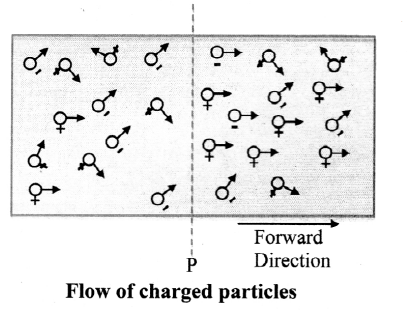
$i.$ Consider an imaginary gas of both negatively and positively charged particles moving randomly in various directions across a plane $P.$
Image
$ii.$ In a time interval $t,$ let the amount of positive charge flowing in the forward direction be $q^+$ and the amount of negative charge flowing in the forward direction be $q^–.$ Thus, the net charge flowing in the forward direction is $q = q^+ – q^{–}$
$iii.$ Let I be the current varying with time. Let $\Delta q$ be the amount of net charge flowing across the plane $P$ from time $t$ to $t+A t$, i.e. during the time interval $\Delta t$.
$iv.$ Then the current is given by
$I ( t )=\lim _{\Delta t \rightarrow 0} \frac{\Delta q }{\Delta t }$
Flere, the current is expressed as the limit of the ratio $(\Delta q / \Delta t)$ as $\Delta t$ tends to zero.

Need a full question paper?

Generate a complete, print-ready paper with questions like this in minutes — across 16+ boards, with answer keys.
Start Generating Free

Similar questions

How does electric conduction take place inside a pure silicon?
Give the magnitude and direction of the net force acting on$:3$
$1.$ a drop of rain falling down with a constant speed.
$2.$ a cork of mass $10 g$ floating on water.
$3.$ a kite skilfully held stationary in the sky.
$4.$ a car moving with a constant velocity of $30 \ kmh^{-1}$ on a rough road.
$5.$ a high speed electron in space far from all gravitating objects, and free of electric and magnetic fields.
What is super conductivity?
Explain relative velocity between two objects moving in a plane.
Explain asymmetrical flow of current in $p-n$ junction diode in detail.
The acceleration due to gravity is determined by using a simple pendulum of length $l = (100 ± 0.1) \ cm$. If its time period is $T = (2 ± 0.01) s$, find the maximum percentage error in the measurement of g.
A monochromatic ray of light is incident at $37^\circ $ on an equilateral prism of refractive index $3/2$. Determine angle of emergence and angle of deviation. If angle of prism is adjustable, what should its value be for emergent ray to be just possible for the same angle of incidence.
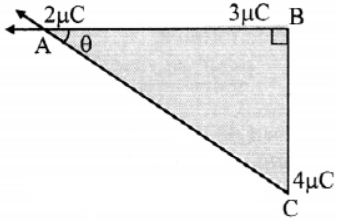
Three charges of $2 \mu C, 3\mu C$ and $4 \mu C$ are placed at points $A, B$ and $C$ respectively, as shown in the figure. Determine the force on $A$ due to other charges.
$($Given: $AB = 4 \ cm, BC = 3 \ cm)$
Image
Derive an expression for decrease in potential energy when a charge flows through an external resistance in a circuit.
A girl stands 170 m away from a high wall and claps her hands at a steady rateso that each clap coincides with the echo of the one before.
a) If she makes 60 claps in 1 minute, what value should be the speed of sound in air?
b) Now, she moves to another location and finds that she should now make 45 claps in 1 minute to coincide with successive echoes. Calculate her distance for the new position from the wall.