Question
State and explain Maxwell’s right-hand thumb rule.

Answer

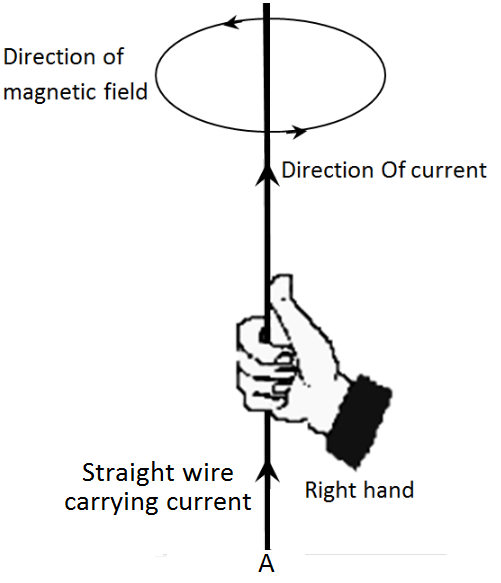
According to Maxwell’s right hand thumb rule: Imagine that you are grasping the currentcarrying wire in your right hand so that your thumb points in the direction of current, then the direction in which your fingers encircle the wire will give the direction of magnetic field lines around the wire.
Let AB be the straight wire carrying current in the vertically upward direction from A to B. To find out the direction of the magnetic field lines produced by this current, we imagine that we are grasping the current carrying wire in our right hand as shown in fig. so that our thumb points in the direction of current towards B. Now, the direction in which our fingers are folded gives the direction of magnetic field lines. In this case, the direction of magnetic field lines is in the anticlockwise direction.

Need a full question paper?

Generate a complete, print-ready paper with questions like this in minutes — across 16+ boards, with answer keys.
Start Generating Free

Similar questions

Explain the following:
In cold regions in winter, the rocks crack due to anomalous expansion of water.
When the branches of a plant growing in the field are pulled towards the ground and a part of them is covered with moist soil (leaving the tips of the branches exposed above the ground), then after some time new roots develop from the parts of branches buried in the soil. On cutting these branches from the parent plant, new plants are produced from the cut parts of branches which had developed roots.
  1. What is this method of propagation of plants known as?
  2. What type of branches should a plant have to be able to be propagated by this method?
  3. Name any two plants which are grown for their flowers and propagated by this method.
  4. Name any two plants which are grown for their fruits and propagated by this method.
  5. Name one plant which gets propagated by this method naturally by forming runners (soft horizontal stems running above the ground).
“Only variations that confer an advantage to an individual organism will survive in a population”. Do you agree with this statement? Give reason for your answer.
When an insect sits on the flower of a plant then some particles A present in the top of little stalks in the flower attach to its body hair. When this insect now sits on the flower of another similar plant, then particles A attached to the hair of insect are put on the top of a flask-shaped organ at the centre of flower. The particle A grows a long tube b from the top of flask-shaped organ through which C moves down and reaches the bottom part of flask-shaped organ. Here C fuses with the nucleus of d contained in structure E. the fusion of C and D forms a new cell f which grows and develops into a seed of the plant.
  1. What are particles A? What is the process of transferring A from one flower to another flower of similar plant by the insect known as?
  2. What is the name of tube B?
  3. What is C which moves down through the tube B?
  4. Name D and E.
  5. What is F?
Answer the following questions:
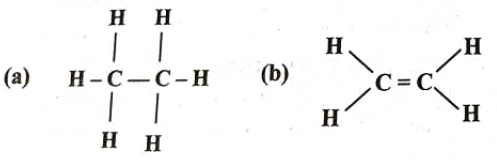
i. Identify saturated and unsaturated hydrocarbon from the given structural formula:
Image
ii. Draw electron dot structure for (a) and (b).
iii. Define Homologous series.
The stem of a fruit tree X fixed in soil is cut in a slanting way. The upper part of stem of another fruit tree Y of different variety of same species is also cut in a slanting way. The cut stem of tree Y, without roots but having some leaves, is placed over the rooted cut stem of tree X in such a way that their cut surfaces fit together properly. While joining the two cut stems, care is taken to make sure that the layer Z of one cut stem is in contact with layer Z of the other cut stem. The joint of cut stem is The stem of a fruit tree X fixed in soil is cut in a slanting way. The upper part of stem of another fruit bound tightly with a piece of cloth and covered properly with polythene. Soon the cut heals and the two stems grow together and become one fruit tree producing leaves, flowers and fruits.
  1. What is the name of this method of producing plants or trees?
  2. What name is given to the cut stem of tree X having roots?
  3. What name is given to the cut stem of tree Y which has no roots but has some leaves?
  4. Name the layer Z.
  5. Why should the layer Z of one cut stem be in contact with the layer Z of the other cut stem?
  6. Name any four fruit trees which are usually bred by this technique.
  7. State any one advantage of producing fruit trees by this technique.
Explain the magnetic field created around a straight current carrying conductor with the help of a diagram.
If the angle of incidence and angle of emergence of a light ray falling on a glass slab are i and e respectively, prove that i = e. (Practice Activity Sheet – 4)
Which different aspects of disaster management would you check for your school? Why?
With the help of a labelled ray-diagram, describe how a plane mirror forms an image of a point source of light placed in front of it. State the characteristics of the image formed in a plane mirror.