Question
State and explain principle of moments.
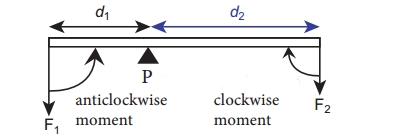
In the illustration given in figure, the force $F_1$ produces an anticlockwise rotation at a distance $d_1$ from the point of pivot $P$ (called fulcrum) and the force $F_2$ produces a clockwise rotation at a distance $d_2$ from the point of pivot $P$. The principle of moments can be written as follows: Moment of clockwise direction $=$ Moment of anticlockwise direction $F _1 \times d _1= F _2 \times d _2$
Generate a complete, print-ready paper with questions like this in minutes — across 16+ boards, with answer keys.