Periodic Classification of Elements — Science STD 10 — Question
Tamilnadu BoardEnglish MediumSTD 10SciencePeriodic Classification of Elements4 Marks
Question
Explain the metallurgy of iron.
✓
Answer
Iron is chiefly extracted from haematite ore $\left( Fe _2 O _3\right)$ :
(i) Concentration by Gravity Separation: The powdered ore is washed with steam of water. As a result, the lighter sand particles and other impurities are washed away and the heavier ore particles settle down.(ii) Roasting and Calcination: The concentrated ore is strongly heated in a limited supply of air in a reverberatory furnace. As a result, moisture is driven out and sulphur, arsenic and phosphorus impurities are oxidized off.
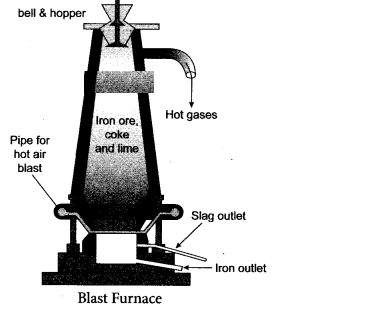
(iii) Smelting (in a Blast Furnace): The charge consisting of roasted ore, coke and limestone in the ratio $8: 4: 1$ is smelted in a blast furnace by introducing it through the cup and cone arrangement at the top. There are three important regions in the furnace.
a. The Lower Region (Combustion Zone):
The temperature is at $1500^{\circ} C$. In this region, coke bums with oxygen to form $CO _2$ when the charge comes in contact with a hot blast of air.
$C + O _2 \underset{\Delta}{\stackrel{1500^{\circ} C }{\longrightarrow}} CO _2+\text { Heat }$
It is an exothermic reaction since heat is liberated.
b. The Middle Region (Fusion Zone):
The temperature prevails at $1000^{\circ} C$. In this region, $CO _2$ is reduced to $CO$.
$CO _2+ C \underset{\Delta}{\stackrel{1000^{\circ} C }{\longrightarrow}} 2 CO -\text { Heat }$
Limestone decomposes to calcium oxide and $CO _2$
$CaCO _3 \underset{\Delta}{ \longrightarrow } CO _2-\text { Heat }$
These two reactions are endothermic due to absorption of heat. Calcium oxide combines with silica to form calcium silicate slag.
$CaO + SiO _2 \rightarrow CaSiO _3$
c. The Upper Region (Reduction Zone): The temperature prevails at $400^{\circ} C$. In this region carbon monoxide reduces ferric oxide to form a fairly pure spongy iron.
$Fe _2 O _3+3 CO \stackrel{400^{\circ} C }{\longrightarrow} 2 Fe +3 CO _2$
The molten iron is collected at the bottom of the furnace after removing the slag. The iron thus formed is called pig iron. It is remelted and cast into different moulds. This iron is called cast iron.
Need a full question paper?
Generate a complete, print-ready paper with questions like this in minutes — across 16+ boards, with answer keys.