Question
State and explain three properties of indifference curves.

Answer

Properties of indifference curves (ICs):

  1. Indifference curves slope downwards or negative slope:

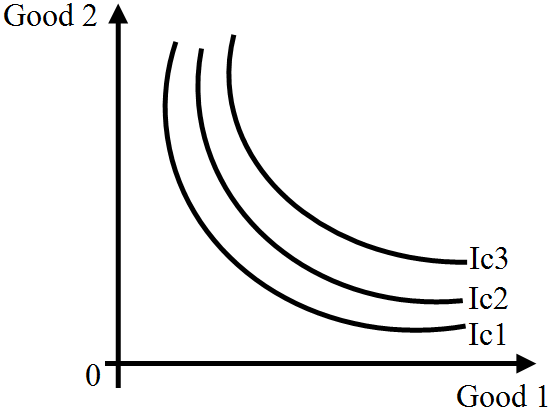
The indifference curves slope downwards, left to right, because an increase in the amount of Good X along the indifference curve is associated with a decrease in the amount of Good Y, as the preferences are monotonic.

  1. Slope of indifference curves represents marginal rate of substitution:

Marginal rate of substitution (MRS) is the rate at which a consumer is willing to substitute one commodity for another commodity.

Slope of indifference curve between A and B $=\frac{\Delta\text{Y}}{\Delta\text{X}}=\text{MRS}$

MRS is the rate at which the output of Good Y is sacrificed for every additional unit of Good X.

  1. In an indifference map, higher IC represents higher level of satisfaction:

An indifference map refers to a set of indifference curves. An indifference curve which is to the right and above another shows a higher level of satisfaction to the consumer. Here, IC3 shows higher level of satisfaction than IC2. Thus, the indifference curve relates to a higher level of income of the consumer.
Need a full question paper?

Generate a complete, print-ready paper with questions like this in minutes — across 16+ boards, with answer keys.

Start Generating Free

Similar questions

What do you mean by excess supply? Explain with the help of a diagram the effect of excess supply on the price of the commodity.
The price elasticity of supply of commodity Y is half the price elasticity of supply of commodity X. 16 percent rise in the price X results in a 40 percent rise in its supply. If the price of Y falls by 8 percent, calculate the percentage fall in its supply.
What are the conditions of consumer’s equilibrium under the indifference curve approach? What changes will take place if the conditions are not fulfilled to reach equilibrium?
From the following data find out the level of output that will give the producer maximum profit (use marginal cost and marginal revenue approach). Give reasons for your answer.
Output (units) 12345
Total Cost 917242936
Total Revenue1120273235
State and discuss four characteristics of perfect competition.
A consumer consumes only two goods X and Y both priced at Rs. 3 per unit. If the consumer chooses a combination of these two goods with Marginal Rate of Substitution equal to 3, is the consumer in equilibrium? Give reasons. What will a rational consumer do in this situation? Explain.
The following table gives the total cost schedule of a firm. It is also given that the average fixed cost at 4 units of output is Rs 5. Find the TVC, TFC, AVC, AFC, SAC and SMC schedules of the firm for the corresponding values of output.
Q
TC
1
2
3
4
5
6
50
65
75
95
130
185
Calculate Net National Product at Market Price and Private income.
 
 
(₹ crores)
(i)
Net current transfers to abroad
10
(ii)
Private final consumption expenditure
500
(iii)
Current tansfers from government
30
(iv)
Net factor income to abroad
20
(v)
Net exports
(-) 20
(vi)
Net indirect tax
120
(vii)
National debt interest
70
(viii)
Net domestic capital formation
80
(ix)
Income accruing to government
60
(x)
Government final consumption expenditure
100
On the basis of the following schedule, calculate Price Elasticity of Demand by percentage method.
Price per unit (₹)
Total expenditure (₹)
10
180
9
162
How will you treat the following while estimating can National Income? Give reasons for your answer.
  1. Salaries received by non-residents Indian working in Russian Embassy in India.
  2. Profits earned by an Indian bank from its branches abroad.
  3. Entertainment tax received by the government.