Systems of Particles and Rotational Motion — Physics STD 11 Science — Question
Gujarat BoardEnglish MediumSTD 11 SciencePhysicsSystems of Particles and Rotational Motion3 Marks
Question
State and prove the parallel axis theorem.
✓
Answer
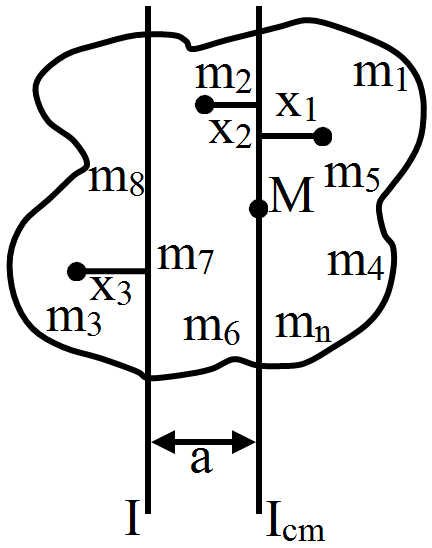
The moment of inertia about an axis parallel to the axis through the centre of mass is the sum of the moment of inertia about the axis through centre of mass and the product of the mass M and the square of the separation between the axes, i.e., $\text{I}=\text{I}_{\text{cm}}+\text{Ma}^2$ Moment of inertia is the product of mass and the square of the separation from the axis. The moment of inertia of the system of n masses shown in the figure about the parallel is,
$\text{I}=\text{m}_1(\text{x}_1+\text{a})^2+\text{m}_2(\text{a}-\text{x}_2)^2+\text{m}_3(\text{x}_3-\text{a})^2+\dots$ for n masses. In general, $\text{I}=\sum^\limits{\text{n}}_\limits{\text{i}=\text{I}}\text{m}(\pm\text{x}_{\text{i}}\pm\text{a}_{\text{i}})^2$ if all the n masses are considered equal. $\text{I}=\sum^\limits{\text{n}}_\limits{\text{i}=\text{I}}\text{mx}^2_{\text{i}}+\sum^\limits{\text{n}}_{\text{i}=\text{I}}\text{ma}^2+2\text{a}\sum^\limits{\text{n}}_\limits{\text{i}=\text{I}}\text{mx}_{\text{i}}$ $\text{I}=\text{I}_{\text{cm}}+\text{Ma}^2$ $\because\sum\text{mx}_{\text{i}}=0$ if the centre of mass is considered as origin.
Need a full question paper?
Generate a complete, print-ready paper with questions like this in minutes — across 16+ boards, with answer keys.