Question
State and prove the parallel axis theorem.
Answer

The moment of inertia about an axis parallel to the axis through the centre of mass is the sum of the moment of inertia about the axis through centre of mass and the product of the mass M and the square of the separation between the axes, i.e., $\text{I}=\text{I}_{\text{cm}}+\text{Ma}^2$

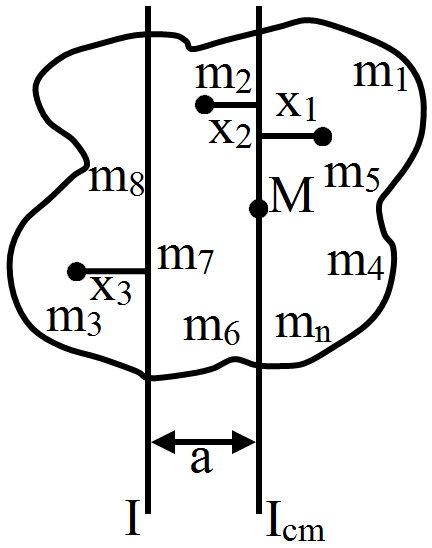
Moment of inertia is the product of mass and the square of the separation from the axis. The moment of inertia of the system of n masses shown in the figure about the parallel is,

$\text{I}=\text{m}_1(\text{x}_1+\text{a})^2+\text{m}_2(\text{a}-\text{x}_2)^2+\text{m}_3(\text{x}_3-\text{a})^2+\dots$

for n masses.

In general, $\text{I}=\sum^\limits{\text{n}}_\limits{\text{i}=\text{I}}\text{m}(\pm\text{x}_{\text{i}}\pm\text{a}_{\text{i}})^2$

if all the n masses are considered equal.

$\text{I}=\sum^\limits{\text{n}}_\limits{\text{i}=\text{I}}\text{mx}^2_{\text{i}}+\sum^\limits{\text{n}}_{\text{i}=\text{I}}\text{ma}^2+2\text{a}\sum^\limits{\text{n}}_\limits{\text{i}=\text{I}}\text{mx}_{\text{i}}$

$\text{I}=\text{I}_{\text{cm}}+\text{Ma}^2$

$\because\sum\text{mx}_{\text{i}}=0$ if the centre of mass is considered as origin.

Need a full question paper?

Generate a complete, print-ready paper with questions like this in minutes — across 16+ boards, with answer keys.
Start Generating Free

Similar questions

Iceberg floats in water with part of it submerged. What is the fraction of the volume of iceberg submerged if the density of ice is $\rho_\text{i}=0.917\text{g cm}^{-3}?$
Light in certain cases may be considered as a stream of particles called photons. Each photon has a linear momentum $\frac{\text{h}}{\lambda}$ where h is the Planck's constant and $\lambda$ is the wavelength of the light. A beam of light of wavelength $\lambda$ is incident on a plane mirror at an angle of incidence $\theta.$ Calculate the change in the linear momentum of a photon as the beam is reflected by the mirror.
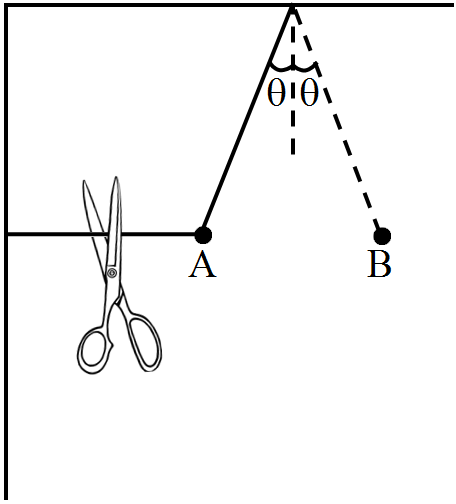
A ball is held at rest at position A in Fig., by two light strings. The horizontal string is cut and the ball starts swinging as a pendulum. Point B is the farthest to the right where the ball goes as it swings back and forth. What is the ratio of the tension in the supporting string in position B to its value at A before the horizontal string was cut?A ball is held at rest at position A in Fig., by two light strings. The horizontal string is cut and the ball starts swinging as a pendulum. Point B is the farthest to the right where the ball goes as it swings back and forth. What is the ratio of the tension in the supporting string in position B to its value at A before the horizontal string was cut?

A 60kg man skating with a speed of 10m/s collides with a 40kg skater at rest and they cling to each other. Find the loss of kinetic energy during the collision.
When walking on ice, one should take short steps rather than long steps. Why?
A metre scale made of steel is calibrated at 20°C to give correct reading. Find the distance between the 50cm mark and the 51cm mark if the scale is used at 10°C. Coefficient of linear expansion of steel is 1.1 × 10⁻⁵ °C-1.
A Carnot engine absorbs 1000J of heat energy from a reservoir at 12.7°C and rejects 600J of heat energy during each cycle. Calculate. (i) efficiency of the engine, (ii) temperature of sink, (iii) amount of useful work done per cycle.
Angular momentum of a system is conserved if its M.I. is changed. Is its rotational K.E. also conserved?
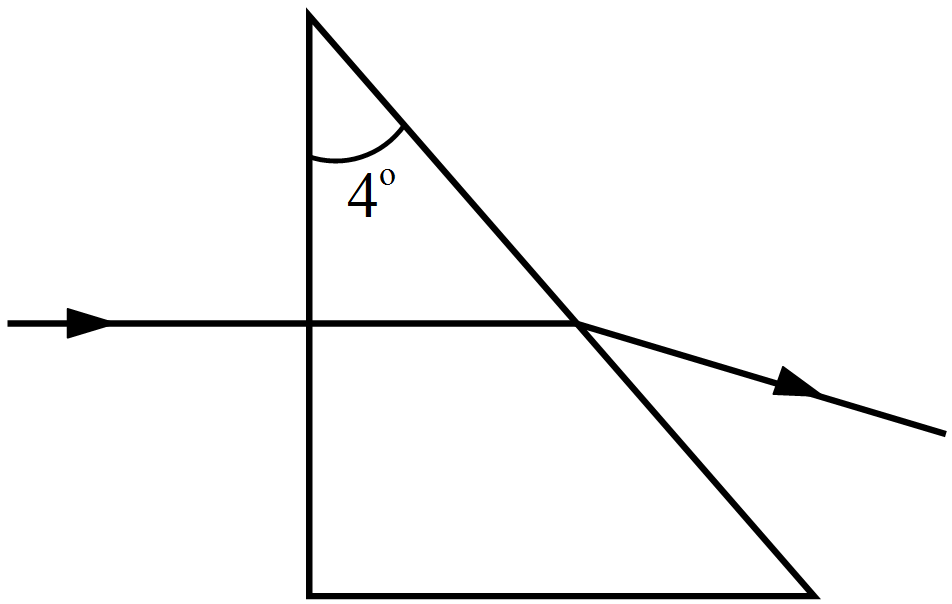
Find the angle of deviation suffered by the light ray shown in figure. The refractive index $\mu=1.5$ for the prism material.

Consider a head-on collision between two particles of masses m1 and m2. The initial speeds of the particles are u1 and u2 in the same direction. The collision starts 2 at t = 0 and the particles interact for a time interval $\triangle\text{t}.$ During the collision, the speed of the first particle varies as.

$\text{v}(\text{t})=\text{u}_1+\frac{\text{t}}{\triangle\text{t}}(\text{v}_1-\text{u}_1).$

Find the speed of the second particle as a function of time during the collision.