Systems of Particles and Rotational Motion — Physics STD 11 Science — Question
Gujarat BoardEnglish MediumSTD 11 SciencePhysicsSystems of Particles and Rotational Motion3 Marks
Question
State and prove the perpendicular axis theorem.
✓
Answer
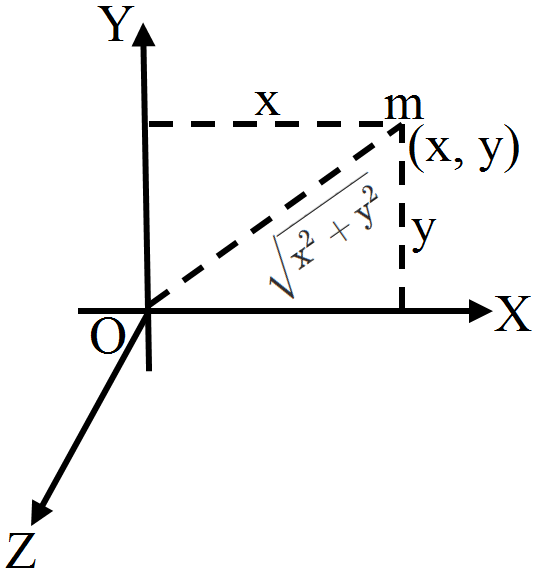
According to perpendicular axis theorem, the sum of the moment of inertia about x and y axes is equal to the moment of inertia about z-axis. The mass m has co-ordinates $(x, y)$.
The moment of inertia about x-axis,
$\mathrm{I}_{\mathrm{x}}=\mathrm{my}^2$
$\text { about } \mathrm{y} \text {-axis, } \mathrm{I}_{\mathrm{y}}=m \mathrm{x}^2$
$ \mathrm{I}_{\mathrm{x}}+\mathrm{I}_{\mathrm{y}}=\mathrm{m}\left(\mathrm{x}^2+\mathrm{y}^2\right)$
$=\text{m}(\sqrt{\text{x}^2+\text{y}^2})^2$
$=\text{I}_{\text{x}}+\text{I}_{\text{y}}=\text{m}(\bot\text{distance from z-axis})^2$
$=\text{I}_{\text{x}}+\text{I}_{\text{y}}=\text{I}_{\text{z}}$
Need a full question paper?
Generate a complete, print-ready paper with questions like this in minutes — across 16+ boards, with answer keys.