Question
State any four differences between photosynthesis and respiration.

Answer

Photosynthesis

Respiration


Carbon dioxide is used up and oxygen is released.

Oxygen is used up and carbon dioxide is released.

Photosynthesis occurs in plants and some bacteria.

Respiration occurs in all living organisms.

Photosynthesis results in gain of dry weight of the plants.

Respiration results in loss of dry weight of the plants.

Glucose is produced which is utilized by the plants.

Glucose is broken down to obtain energy.

The raw materials for the photosynthesis are water, carbon dioxide and sunlight.

The raw material for respiration is glucose.

Need a full question paper?

Generate a complete, print-ready paper with questions like this in minutes — across 16+ boards, with answer keys.
Start Generating Free

Similar questions

How would you justify that Australopithecus was a human ancestor?
A certain couple got four daughters in a sequence and no son. Does it mean that the husband does not produce Y-chromosome bearing sperms? Explain. What is the chance of this couple having a daughter?
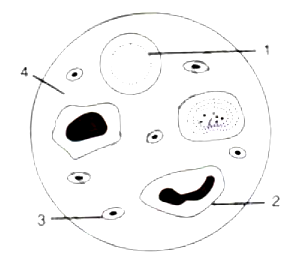
Given below is a diagram of a smear of human blood. Study the same and answer the question that follow:
What is the main function of the parts labeled 1, 2 and 3 respectively?
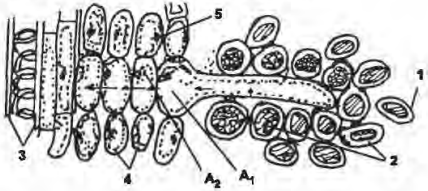
The figure given below is a diagramatic representation of a part of the cross section of the root in the root hair zone. Study the same and answer the questions that follow:
Image
(i) Name the parts indicated by guidelines 1 to 5 .
(ii) Name the process responsible for the passage of water molecules from soil into $A_1$ and then into $A_2$.
(iii) How is this pressure set up?
Differentiation between:
Transpiration and guttation
Differentiate between the following:Plasmolysis and deplasmolysis
Draw a labeled diagram of the front view of human eye.
Draw a diagram of the side view of human brain and label the part which suits the following functions/ descriptions:
(i) It lies below and behind the cerebrum. It consists of three parts.
(ii) It is a cross-wise broad band of fibres which comments medulla oblongata, cerebellum and cerebrum.
(iii) It is the lower most and hinder part of the brain which continues below into spinal cord
(iv) It is a small thick-walled area which lies hidden below the cerebrum.
(v) It is the largest part of the brain which constitutes more than 80% and possesses 6-7 billion neurons.
(vi) It takes part in relaying sensory impulses and regulation of smooth muscle activity?
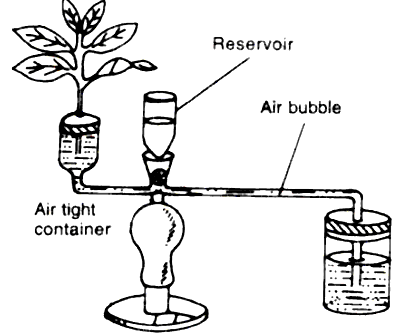
The diagram given alongside is an apparatus used to study a particular phenomenon in plants.
(i) Name the apparatus.
(ii) What is it used for?
(iii) What is the role played by the air bubble in this experiment?
(iv) Of what use is the reservoir?
Which glands are responsible for the following disease?
(i) Goitre (ii) Diabetes mellitus (iii) Gigantism
(iv) Diabetes insipidus (v) Cretinism (vi) Exophthalmic goiter