Questions

[3 marks Question Answer]

🎯

Test yourself on this topic

14 questions · timed · auto-graded

Question 13 Marks
A potted plant was taken in order to prove a factor necessary for photosynthesis. The potted plant was kept in the dark for 24 hours. One of the leaves was covered with black paper in the centre. The potted plant was then placed in sunlight for a few hours.

Draw a neat diagram of a chloroplast and label its parts.
View full question & answer
Question 23 Marks
Draw a neat diagram of the stomatal apparatus found in the epidermis of leaves and label the Stoma, Guard cells, Chloroplast, Epidermal cells, Cell wall and Nucleus.
View full question & answer
Question 33 Marks
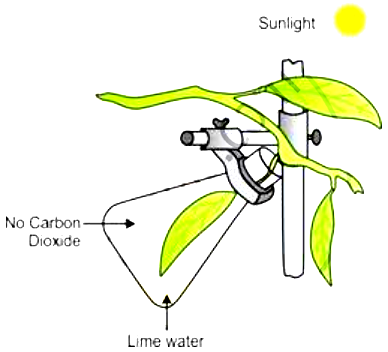
Given alongside is the diagram of an experimental set-up:

Would you take any step before starting the experiment? Describe this step and explain its necessity.
Answer
Before starting the experiment, it is necessary to destarch the leaves of the plant by keeping the plant in complete darkness for 48 hours. This is because if the plant is not destarched, then the experiment will give false results because starch stored previously may be detected in the leaf placed in the beaker even if no starch is produced during the experiment.
View full question & answer
Question 43 Marks
Enumerate the steps involved in testing a green leaf for the presence of starch.
Answer
Test to determine the presence of starch in a leaf:
  • Dip a leaf in boiling water for a minute to kill the cells.
  • Boil the leaf in methylated spirit in a water bath to remove the chlorophyll, till the leaf turns pale blue and becomes hard and brittle.
  • Now place the leaf in hot water to soften it.
  • Place the leaf in a Petri dish and pour iodine solution over it.
  • The appearance of a blue-black colour on the leaf is indicative of the presence of starch.
  • The absence of starch is indicated by a brown colouration.
View full question & answer
Question 53 Marks
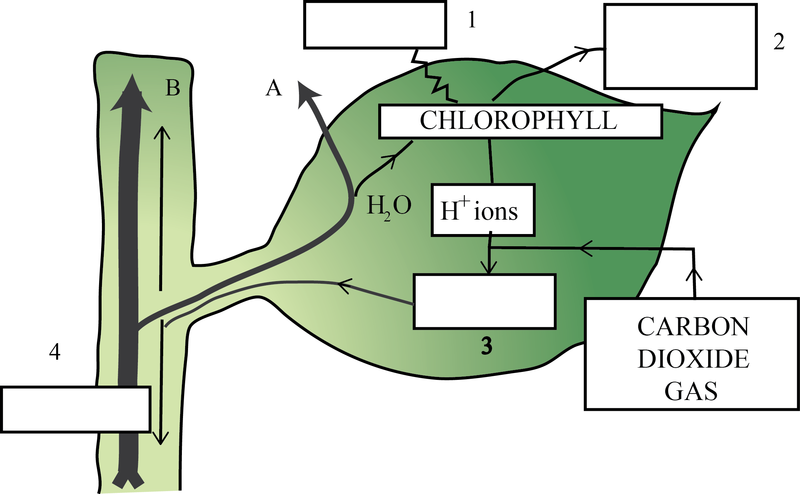
Given below is a schematic diagram to illustrate some aspects of photosynthesis.
a.Fill up the gaps, in blank spaces (1-4), by writing the names of the correct items.
b.What phenomenon do the thick arrows A and B indicate?
Image
Answer
(a)
1 - Sunlight

2 - Oxygen

3 - Glucose

4 - Xylem
(b)
A - Transpiration

B - Translocation

View full question & answer
Question 63 Marks
Photosynthesis in green plants is directly and indirectly dependent on so many plant structures.
Explain briefly the role of the following structures in this process is Phloem tissue in the leaf veins.
Answer
Phloem Tissue in the Leaf Veins: The prepared food is transported from leaves to all parts of the plant by the phloem tissue. The glucose is converted into insoluble starch and later into soluble sugar i.e. sucrose, which is transported in solution through the phloem in the veins of the leaf and down through the phloem of the stem.
View full question & answer
Question 73 Marks
Photosynthesis in green plants is directly and indirectly dependent on so many plant structures.
Explain briefly the role of the following structures in this process is Xylem tissue in the leaf veins
Answer
Xylem Tissue in the Leaf Veins: Water is essential for photosynthesis to occur. Water is taken up by the roots from the soil, sent up through the stem and finally brought to the leaves (site of photosynthesis) through the xylem tissue. The water is then distributed in the mesophyll tissue.
View full question & answer
Question 83 Marks
A candidate studied the importance of certain factors in photosynthesis. He took a potted plant and kept in the dark for over 24 hours. In the early hours of the next morning, he covered one of the leaves with black paper in the centre only. Then he placed the plant in sunlight for a few hours and tested the leaf which was covered with black paper for starch.
Describe step by step, how the candidate proceeded to test the leaf for the presence of starch?
Answer
  • The student dipped the leaf in boiling water for a minute to kill the cells.
  • Then he boiled the leaf in alcohol/methylated spirit over a water bath to remove chlorophyll. The leaf becomes hard and brittle.
  • He then places the leaf in hot water to soften it.
  • Next the student spreads the leaf in a dish and pours iodine solution on it. The presence of starch is indicated by a blue-black colour.
  • The uncovered portion (exposed to sunlight) turned blue-black colour and the covered portion showed brown colour. The difference in the colours of covered and uncovered part of leaves indicates the importance of sunlight in photosynthesis.
View full question & answer
Question 93 Marks
Why is it necessary to place a plant in the dark before starting an experiment on photosynthesis? Explain.
Answer
The presence of starch is regarded as evidence of photosynthesis. Hence before starting an experiment on photosynthesis, the plant should be placed in the dark for 24-48 hours to destarch the leaves. During this period, all the starch from the leaves will be sent to the storage organs and the leaves will not show the presence of starch. So the various experiments on photosynthesis can be carried out effectively.
View full question & answer
Question 103 Marks
"Oxygen is a waste product of photosynthesis." Comment.
Answer
Oxygen is released during photosynthesis. Some of this oxygen may be used in respiration in the leaf cells, but the major portion of it is not required and it diffuses out into the atmosphere through the stomata. However, in a sense, even this oxygen is not a waste because all organisms require it for their existence including the plants.
View full question & answer
Question 113 Marks
State any four differences between photosynthesis and respiration.
Answer

Photosynthesis

Respiration


Carbon dioxide is used up and oxygen is released.

Oxygen is used up and carbon dioxide is released.

Photosynthesis occurs in plants and some bacteria.

Respiration occurs in all living organisms.

Photosynthesis results in gain of dry weight of the plants.

Respiration results in loss of dry weight of the plants.

Glucose is produced which is utilized by the plants.

Glucose is broken down to obtain energy.

The raw materials for the photosynthesis are water, carbon dioxide and sunlight.

The raw material for respiration is glucose.
View full question & answer
Question 123 Marks
All life owes its existence to chlorophyll. Give reason.
Answer
Chlorophyll is the foundation site for the photosynthesis in green plants. The initiation of photosynthesis takes place when the chlorophyll molecule traps the light energy. The light energy is then converted into chemical energy in the form of glucose using carbon dioxide $\left( CO _2\right)$ from the atmosphere, and water $\left( H _2 O \right)$ from the soil. All other organisms, directly or indirectly depend on this food for their survival. The starting point of any food chain is always a plant. If green plants were to suddenly disappear, then so would virtually all life on Earth. Thus, we can say that all ife owes its existence to chlorophyll.
View full question & answer
Question 133 Marks
How do non-green plants such as fungi and bacteria obtain their nourishment?
Answer
Non-green plants such as fungi and bacteria obtain their nourishment from decaying organic matter in their environment. This matter comes from dead animals and plants. Fungi and bacteria break down the organic matter to obtain the nourishment and they release carbon dioxide back in the atmosphere.
View full question & answer
Question 143 Marks
Most leaves have the upper surface more green and shiny than the lower one. Why?
Answer
The chloroplasts are concentrated in the upper layers of the leaf which helps cells to trap the sunlight quickly. Also the epidermis is covered by a waxy, waterproof layer of cuticle. This layer is thicker on the upper surface than the lower one. Hence most leaves have the upper surface more green and shiny than the lower one.
View full question & answer