The principle of Archimedes states that when a body is totally or partially immersed in a fluid, it experiences an upthrust equal to the weight of the fluid displaced. We can verify Archimedes' principle experimentally by doing this experiment.
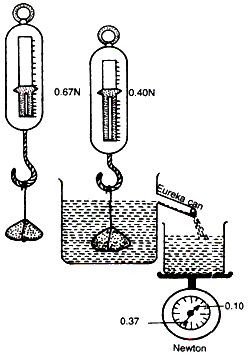
The stone weighed 0.67 N in air and 0.40 N when immersed in water. The displaced water weighed is 0.27 N (= 0.67 - 0.40)
Pour water into eureka can till the water starts overflowing through the spout.
When the water stops dripping replace the beaker by another one of known weight. Suspend a stone with the help of a string from the hook of a spring balance and record the weight of the stone.
Now, gradually lower the body into eureka can containing water and record its new weight in water when it is fully submerged in water. When no more water drips from the spout, weigh the beaker containing water.
After observation, we can conclude that apparent loss of weight of stone (calculated by differences in weight measured by spring balance) = weight of water displaced (weight of water in beaker ).
This proves the Archimedes' principle that when a body is totally or partially immersed in a fluid, it experiences an upthrust equal to the weight of the fluid