Questions

[5 Mark Question Answer]

🎯

Test yourself on this topic

25 questions · timed · auto-graded

Question 15 Marks
Describe an experiment to demonstrate that air exerts pressure.
Answer
Air exerts pressure and this can be demonstrated by this experiment.
Image
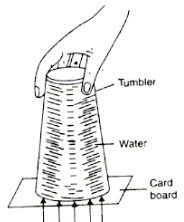
Take a glass tumbler. Fill it to the brim with water, with water overflowing the rim of the tumbler. Cover it with a piece of cardboard. Press the cardboard so that it touches the rim of the tumbler at all points. This will ensure that no air is left inside.
With the hand on the cardboard, invert the tumbler gently and remove the hand. Both cardboard and water shall not fall. This shows that air exerts pressure on the lower surface of the cardboard in the upward as shown in the figure. The upward thrust acting on the cardboard due to air pressure supports the combined weight of cardboard and water in the tumbler.
So, this shows that air exerts pressure.
View full question & answer
Question 25 Marks
Draw a simple diagram of a Fortin's barometer and state how it is used to measure the atmospheric pressure.
Answer
Fortin barometer is used to measure atmospheric pressure.
Image
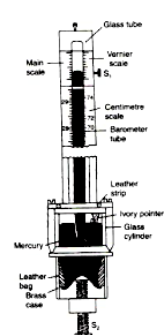
Before reading the Fortin barometer, the free surface of the mercury in the reservoir is made to touch the tip of the ivory pointer by raising or lowering the level with the help of the screw $S_2$ The vernier scale is then adjusted with the screw $S_1$ till its lower edge touches the upper meniscus of mercury in the tube. While making this adjustment the eye is kept in level with the mercury meniscus. For this adjustment, the vernier is moved till the wall of the glass plate just ceases to be visible through the slits. The vernier can read to 1/ 20 mm or 1/ 500 inch. The reading of the barometer then gives the true atmospheric pressure. A thermometer is usually provided with the barometer which is also read and correction is made for the expansion of scale with a rise in temperature and also for the change in density of mercury with temperature. The scale graduations are correct only for the temperature at which the graduations are made.
View full question & answer
Question 35 Marks
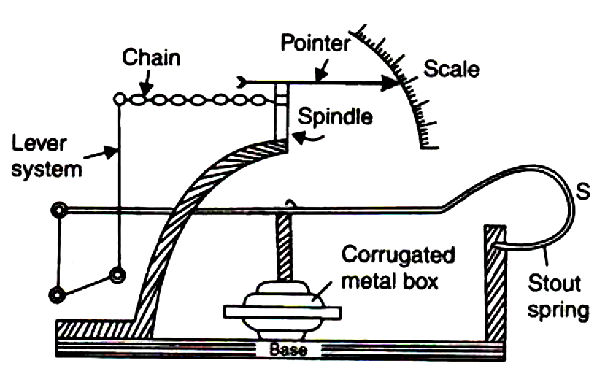
What is an aneroid barometer?
Draw a neat and labeled diagram to explain its construction and working.
Answer
Aneroid barometer is a portable type of barometer.


In this, no liquid is used. It consists of a metal box corrugated to make it flexible. The lower side of the box is fixed to the base of the instrument and the upper side is supported by a stout spring S. The box is partially evacuated. So it tends to collapse under the pressure of air. The stout spring balances the thrust on the metal box due to normal air pressure and prevents the box from collapsing.

When atmospheric pressure changes, the surface supported by the spring S moves in if pressure increases or out if the pressure decreases slightly. This small movement is increased considerably by a system of levers one end of which is connected to the spring S. The other end of the lever system is connected to a chain which is wrapped round a spindle carrying a pointer. The pointer moves over a scale which is graduated to read the pressure in centimeters or inches.
View full question & answer
Question 45 Marks
What is a barometer? How is a simple barometer constructed?
Answer
A barometer is an instrument which is used to measure the atmospheric pressure.

Construction of a simple barometer:

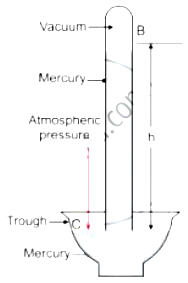
A simple mercury barometer can be made with a clear, dry, thick-walled glass tube about 1 metre ling. The glass tube is sealed at one end and is filled with mercury completely. While filling the tube with mercury care has to be taken so that there are no air bubbles present in the mercury column. Close the open end with thumb and turn the tube upside down carefully over a trough containing mercury. Dip the open end under the mercury level in the trough and remove the thumb.

The mercury level in the tube falls until it is about 76 cm (h =760 mm) vertically above the mercury level. It is the atmospheric pressure acting on the surface of the mercury in the trough that supports the vertical mercury column. The empty space above the mercury column is called the ‘Torricellian vacuum’.
View full question & answer
Question 55 Marks
State Archimedes' principle, describe an experiment to verify Archimedes' principle.
Answer
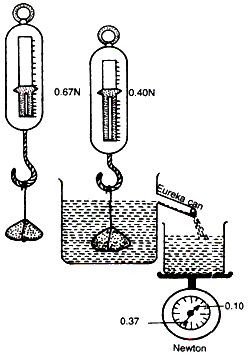
The principle of Archimedes states that when a body is totally or partially immersed in a fluid, it experiences an upthrust equal to the weight of the fluid displaced. We can verify Archimedes' principle experimentally by doing this experiment.

The stone weighed 0.67 N in air and 0.40 N when immersed in water. The displaced water weighed is 0.27 N (= 0.67 - 0.40)

Pour water into eureka can till the water starts overflowing through the spout.

When the water stops dripping replace the beaker by another one of known weight. Suspend a stone with the help of a string from the hook of a spring balance and record the weight of the stone.

Now, gradually lower the body into eureka can containing water and record its new weight in water when it is fully submerged in water. When no more water drips from the spout, weigh the beaker containing water.

After observation, we can conclude that apparent loss of weight of stone (calculated by differences in weight measured by spring balance) = weight of water displaced (weight of water in beaker ).

This proves the Archimedes' principle that when a body is totally or partially immersed in a fluid, it experiences an upthrust equal to the weight of the fluid
View full question & answer
Question 65 Marks
Using Archimedes' principle, describe an experiment to find the relative density of a solid denser than water.
Answer
We can find the relative density of a solid denser than water by following the experiment.

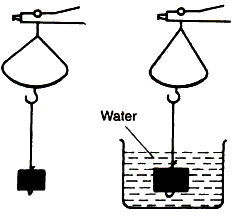
Weighing a solid in air and water
Find the weight $\left( W _1 gf \right)$ of a solid in the air using a hydrostatic balance.
Tie the solid firmly with a thread and suspend it from the hook. Lower the solid in water and find its weight.
Record the result as shown below:
Weight of solid in air $=w_1 gf$.
Weight of solid in water $= W _2 gf$. The apparent loss of weight of solid $=\left( W _1- W _2\right) gf$.
Relative density $=W_1 /\left(W_1-W_2\right)$ The relative density of the solid = (weight of solid in the air )/(Apparent loss of weight of solid in water).
View full question & answer
Question 75 Marks
Using Archimedes' principle, describe an experiment to find the relative density of a solid which floats on water.
Answer
We can find the relative density of a solid which floats on water by following the experiment.
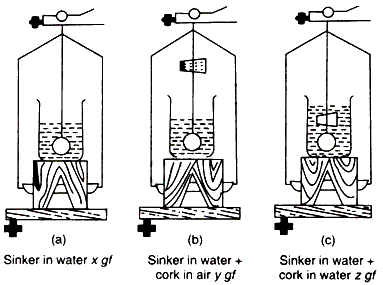
Measuring the relative density of a cork

Choose a sinker and find its weight in water by suspending it in water.

Tie the solid to the string attached to the sinker and find its weight in air but sinker in water.

Remove the solid and tie it together with the sinker and suspend it in water and find the weight of the solid together with the sinker in water.

Record your observation as shown below: Weight of sinker in water = x gf

Weight of sinker in water + solid in air = y gf Weight of solid in air = (y - x) gf

Weight of solid + sinker in water = z gf

upthrust on solid in water = (y - z) gf.

The upthrust on in water also represents the weight of the water displaced by the solid. Relative density of solid = (weight of cork in air )/(weight of equal volume of water) Relative density = (y - x)/(y - z).
View full question & answer
Question 85 Marks
Name an instrument based on this principle. State two uses of the instrument that you describe.
Answer
A hydrometer is based on the principle of floatation.
A hydrometer is a device used for measuring the relative densi ty of a liquid directly.

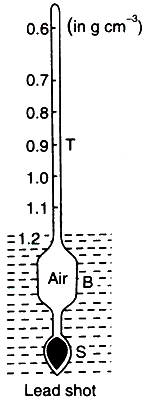
Hydrometer
It usually consists of a glass float with a long thin stem which is graduated. The glass float is a large hollow bulb which increases with buoyancy. The narrow stem increases the sensitivity of hydrometer. The bottom of the hydrometer is made heavier by loading it with lead shots so that it floats vertically.
The hydrometer works on the principle of floatation. Consider a thin-walled and flat bottomed test tube. Add some lead shots in the test tube and place it in a jar containing water. Adjust the number of lead shots such that it floats vertically with some of its portion outside the surface of the water in a jar.
If I is the length of the test tube inside water, $a$ is an area of cross-section of the test tube, $d$ is the density of water in which it floats, then the weight of water displaced = aldg and it is equal to the weight of loaded test tube.
Now allow the test tube to float in the other jar filled with a liquid of density $d _1$ and note the level $I _1$ at which it floats in that liquid.
Using the law of floatation
aldg $= al_1d_1g$
$Id = l_1d_1l/l_1 = d_1/d$
or l is inversely proportional to the density.
It sinks more in a lighter liquid so as to displace more volume of the lighter liquid whose weight is equal to the weight of Hydrometer. Hence, it will sink less in a denser liquid so that it has displaced less volume of the denser liquid whose weight will be equal to the hydrometer.
In this way, this measure relative density of a liquid Barometer can be used as a lactometer which can be used to check the purity of milk.
The barometer can be used as an acid battery hydrometer which can be used to check the concentration of sulphuric acid in an acid battery.
View full question & answer
Question 95 Marks
A body of volume $100 cm^3$​​​​​​​ weighs 1 kgf in air. Calculate its weight in water. What is its relative density?
Answer
Volume of body $=100 cm^3$.
Weight of body $=1 kgf =1000 gf$
Mass of body= 1000 gm .
Density of liquid $=1000 gm / 100 cm 3=10 gcm { }^3$.
Density of water at $4^{\circ}=1 gcm ^{-3}$.
Relative density= density of substance/density of water at $4^{\circ} C$
Relative density $=10 gcm ^3 / 1 gcm ^3=10$
Mass of body= 1000 gm .
Densityofwater $=1 g cm ^{-3}$
Acceleration due to gravity $=10 ms^{-2}$
Upthrust $= Vxpxg$.
Upthrust = $100 \times 1$ xf = 100 gf .
Resultant weight of the body $=$ weight-upthrust $=1000 gf -100 gf =900 gf$.
View full question & answer
Question 105 Marks
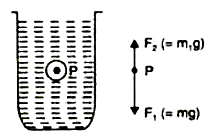
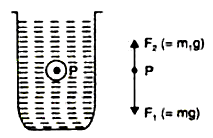
A small stone of mass $m (=200 g)$ is held underwater in a tall jar and allowed to fall as shown in the following figure. The freebody diagram of the stone is also shown.
(i) What does $F _2$ represent?
(ii) What does $m _1$ represent?
(iii) What is the net force acting on the stone?
(iv) What is the acceleration of the stone as it falls through water? Neglect the force due to viscosity. Assume that volume of stone $=80 cml$, density of water $=1.0 g cm ^{-3}$ and acceleration due to gravity $g =10 ms^{-2}$.
Answer
(i) $F _2$ represents the buoyant force acting on the stone in an upward direction.
(ii) $m _1$ represents the apparent mass of the stone during motion through the water.
(iii) Net force acting on the stone $=F_1-F_2=\left(m-m_1\right) g$. (iv) Mass of stone $=200 gm =0.2 kg$.
Volume of stone $=80 cm^3=80 \times 10^{-6} m^3$.
Density of water $=1 gcm ^{-3}=1000 kgm ^3$.
Acceleration due to gravity $=10 ms^{-2}$.
Upthrust $= V \times p \times g$. Upthrust $=80 \times 10^{-6} \times 1000 \times 10=0.8 N$.
Weight of the stone $=$ mass $\times$ gravity $=0.2 \times 10=2 N$.
Resultant weight of the stone $=$ weight - upthrust $=2 N-0.8 N=1.2 N$
Resultant acceleration of the qravity $= m \times a ^{\prime} m \times a ^{\prime}=1.2 N$
$a^{\prime}=1 \cdot 2 / 0 \cdot 2=6 ms^{-2}$. Resultant acceleration of the stone as it falls through the water is $6 ms^{-2}$,
View full question & answer
Question 115 Marks
A body of volume $100 cm^3$ weighs $1$ kgf in air. Find:
(i) Its weight in water and
(ii) Its relative density.
Answer
Volume of body $=100 cm ^3$
Weight in air, $W_1=1 kgf =1000 gf$
Mass of body $=1 kg =1000 g$
R.D. of solid $=10$
R.D. of water $=1$
(i) Let $W_2$ be the weight of the body in water.
R.D. of body $=\frac{W_1}{W_1-W_2} \times$ R.D. of water
or, $10=\frac{1000}{\left(1000-W_2\right)} \times 1$
or , $10\left(1000-W_2\right)=1000$
or, $1000-W_2=100$
or, $W _2=900 gf$
(ii) R.D. of body = Density in C.G.S. (without unit)
or , R.D. $=\frac{\text { Mass }}{\text { Volume }}=\frac{1000}{100}=10$
View full question & answer
Question 125 Marks
A block of wood of mass $24$ kg floats on water. The volume of wood is $0.032 m^3$. Find :(a) the volume of block below the surface of water,
(b) the density of wood.
(Density of water $=1000 kg m ^{-3}$ )
Answer
Mass of block of wood $=24 kg$

Volume of wood $=0.032 m ^3$
(a) Upthrust $=$ Volume of block below the surface of water $(v) \times$ density of liquid $\times g$

Now for floatation, Upthrust $=$ weight of the body $=24 kgf$
or , $24 kgf = v \times 1000 \times g$
or, $v =\frac{24}{1000}=0.024 m ^3$
(b) According to the law of floatation,
$\frac{\text { Volume of the submerged block }}{\text { Total volume of block }}=\frac{\text { Density of wood }}{\text { Density of water }}$
or,$\frac{0.024}{0.032}=\frac{\text { Density of wood }}{1000}$
or, Density of wood $=1000 \times \frac{0.024}{0.032}=750 kgm ^3$
View full question & answer
Question 135 Marks
A wooden cube of side $10$ cm has a mass of $700 $g. It will float in the water with:
(a) Half of its volume inside the water
(b) $3$ cm height above the water surface
(c) $7$ cm height above the water surface
(d) Just inside the water surface.
Answer
Side of wooden cube $=10 cm$.
Volume of wooden cube $=10 \times 10 \times 10=1000 cm^3$.
Mass of wooden cube $=700 g$.
Density of wooden cube $=$ mass $/$ volume $=700 / 1000=0.7 gcm ^{-3}$.
Density of water $=1 gcm ^{-3}$.
(Density of floating body / Density of liquid) = fraction submerged
0.7/1 = fraction submerged
The fraction of wooden cube submerged in water $=0.7$
Height of wooden cube $=10 cm$
Part of wooden cube which is submerged $=10 \times 0.7=7 cm$
So, a wooden cube will float in the water with a 3 cm height above the water surface.
View full question & answer
Question 145 Marks
The $R.D$. of ice is $0.92$ and that of sea water is $1.025$. Find the total volume of an iceberg which floats with its volume $800 cm^3$ above water.
Answer
Relative density of Ice $=0.92$
Relative density of sea water $=1.025$
Let the total volume of iceberg $= X cm { }^3$.
The volume of the iceberg above water $=800 cm^3$.
The volume of the iceberg is submerged in the water $=(X-800) cm ^3$.
Fraction of iceberg submerged $=(X-800) / X$
Now we know that the fractional part submerged equals the ratio of the density of the material of the block to the density of the liquid.
(Density of ice / Density of sea water) = fraction submerged
$0.92/1.025 = (X-800)/X$
$0.8975 X = X - 800$
$X - 0.8975 X = 800$
$0.1025 X = 800$
$X = 800/0.1025 = 7804.8 cm^3.$
Total volume of iceberg $= 7804.8 cm^3.$
View full question & answer
Question 155 Marks
If 2/3rds of a piece of wood submerges in water and 3/4ths of the same piece of wood submerges in oil. Find the density of the oil.
Answer
The fractional part submerged equals the ratio of the density of the material of the block to the density of the liquid.
(Density of floating body / Density of liquid) = fraction submerged.
Fraction of wooden piece submerged in water $=2 / 3=0.67$.
As the liquid is water so the ratio of Density of wooden by the density of water gives a relative density of floating wooden pieces.
So, the relative density of the wooden block is 0.67 .
The density of water in the SI system $=1000 Kg m ^{-3}$.
Density of wood=relative density $x$ density of water $=0.67 \times 1000 Kg m ^{-3}=670 kgm$.
Fraction of wooden piece submerged in oil $=3 / 4=0.75$.
We know the density of wooden piece $=0.67$
(Density of floating body / Density of liquid) = fraction submerged.
Relative Density of oil = (Relative Density of wooden block/fraction submerged)
Density of oil $=0.67 / 0.75=0.893$.
The density of water in the SI system $=1000 Kg m ^{-3}$.
Density of oil = relative density $x$ density of water $=0.893 \times 1000 Kg m ^{-3}=893 kgm ^{-3}$.
View full question & answer
Question 165 Marks
A piece of wood of uniform cross-section and 15 cm height sinks 10 cm in water and 12 cm in spirit. Find the R.D. of wood and spirit.
Answer
The fractional part submerged equals the ratio of the density of the material of the block to the density of the liquid.
(Density of floating body / Density of liquid) = fraction submerged.
Height of wooden piece = 15 cm.
Height of wooden piece sinks in water = 10 cm.
Fraction of wooden piece submerged in water = 10/15 = 0.67.
As the liquid is water so the ratio of Density of wooden by the density of water gives a relative density of floating wooden pieces. So, the relative density of the wooden block is 0.67.
Height of wooden piece = 15 cm.
Height of wooden piece sinks in spirit = 12 cm.
Fraction of wooden piece submerged in water = 12/15 = 0.8.
We know the density of wooden piece = 0.67
(Density of floating body / Density of liquid) = fraction submerged.
Density of liquid/spirit = (Density of floating body /fraction submerged)
Density of liquid/spirit = 0.67/0.8 = 0.83.
The relative density of the spirit is 0.83.
View full question & answer
Question 175 Marks
A metal cube of 5 cm edge and density $9 g cm ^{-3}$ is suspended by a thread so as to be completely immersed in a liquid of density $1.2 g cm ^{-3}$. Find the tension in the thread. (Take $g =10 ms^{-2}$ ).
Answer
Edge of metal cube $=5 cm$.
Density of the metal cube $=9 gcm ^{-3}=9 \times 10^3 kgm ^{-3}$.
Volume of the metal cube $=125 cm^3=125 \times 10^{-6} m^3$.
Mass of the metal cube $=9 \times 10^3 \times 125 \times 10^{-6}=1125 \times 10^{-3}=1.125 kg$.
Weight of the liquid $=$ mass $\times$ gravity $=1.125 \times 10=11.25 N$.
Density of liquid $=1.2 gcm ^{-3}=1.2 \times 10^3 kgm ^{-3}$.
Upthrust of the liquid $= V \times p \times g$.
Upthrust $=125 \times 10-6 \times 1.2 \times 103 \times 10=1.5 N$.
The apparent weight of the body $=$ weight of liquid - upthrust
Apparent weight $=11.25 N-1.5 N=9.75 N$
Tension in the string is equal to the apparent weight of the body
So, the tension in the string would be 9.75 N .
View full question & answer
Question 185 Marks
What length of the water column is equivalent to 0.$76$ m mercury column?
Answer
We know pressure exerted by a liquid column of height $h$, density $p$ is
$P = h \times p \times g$.The pressure exerted by the mercury column of height 76 cm .
Density of mercury $=13.6 g / cc =1.36 \times 10^4 kg / m ^3$.
$P_{\text {mercury }}=0.76 \times 1.36 \times 10^4 \times 9.8=10.12 \times 10^4 Nm ^{-2}$.
Let the height of the water column $= hm$.
Density of water $=1 g / cc =10^3 kg / m ^3$.
$P_{\text {water }}= h \times 10^3 \times 9.8=9.8 h \times 10^3 Nm ^{-2}$.
Now put $P _{\text {mercury }}= P _{\text {water }}$
$9.8 h \times 10^3=10.12 \times 10^4$
$h =10.12 / 9.8=10.34 m$.
So, 10.34 m height of water column would exert the same pressure on its base as a 76 cm column of mercury.
View full question & answer
Question 195 Marks
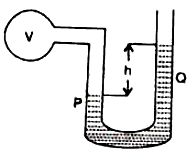
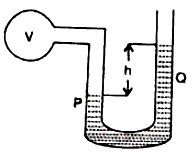
The following figure shows a manometer containing a liquid of density p. The limb P of the manometer is connected to a vessel $V$ and the limb $Q$ is open to atmosphere. The difference in the levels of liquid in the two limbs of the manometer is h as shown in the diagram. The atmospheric pressure is $P_0.$
(i) What is the pressure on the liquid surface in the limb $Q?$
(ii) What is the pressure on the liquid surface in the limb$ P?$
Answer

(i) The pressure on the liquid surface in the limb $Q$ is equal to atmospheric pressure i.e $P_{0.}$
(ii) According to the manometer principle, the difference in atmospheric pressure in two limbs is equal to the difference in height of liquid in two limbs.
So pressure at $P =$ pressure at $Q + h \times p \times g. P_0= PQ + h \times p \times g.$
View full question & answer
Question 205 Marks
What is a manometer? How does it show whether the pressure inside a vessel connected to one arm of it, is lower or above the atmospheric pressure?
Answer
A manometer is a simple pressure gauge that measures differences in pressure at the two ends of the apparatus.
The manometer is a U shaped tube containing water whose one limb is dipped in vessel and vessel is tightly covered with a plastic sheet. U shaped tube has two limbs one towards the vessel and the other is opened to the atmosphere.
Now if the level of water toward atmospheric open limb is more than the level of water in limb towards apparatus end then the liquid is said to be at a higher pressure than the atmosphere. And if the level of water toward atmospheric open limb is less than the level of water in limb towards apparatus end then the liquid is said to be at a lower pressure than atmospheric pressure.
View full question & answer
Question 215 Marks
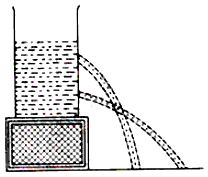
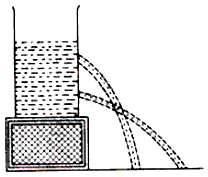
What fact about liquid pressure does the following diagram in the following figure illustrate?
Answer

This diagram illustrates that pressure of liquid increases with depth. The hole at greater depth has more pressure and hence the flow of liquid from there is more. Other hole is at less depth so the pressure of liquid there is less and hence the flow of liquid from there is less. So the diagram shows that pressure increases with an increase in depth.
View full question & answer
Question 225 Marks
State the laws of liquid pressure.
Answer
Laws of liquid pressure:
(i) Pressure at a point inside the liquid increases with the depth from its free surface.
(ii) In a stationary liquid, pressure is same at all points on a horizontal plane.
(iii) Pressure is same in all directions about a point in the liquid.
(iv) Pressure at same depth is different in different liquids. It increases with the increase in the density of liquid.
(v) A liquid seeks its own level.
View full question & answer
Question 235 Marks
 The base of a cylindrical vessel measures $300 cm^2$. Water (density $=1000 kg m ^{-3}$ ) is poured into it up to a depth of 6 cm . Calculate the pressure and thrust of water on the base. $\left( g =10 m s ^{-2}\right)$
Answer
Depth of water= 6 cm = 0 .06 m.Density of water $= 1000 kgm^{-3}.$
Acceleration due to gravity $= 10 ms^{-2}.$
We know pressure
$P = h x p x g.$
$P = 0.06 x 1000 x 10 = 600 Nm^{-2}= 600 Pa.$
Area of base of cylindrical vessel $= 300 cm^2 = 300 x 10^{-4}m^2= 0.03 m^2.$
We know
Thrust = pressure x area.
Thrust $=600 x 0.03 = 18 N$.
So thrust acting on the base of the vessel is $18 N.$
View full question & answer
Question 245 Marks
(i) Calculate the height of a water column which will exert on its base the same
Pressure as the 70 cm column of mercury.
(ii) Will the height of the water column change if the cross-section of the water column is made wider?
Answer
(i) we know pressure exerted by a liquid column of height h, density p is $P = h x px g.$
The pressure exerted by a mercury column of height 70 cm.
Density of mercury $= 13.6 g/cc = 1.36 x 10^4kg/m^3.$
$P_{mercury} = 0.7 x 1.36 x 10^4x 9.8 = 9.32 x 10^4 Nm^{-2}$
Let the height of the water column = hm.
Density of water $= 1g/cc = 10^3 kg/m^3.$
$P_{water} = h x 10^3x 9.8 = 9.8h x 103 Nm^{-2},$
Now put $P_{mercury} = P_{water}​​​​​​​$​​​​​​​
$9.8 h x 10^3 = 9.32 x 10^4$
$h = 93.2/9.8 = 9.52 m.$
So, 9.52 m height of water column would exert the same pressure on its base as 70 cm column of mercury.
(ii) The height of the water column would not change if the cross-section of the water column is made wider.
View full question & answer
Question 254 Marks
Describe an experiment to verify the Archimedes' principle. 
Answer
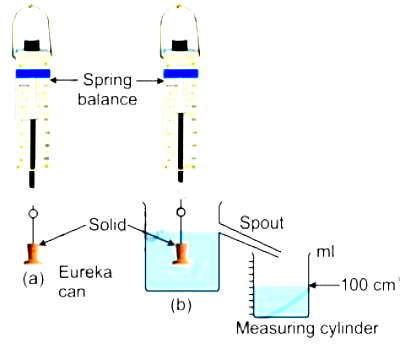
Let us take a solid and suspend it by a thin thread from the hook of a spring balance and note its weight. Then take a eureka can and fill it with water up to its spout. Arrange a measuring cylinder below the spout of the eureka can as shown. Immerse the solid gently in water. The water displaced by the solid gets collected in the measuring cylinder.

When water stops dripping through the spout, note the weight of the solid and volume of water collected in the measuring cylinder.
From diagram, it is clear that Loss in weight $($Weight in air $–$ weight in water$) = 300 \ gf\  – \ 200 \ gf = 100 \ gf$
Volume of water displaced $=$ Volume of solid $= 100 \ cm^3$
Because density of water $= 1 \ g\ cm^{-3}$
Weight of water displaced $= 100 \ gf =$ Upthrust or loss in weight This verifies Archimedes' principle.
View full question & answer
[5 Mark Question Answer] - PHYSICS STD 9 Questions - Vidyadip