Question
  1. State Bohr’s quantization condition for defining stationary orbits. How does de Broglie hypothesis explain the stationary orbits?
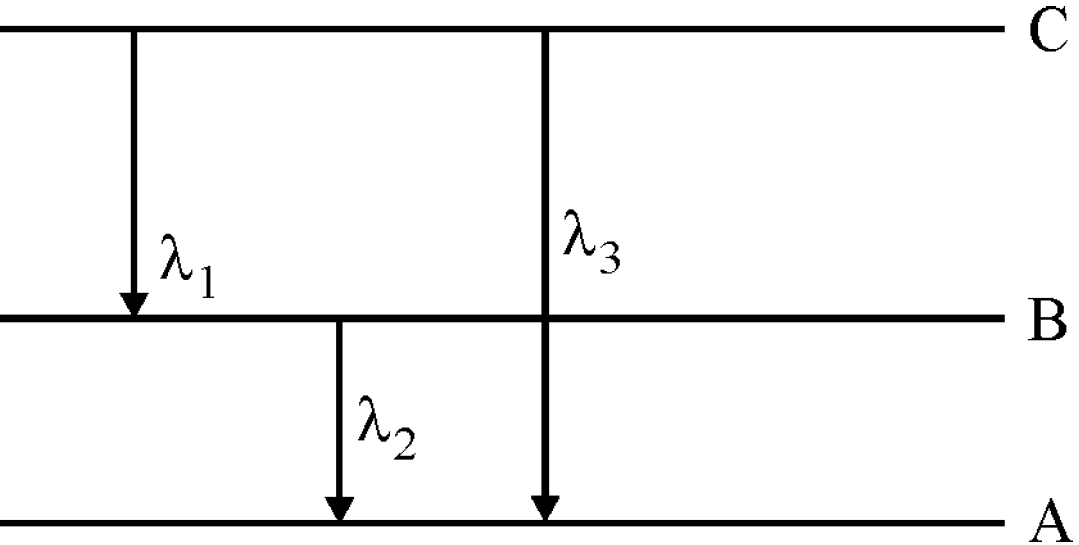
  2. Find the relation between the three wavelengths$\lambda_{1} , \lambda_{2}$ and$\lambda_{3}$ from the energy level diagram shown below.
Answer

Only those orbits are stable for which the angular momentum, of revolving electron, is an integral multiple of $\frac{\text{h}}{2\pi}.$

Alternate Answer

$[\text{L} = \frac{\text{nh}}{2\pi}$ i.e. angular momentum of orbiting electron is quantised.]

According to de Broglie hypothesis

Linear momentum $(\text{P}) = \frac{\text{h}}{\lambda}$ 

And for circular orbit $\text{L} =\text{r}_{n}\text{p}$ where $' \text{r}_{n} '$ is the radius of quantized orbits.

$ = \frac{\text{rh}}{\lambda}$

Also $\text{L} = \frac{\text{nh}}{2\pi}$

$\therefore\frac{\text{rh}}{\lambda} = \frac{\text{nh}}{2\pi}$

$\Rightarrow2\pi\text{r}_{n} = \text{n}\lambda$

$\therefore$ Circumference of permitted orbits are integral multiples of the wavelength $\lambda$

$\text{E}_{c} - \text{E}_{B} = \frac{\text{hc}}{\lambda}_{1}$ . . . . (i)

$\text{E}_{B} - \text{E}_{A} =\frac{\text{hc}}{\lambda}_{2}$ . . . . (ii)

$\text{E}_{c} - \text{E}_{A} = \frac{\text{hc}}{\lambda}_{a}$ . . . . . (iii)

Adding (i) & (ii)

$\text{E}_{c} - \text{E}_{A} = \frac{\text{hc}}{\lambda}_{1} + \frac{\text{hc}}{\lambda}_{2}$ . . . . . (vi)

Using equation (iii) and (iv)

$\frac{\text{hc}}{\lambda}_{3} = \frac{\text{hc}}{\lambda}_{1} + \frac{\text{hc}}{\lambda}_{2} = > \frac{1}{\lambda}_{3} = \frac{1}{\lambda}_{1} + \frac{1}{\lambda}_{2}$

Need a full question paper?

Generate a complete, print-ready paper with questions like this in minutes — across 16+ boards, with answer keys.

Start Generating Free

Similar questions

  1. When an AC source is connected to an ideal inductor show that the average power supplied by the source over a complete cycle is zero.
  2. A lamp is connected in series with an inductor and an AC source. What happens to the brightness if the lamp when the key is plugged in and an iron rod is inserted inside the inductor? Explain.

A uniform chain of mass m and length l overhangs a table with its two third part on the table. Find the work to be done by a person to put the hanging part back on the table.
The specific heat capacities of hydrogen at constant volume and at constant pressure are 2.4cal-g-1 °C−1 and 3.4cal-g-1 °C-1 respectively. The molecular weight of hydrogen is 2g-mol-1 and the gas constant, R = 8.3 × 10⁷ erg°C-1 mol-1. Calculate the value of J.
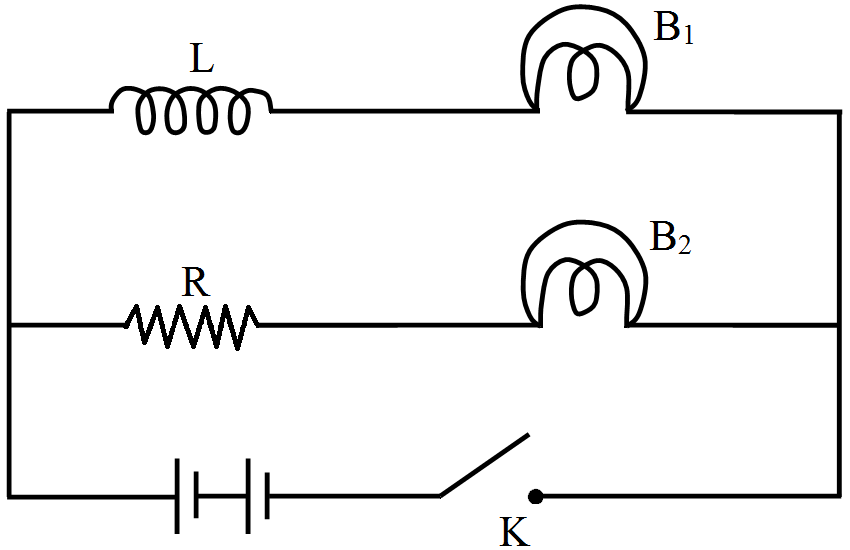
In the given circuit, the value of resistance effect of the coil L is exactly equal to the resistance R. Bulbs B1 and B2 are exactly identical.

Answer the following questions based on above information:

  1. Which one of the two bulbs lights up earlier, when key K is closed and why?
  2. What will be the comparative brightness of the two bulbs after sometime if the key K is kept closed and why?
Calculate the maximum kinetic energy of the beta particle emitted in the following decay scheme:
$\text{ }^{12}\text{N}\rightarrow{ }^{12}\text{C}^*+\text{e}^++\text{v}$
$\text{ }^{12}\text{C}^*\rightarrow\text{ }^{12}\text{C}+\gamma(4.43\text{MeV}).$
The atomic mass of 12N is 12.018613u.
Estimate the number of electrons in 100g of water. How much is the total negative charge on these electrons?
A square loop of side $10 cm$ and resistance $0.5 \Omega$ is placed vertically in the east-west plane. A uniform magnetic field of $0.10 T$ is set up across the plane in the north-east direction. The magnetic field is decreased to zero in $0.70 s$ at a steady rate. Determine the magnitudes of induced emf and current during this time-interval.
Identify the following electromagnetic radiations as per the wavelengths given below.
Write one application of each.
  1. 10–3 nm
  2. 10–3 m
  3. 1 nm
When a photon is emitted by a hydrogen atom, the photon carries a momentum with it. (a) Calculate the momentum carries by the photon when a hydrogen atom emits light of wavelength 656.3nm. (b) With what speed does the atom recoil during this transition? Take the mass of the hydrogen atom = 1.67 × 10⁻²⁷kg. (c) Find the kinetic energy of recoil of the atom.
A plane polarized light is incident normally on the tourmaline plate. Its $\vec{E}$ vectors make an angle $60^{\circ}$ with the optic axis of the plate. Find the $\%$ difference between initial and final maximum values of vectors.