Question
  1. State Bohr’s quantization condition for defining stationary orbits. How does de Broglie hypothesis explain the stationary orbits?
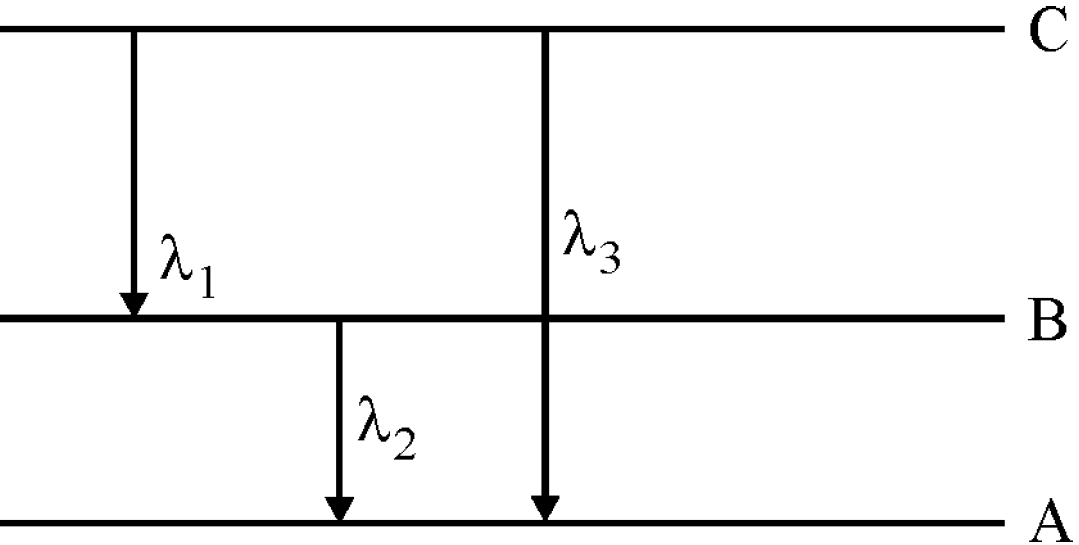
  2. Find the relation between the three wavelengths$\lambda_{1} , \lambda_{2}$ and$\lambda_{3}$ from the energy level diagram shown below.
Answer

Only those orbits are stable for which the angular momentum, of revolving electron, is an integral multiple of $\frac{\text{h}}{2\pi}.$
Alternate Answer
$[\text{L} = \frac{\text{nh}}{2\pi}$ i.e. angular momentum of orbiting electron is quantised.]
According to de Broglie hypothesis
Linear momentum $(\text{P}) = \frac{\text{h}}{\lambda}$
And for circular orbit $\text{L} =\text{r}_{n}\text{p}$ where $' \text{r}_{n} '$ is the radius of quantized orbits.
$ = \frac{\text{rh}}{\lambda}$
Also $\text{L} = \frac{\text{nh}}{2\pi}$
$\therefore\frac{\text{rh}}{\lambda} = \frac{\text{nh}}{2\pi}$
$\Rightarrow2\pi\text{r}_{n} = \text{n}\lambda$
$\therefore$ Circumference of permitted orbits are integral multiples of the wavelength $\lambda$
$\text{E}_{c} - \text{E}_{B} = \frac{\text{hc}}{\lambda}_{1}$ . . . . (i)
$\text{E}_{B} - \text{E}_{A} =\frac{\text{hc}}{\lambda}_{2}$ . . . . (ii)
$\text{E}_{c} - \text{E}_{A} = \frac{\text{hc}}{\lambda}_{a}$ . . . . . (iii)
Adding (i) & (ii)
$\text{E}_{c} - \text{E}_{A} = \frac{\text{hc}}{\lambda}_{1} + \frac{\text{hc}}{\lambda}_{2}$ . . . . . (vi)
Using equation (iii) and (iv)
$\frac{\text{hc}}{\lambda}_{3} = \frac{\text{hc}}{\lambda}_{1} + \frac{\text{hc}}{\lambda}_{2} = > \frac{1}{\lambda}_{3} = \frac{1}{\lambda}_{1} + \frac{1}{\lambda}_{2}$

Need a full question paper?

Generate a complete, print-ready paper with questions like this in minutes — across 16+ boards, with answer keys.

Start Generating Free

Similar questions

What is the kinetic energy of an electron in electronvolts with mass equal to double its rest mass?
A certain sample of a radioactive material decays at the rate of 500 per second at a certain time. The count rate falls to 200 per second after 50 minutes.
  1. What is the decay constant of the sample?
  2. What is its half-life?
Draw a plot of potential energy of a pair of nucleons as a function of their separations. Mark the regions where the nuclear force is (i) attractive and (ii) repulsive. Write any two characteristic features of nuclear forces.
  1. Using Bohr's second postulate of quantization of orbital angular momentum show that the circumference of the electron in the $n^{th}$ orbital state in hydrogen atom is n times the de Broglie wavelength associated with it.
  2. The electron in hydrogen atom is initially in the third excited state.What is the maximum number of spectral lines which can be emitted when it finally moves to the ground state?
The electric current in an X-ray tube (from the target to the filament) operating at 40kV is 10mA. Assume that on an average, 1% of the total kinetic energy of the electron hitting hte target are converted into X-rays.
  1. What is the total power emitted as X-rays
  2. How much heat is produced in the target every second?
The centre of mass is defined as $\overrightarrow{\text{R}}=\frac{1}{\text{M}}\sum\limits_\text{i}\text{m}_\text{i}\overrightarrow{\text{r}_{\text{i}}}.$ Suppose we define "centre of charge" as $\overrightarrow{\text{R}}_\text{c}=\frac{1}{\text{Q}}\sum\limits_\text{i}\text{q}_\text{i}\overrightarrow{\text{r}_{\text{i}}}$ where $q_i$ represents the $i^{th}$ charge placed at $\overrightarrow{\text{r}_\text{i}}$ and Q is the total charge of the system.
  1. Can the centre of charge of a two-charge system be outside the line segment joining the charges?
  2. If all the charges of a system are in X-Y plane, is it necessary that the centre of charge be in X-Y plane?
  3. If all the charges of a system lie in a cube, is it necessary that the centre of charge be in the cube?
A river 400m wide is flowing at a rate of 2.0m/s. A boat is sailing at a velocity of 10m/s with respect to the water, in a direction perpendicular to the river.
  1. Find the time taken by the boat to reach the opposite bank.
  2. How far from the point directly opposite to the starting point does the boat reach the opposite bank?
A healthy youngman standing at a distance of 7m from a 11.8m high building sees a kid slipping from the top floor. With what speed (assumed uniform) should he run to catch the kid at the arms height (1.8m)?
An illuminated object and a screen are placed 90 cm apart. Determine the focal length and nature of the lens required to produce a clear image on the screen, twice the size of the object.
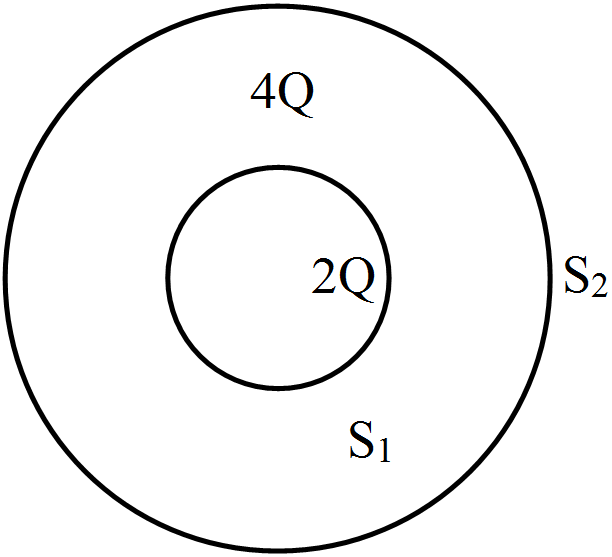
Consider two hollow concentric spheres, $S_1$ and $S_2$, enclosing charges 2Q and 4Q respectively as shown in the figure.
  1. Find out the ratio of the electric flux through them.
  2. How will the electric flux through the sphere $S_1$ change if a medium of dielectric constant $'\in_\text{r}'$ is introduced in the space inside $S_1$ in place of air? Deduce the necessary expression.